Sportscar racing in the modern era is all about fine margins. With Balance of Performance governing the premier prototype and GT categories around the world, it’s often the little things that make the biggest difference on race day.
At Team Penske, the battle to exploit marginal gains and the pursuit of perfection is on show the moment you step through the doors of its headquarters in Mooresville, North Carolina, as DSC found out during an all-access tour after the Sebring 12 Hours back in March.
Winning isn’t a goal for Roger Penske’s organisation, it’s a pillar of its culture. Over more than half a century, Team Penske has set the bar in American motorsport, with over 640 race wins, nearly 700 poles and 47 major championships.

And it’s at Mooresville that the heart of North America’s most decorated outfit beats, within a colossal 425,000-square-foot shop that houses not one, not two, but three major programmes and around 450 staff. It’s a facility that breeds title-winning cars for the NASCAR Cup Series, INDYCAR Series and IMSA WeatherTech SportsCar Championship, on a scale that needs to be seen to be believed.
Five-time Le Mans winner Derek Bell told this writer previously, “When Enzo Ferrari called you, you didn’t say ‘no’.” The same can be said of Roger Penske and the empire he’s built since he founded the team in 1966. Team Penske’s shop at Mooresville is a place where winners come to work, and once their foot is in the door, they stay.
The average tenure for a Team Penske employee is 11 years, and the longest-serving member of the team outside of Roger himself is Dave Eisenhofer, who has been part of the journey for over 40 years and currently heads up the body shop.
We’re genuinely running out of space for the banners
Eisenhofer’s name sits at the top of a pool table-sized board in the corridor that leads to the main NASCAR Cup Series shop, which displays the names of all the employees with more than two decades of service.
“It’s a big deal to make this board,” one of DSC’s guides for the visit, Ian Moye, says. “It’s what everyone here aspires to achieve.”
Everyone you meet while exploring Team Penske HQ has a story to tell and takes an enormous amount of pride in their work. The result? Trophies, banners and murals celebrating major race and title wins are on display everywhere.
They ensure you are constantly reminded when navigating the cavernous workshops and maze-like cut-throughs that Team Penske is a winning machine, a freight train running at full speed without a final destination.
“We’re genuinely running out of space for the banners; we have to switch some out and store some of the older ones in our archives,” Theresa Zorn, a public relations representative for Team Penske and Porsche Penske Motorsport and DSC’s main guide for the day, quips.

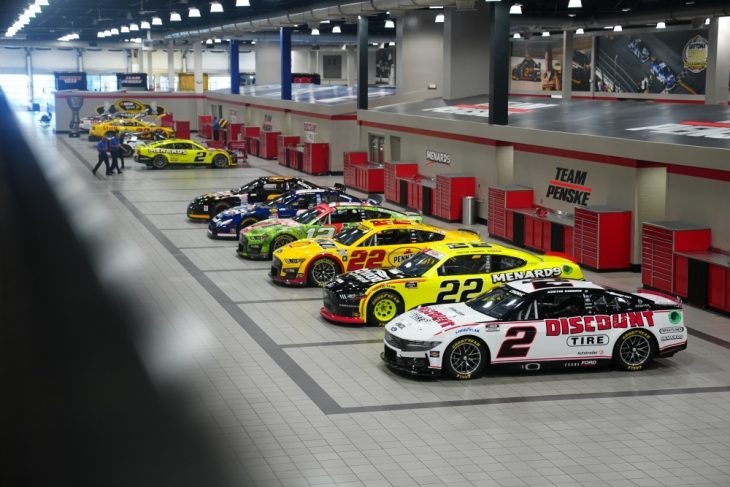
The first stop when you enter Team Penske is the NASCAR Cup Series shop floor. A space big enough to house multiple aircraft, which serves as a conveyor belt for the team’s three-car Cup Series effort with Ford Performance.
Front and centre are the cars being prepped on set-up plates for the upcoming weekend (in DSC’s case, Homestead, Florida) by their dedicated set-up manager and associated mechanics. They will also visit the on-site pull-down rig to have their kinematics checked prior to being loaded on one of the trucks from the team’s 90-strong fleet sitting inside the dedicated indoor bay. At that point, they will be replaced by another car that’s been prepped in advance.
NASCAR’s Cup Series has undergone a major philosophical change with the Next Gen rules, which utilise single-source manufacturers for building the chassis, providing parts and supplying a carbon composite body. As such, Team Penske develops and produces only a handful of components in-house these days, but this hasn’t led to a change in its overarching, detail-oriented approach to winning.

“The process of prepping cars has condensed considerably with the current model,” Ben Atkins, operations director at Team Penske (below), explains.
“Post-race, we will do a teardown, debrief, and seven post-rig work, then start rebuilding each car pretty quickly thereafter, with cars back on the plate over the next week. Within three weeks, we can complete the cycle of tear down, analysis, restoration, refit the motor and get the car ready to race again.
“We have enough staffing internally to build up each car outside of our travelling road crews. The cars will be ready, set up and liveried so that when the race team returns to base after a weekend, the internal team has them covered.”
There’s no will to replace its previous manufacturing load with private defence contracts or work with other manufacturers and teams. When the ethos behind NASCAR’s premier series shifted, so did its staff, who, for the most part, have been reassigned appropriately to other roles. This is a race team first and foremost, and everything it does “has to check the ‘does this help us win races’ box,” says Atkins.

“It’s a big shop, with a clear focus, that provides a lot of opportunities for growth for our employees,” he continues. “I started off as a DAG, worked my way up to race engineer, then different aerodynamics departments, then to a management role.
“One of the things Mr. Penske always talks about is the resources of our people. We have all the tools, but the most important thing we have is the people, and we flex them and shift them around our programmes over the course of the season, which is staggered in terms of pressure points.”
We have all the tools, but the most important thing we have is the people
The next stop is a venture across the corridor that divides the NASCAR and INDYCAR programmes. But first, time for a ‘Win Lunch’ on the shop floor, which is laid on mid-week after each major win.
This time, it’s the turn of Joel Svensson, Porsche Penske Motorsport’s team manager, to say a few words in front of his colleagues after winning the Sebring 12 Hours. He then hands over to Felipe Nasr – who joins the occasion remotely on a big screen – and later young Christian Colasuonno, the recipient of the latest employee spotlight award.
That, plus a moment when Cup Series racer Austin Cindric walks past later in the day and waxes lyrical about the Sebring win, serves as further evidence that Team Penske acts as one family across all programmes and has retained a tight-knit feel.
There are clear divisions between the three major teams – there has to be, to protect the IP of the three major manufacturers (Ford, Chevrolet and Porsche) it is partnered with – but everyone seems to know everyone and takes the time to celebrate every single one of the organisation’s achievements.

When crossing over to the INDYCAR workspace, via the chassis, fabrication, shock, damper, gearbox and machine shops (some of which are in operation almost 24 hours a day), you pass a faux pit road used for pit stop practice. It’s one of the most impressive sights on campus.
Races in all three of Team Penske’s major North American series can be won or lost on the execution of a pit stop, so the team, as you’d expect, goes the extra mile to ensure its pit crews are amongst the best in the business.
It’s NASCAR Cup Series practice time when DSC strolled by, and Joey Logano’s crew were in the middle of an intense session. Using an EV-powered Cup Series Mustang to simulate the scenario, the team gets to work.
Over and over again, the athletes, some of whom are scouted and plucked from other pro sports in America, work to perfect the art of tyre changes and fuel stops.

Adding to the impressive set-up is a set of video cameras overhanging the pit box on a gantry which record each sequence. Those recordings are then played back from multiple angles on big screens, allowing the pit coaches and crews to analyse and co-ordinate the petrol-soaked ballet.
That leads us to the INDYCAR works, where spare chassis are on display while the team is en route to Thermal Club. Around 100 team members are dedicated to working across Team Penske’s cars, and spend their weekdays between races here, prepping the oval and road course-specific chassis to match specific stops on the schedule.
“The chassis for INDYCAR has been around since 2012, and I can tell you, they are not lacking any work in that room to try and improve,” adds Travis Law, Porsche Penske Motorsport’s competition director.

What’s striking is the mural that stretches to the ceiling, all the way round, featuring some of the highlights from Team Penske’s decades of success at Indianapolis and beyond. It’s like a ‘Where’s Wally’ scene, but for INDYCAR legends.
It’s this area that leads directly to Porsche Penske Motorsport’s U.S headquarters. The sportscar facility is spacious and feels lived in. The team operates a pair of 963s in IMSA GTP from this room, but there are six chassis on show.
We’ll take a closer look at those in Part 2 tomorrow…
Images courtesy of Team Penske & Ford Performance