As he’d done the last two years in the Fuji Super TEC 24 Hour Race, Tatsuya Kataoka helped drive a Mercedes-AMG GT3 EVO to victory in the biggest event of the Eneos Super Taikyu Series.
But after back-to-back wins with ROOKIE Racing as a driver/manager, this year Kataoka won as an owner/driver, navigating the #23 TKRI Mercedes-AMG to victory joined by co-drivers Daisuke Matsunaga, Shunji Okumoto, Yuhki Nakayama, and Yuya Motojima.
The “TK” in TK Racing Invitation’s third Fuji 24H win ties him with Kiyoto Fujinami for the most overall wins in the young history of the event. Fujinami, Hiroyuki “Bankcy” Ogawa, Taichi Watarai, and João Paulo de Oliveira finished second overall in the #666 seven x seven Racing Porsche 911 GT3 R, 54.559s behind, in the second-closest finish in race history. While they missed out on the win, seven x seven Racing maintains the lead in the ST-X Class Championship after three races.

And with the #101 Hitotsuyama Racing Audi R8 LMS GT3 EVO II (Kenji Suzuki/Sota Ogawa/James Pull/Anna Inotsume/Shintaro Kawabata) finishing third, three different manufacturers made it onto the podium.
This year’s Fuji 24 Hours was one of the most challenging for a variety of reasons, mainly severe weather including rain and fog. In fact, the race did not run to the advertised distance. About 90 minutes before the scheduled 3:00 PM start time on Saturday, heavy rain fell over Fuji Speedway. Race control elected to suspend the start of the race until 4:00 PM, shortening the race to 23 hours.
And it would not be the only time that weather would impact the race – as overnight there were multiple Full Course Yellow and Safety Car interventions due to rain, fog, and poor visibility, and even a two-hour, 44-minute red flag due to thick fog just as the sun was due to rise over the circuit.
It was the second red flag of the day, the first of which was the result of barrier repairs following a heavy incident on the run between TGR Corner and Coca-Cola Corner. In total, almost three and a half hours were lost due to red flag conditions, not including the delayed start.
By this stage, the pole-winning #33 Craft-Bamboo Racing Mercedes-AMG (Jeffrey Lee/Kakunoshin Ohta/Dean Chen/Tom Kalender/Seiya Motojima) had been in control for most of the race, taking the lead through an alternate strategy early in the race and some savvy driving from teenage sensation Kalender, and staying in the lead thanks to a well-timed Safety Car intervention due to fog at just before the five-hour mark.
During another weather-related Safety Car intervention, Craft-Bamboo brought its car in for its required ten-minute maintenance period to change brakes.
And when the morning fog lifted, the race resumed at just past 7:30 AM on Sunday, with less than seven and a half hours to go. The #33 Craft-Bamboo Mercedes had a one-lap lead when the race restarted.
But with about four hours to go and star driver Ohta behind the wheel, his pace dropped rapidly, then smoke began to billow out of the left-side exhaust. He could only get to the entrance of pit lane before stopping. Once he and the Craft-Bamboo crew helped push the #33 Mercedes-AMG back to the garage, and after diagnosing an exhaust failure and other problems, Craft-Bamboo Racing retired from the race.
Three cars were now in contention for the win – the #23 TKRI Mercedes, the #101 Hitotsuyama Audi, and the #666 seven x seven Porsche. With two hours and 40 minutes to go, Hitotsuyama’s hopes of contending for the win were thwarted after the right-rear tyre came off as Pull headed towards Dunlop Corner. The #101 Audi finished 11 laps off the overall lead.
This made it a two-car battle between TKRI and seven x seven Racing, though TKRI had fulfilled ‘A’ Driver Daisuke’s minimum drive-time obligations before Bankcy could do the same. Yuya Motojima was right behind Bankcy when a Full Course Yellow was deployed for debris on track, and when the FCY was lifted, Motojima quickly overtook the Porsche in order to build a gap before its final stop.
With 61 minutes left, Motojima brought the #23 Mercedes-AMG in from the lead for its final routine stop and driver change to Nakayama. Oliveira was running him down in the #666 Porsche, but had pitted with 95 minutes to go. The legendary Brazilian driver had to abandon his pursuit of the lead with 15 minutes left, needing a splash of fuel to get to the end.
That was the reprieve that Nakayama and TKRI needed to secure the win after 572 laps and 23 hours of racing under very challenging conditions. So challenging that Oliveira was treated for dehydration after the race, and understandably could not join his co-drivers in the podium ceremonies. One could only wonder what could have been if the #666 Porsche hadn’t been hit with a 60-second penalty stop for a Full Course Yellow infringement with four hours and 40 minutes to go.

The other contender that had a chance at the win but suffered a catastrophic issue was the #81 GTNET MotorSports Nissan GT-R NISMO GT3 (Ryuichiro Oyagi/Natsu Sakaguch/Noboyuki Oyagi/Takayuki Aoki/Iori Kimura) – Sakaguchi was running second overall, 30 seconds off the lead, when a drivetrain issue forced the orange Daishin GT-R into the garage with less than six hours to go.
The #81 Daishin GT-R only re-emerged from the garage after a second trip to take the chequered flag, 45th overall out of 53 finishers – and fifth in ST-X behind the #31 apr Lexus RC F GT3 (Hiroaki Nagai/Rikuto Kobayashi/Naoya Gamou/Hideki Nagai/Sena Sakaguchi) which had its share of mechanical problems Saturday evening and finished 29th overall.
Finishing fourth overall, therefore, was the ST-1 class-winning #47 D’station Racing Porsche 911 GT3 Cup. Less than a year after announcing his retirement from Le Mans and the WEC, team owner/driver Satoshi Hoshino won his class alongside his brother Tatsuya, as well as Kenji Hama, Tetsuya Tanaka, Taiga Kabaki, and Yuta Kamimura.
D’station Racing won ST-1 after the #2 K’s Frontier KTM Cars X-Bow GTX suffered serious mechanical problems, requiring a complete engine change overnight. With a 75-lap margin of victory, the KTM squad’s streak of four straight Fuji 24H class wins (even the ones that came as the only entrant) came to an end.
In ST-Z, Team ZeroOne captured perhaps the most important victory for the Nissan Z NISMO GT4 programme. Just two months after the brand pulled out of the North American GT4 market, one of the Nissan GT4 cars – the #25 ZeroOne Z NISMO GT4 – won the class, driven by Yuki Tanaka, Teppei Natori, Tsugio Matsuda, Kimiya Sato, Ronnie Quintarelli, and Masataka Yanagida.

Not only was the victory a morale boost to all at Nissan and NISMO, but it was also a feel-good moment of nostalgia as legends of the marque like Matsuda, Quintarelli, and Yanagida – who won a combined eight SUPER GT GT500 Championships between them – reunited behind the wheel for at least one more race.
The red #25 Nissan took control of the race and had a flawless run to the flag, picking the team’s spirits up after Ryuichiro Tomita in the sister #26 Nissan suffered a vicious crash at the nine-hour mark. While running in the class lead at night, Tomita ran into the ST-2 class #36 HCM Uchino Racing Civic Type R, spun off to the left and hit hard into the barriers. A 40-minute red flag was required to fix the barriers, meanwhile, Tomita was taken to the circuit medical centre where he thankfully suffered no fractures.
The crash was not caused by the same safety issues that led previous ‘A’ driver Tadao Uematsu to depart the team, or led top US customer Flying Lizard Motorsports to abandon the programme weeks before the Pirelli GT4 America season – though the #26 Nissan chassis was written off.
As Team ZeroOne finished fifth overall, the #52 Saitama Green Brave Toyota GR Supra GT4 EVO2 (Manabu Yamazaki/Hiroki Yoshida/Naoki Hattori/Seita Nonaka/Rin Arakawa) willed its way to second in ST-Z, barely finishing off the same lap as the #25 Nissan through some clever strategy and strong driving late in the race.
Rounding out the ST-Z podium and in seventh overall was the #22 Porsche Team EBI Cayman GT4 RS Clubsport (Shota Kitazono/Rintaro Kubo/Ryoma Henzan/Naoya Yamano/Keishi Ishikawa) which had a strong run of its own.

They were followed by the other two Toyotas in ST-Z: Last year’s winning #885 SHADE Racing Toyota (Hironori Takeuchi/Katsuyuki Hiranaka/Yuji Kunimoto/Yuki Sano), and the #5 Team Noah Toyota (Toshiro Tsukada/Aruga Tomita/Kokoro Morita/Yusuke Shiotsu/Takuya Nakazawa), in eighth/ninth overall and fourth/fifth in class.
And in tenth overall, sixth in ST-Z, was the #20 Team Impul Nissan (Takashi Matsumoto/Kazuki Hiramine/Kazuki Oki/Jules Treluyer/Bertrand Baguette), which led during the first hour and into nightfall before a mechanical problem dropped them down the order.
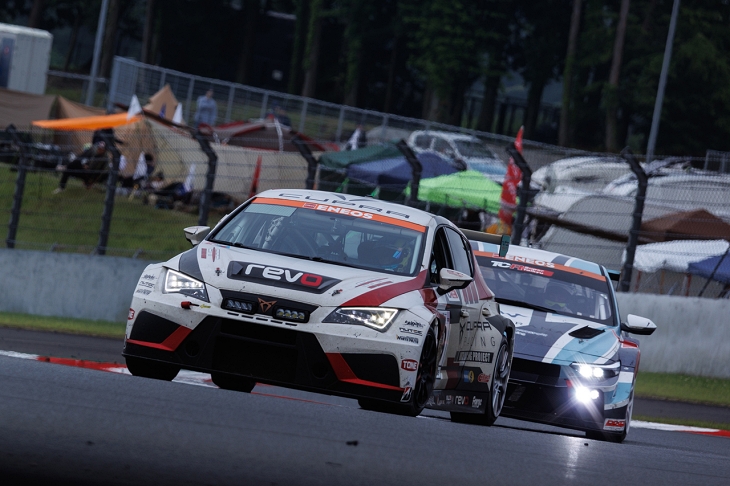
Like ST-1, ST-TCR was also a one-sided rout in the end. Several troubles for the #98 Waimarama Racing Hyundai cleared a path for the #19 Birth Racing Project Cupra TCR to win the class in a landside. Takashi Kochiya, Takeshi Suehiro, Jiei Okuzumi, Takahisa Ohno, Taiga Imoto, and Koichi Okumura finished 11th overall in the first-gen Cupra.

ST-2 was won by the first time by the latest Honda Civic Type R, as the #72 Nihon Automobile College entry of Makoto Kanai, Tetsuya Yamano, Toshiya Nojima, Ippei Yamazaki, and Hiroki Otsu took a hard-fought victory over the #95 Team Spoon Civic (Eiji Yamada/Syun Koide/Kazuma Nishimura/Yusuke Mitsui/Taketoshi Matsui/Yasunori Nakajima) – by just one lap.
Team Spoon had the race seemingly in hand until a 60-second penalty stop was given for starting the engine before pit work was completed. The legendary gymkhana and endurance driver Yamano drove the “other” yellow and blue Civic to the lead and never looked back – while the #13 Endless Sports Toyota GR Yaris finished third.
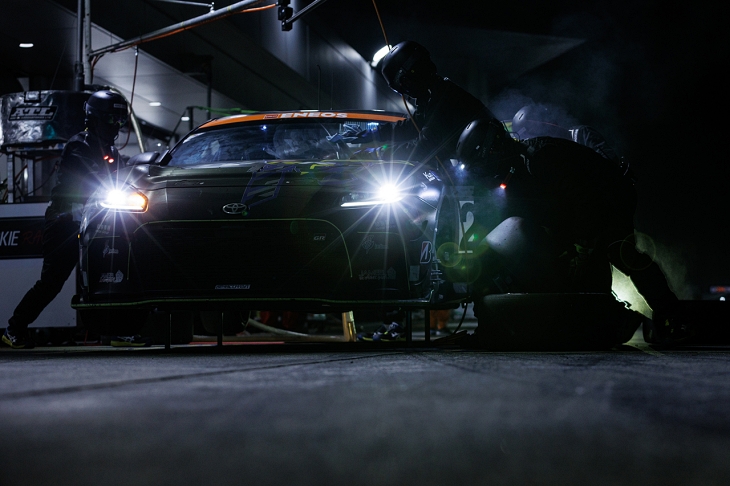
Finishing 13th overall, completing 523 laps, was the top car in the exhibition ST-Q class: The #28 Toyota Gazoo ROOKIE Racing GR86 ‘Future FR Concept’, a prototype to develop a sports car to meet Japan’s stiffer emissions regulations, running on E20 low-carbon petrol. The other major attraction was the husband and wife combo of Sho Tsuboi and Aimi Saito driving together, with Eisuke Sasaki, Kazuya Oshima, Daisuke Toyoda, and Nirei Fukuzumi alongside.
Also finishing inside the overall top 20 was the #61 Team SDA Engineering Subaru HiPerfX Future Concept, the WRX-based, carbon-neutral fuelled prototype driven by Kazuhiro Ito, Hideki Yamauchi, Takuto Iguchi, Masafumi Hanazawa, and Susumu Ito. The Subaru finished 17th and completed 518 laps. In 27th was the #12 Mazda Spirit Racing Roadster Future Concept, another E20-fuelled concept, driven by Hiroshi Kawata, Yutaka Seki, Yuui Tsutsumi, Takahiro Sato, and Tatsuya Minowa.
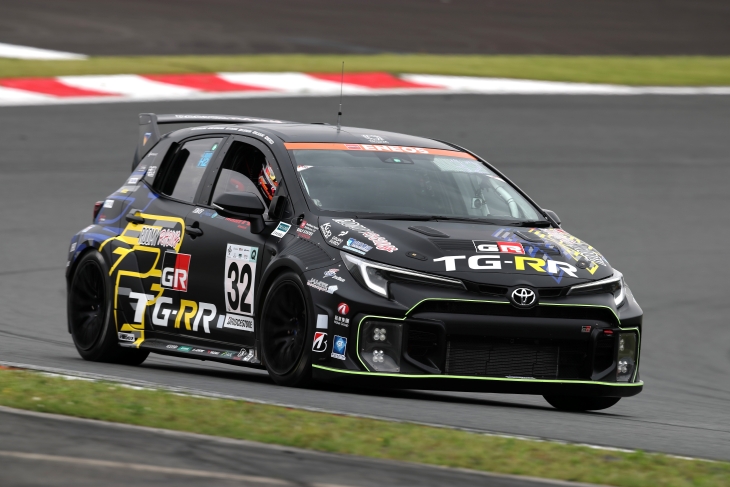
All six ST-Q cars took the chequered flag after 23 hours of running – including the #104 GR Team SPiRIT Toyota GR Yaris DAT Racing Concept, the #55 Mazda Spirit Racing Mazda3 Future Concept – and of course, the #32 TGRR Toyota GR Corolla H2 Concept.
The liquid hydrogen GR Corolla, despite the many delays in this race, completed 468 laps – only nine fewer than the car’s previous best in any configuration – in the hands of drivers like Akio ‘Morizo’ Toyoda, Masahiro Sasaki, Hiroaki Ishiura, Yasuhiro Ogura, Mako Hirakawa, and three-time Le Mans winner Kazuki Nakajima. Enhancements to the hydrogen engine combustion, a new, faster hydrogen supply filling valve, and other changes to reduce weight have made the most effective version of the hydrogen Corolla seen thus far.

Tracy Sports with Delta won the ST-3 class for the third year in a row. The #39 Lexus RC 350 driven by Shinya Fujita, Takumi Sanada, Takashi Ito, Takuya Otaki, and Ren Takahashi finished ahead of the two Okabe Jidosha Motorsport Nissan Fairlady Z34s, the #16 and #15.

SHADE Racing took top honours in the ST-4 class as their #884 Toyota GR86 driven by Masahiko Kageyama, Eijiro Shimizu, Shinnosuke Yamada, and Morio Nitta, won the class comfortably. The #41 Tracy Sports with Delta GR86 was second in class, and in quite a major upset, Team NOPRO’s third-generation #37 Mazda Roadster NC-RHT finished third, salvaging some dignity for Toshihiro Nogami’s team.
ST-4 also produced the unofficial ‘Spirit of the Race’ award – this year it was AutoLabo Racing’s #290 Suzuki Swift, which underwent an emergency transmission transplant during the race. The team brought one of its civilian Suzuki Swifts in as the donor car to complete the replacement. The car may not have completed enough laps to be classified, but making it to the finish under these circumstances was no less admirable.

ST-5F was blown wide open when the #17 Team NOPRO Mazda2 Diesel Turbo broke down on the formation lap and never returned to the race. A diesel-powered NOPRO Mazda had won the ST-5 class in four of the last five Fuji 24 Hours.
Instead, the victory went to the upstart AndLegal Racing’s third-generation #821 Honda Fit RS, driven by Katsuhiro Sato, Kenta Kawafuku, Hiroshi Ueda, Takuya Shiga, Junichiro Kasahara, and Masaki Baba. The #821 AndLegal car overcame a penalty stop of its own to defeat the fan-favourite #11 Sakae Motorsports “Kodan-chan” Honda, in its awesome Japanese road patrol livery.

And in ST-5R, Murakami Motors’ ace car, the #88 Mazda Roadster of Hiroyuki Murakami, Tatsuya Ota, Keiji Amemiya, Sena Kuronuma, and Soichiro Yoshida took a comfortable class win of its own. Second in class was the #610 Koshido Racing Roadster.
In third was the #120 Club Mazda Spirit Racing Roadster, featuring alumni from the Mazda Roadster Party Race one-make series in Japan.
Images © STMO, Nissan