The Le Mans Test Day is always something of an enigma – a day of track action to kick off the event that ultimately doesn’t mean all that much.
But, beyond the headline of Toyota fastest and Lexus tops both sessions, there’s plenty more hidden in the timesheets!
After diving into the numbers, here are some key points to look at as we head into the week ahead:
The Hypercar Pace is hot
Brendon Hartley’s 3:26.246 put the #8 Toyota Gazoo Racing GR010 at the top of the timesheets in Sunday Afternoon’s test session, which was half a second better than the closest challengers – the #51 AF Corse Ferrari 499P.
That time is almost seven-tenths better than the corresponding session last year, where Kevin Estre topped the day with a 3:26.907 in the #6 Penske Porsche 963. In fact, the top three times from this year – set by Hartley, Calado in the #51, and Robert Kubica in the #83 AF Corse Ferrari 499P – would have been good enough to top last year’s test day.
Looking further afield, last year’s test saw 10 cars breach the 3:29 lap time mark, with the #12 Hertz Team Jota Porsche last year setting a 3:28.487 to sit in 10th place. This year, 12 Hypercars are below the 3:28 lap marker, after the 12th-placed #15 BMW M Team WRT Hybrid V8 hit a 3:27.959.
The growth in competitiveness in the Hypercar field means that more cars are looking to be in the mix this year. And a combination of power increases in the BoP table from last year and key bits of resurfacing between Arnage and the Porsche Curves entry should mean a faster pole lap if it stays dry.
The Best of the Theoretical Best
Looking at theoretical best lap times, the story only gets better. The theoretical best lap time for each car is calculated by taking the sum of the car’s best first, second and third sector, and is a useful tool for looking at an ‘ideal’ lap, in case of instances where a car was in traffic or had a moment on their best tours.
The Toyota #8 GR010 topped the theoretical best lap chart, with Hartley’s sub-par middle sector being replaced by a much better run from Ryo Hirakawa to improve the ideal lap for the #8 to a 3:25.844. Again, this translates to a seven-tenth improvement over the theoretical best lap from 2024.

Looking exclusively at the theoretical best lap times, while there isn’t much shuffling at the top of the field (The #83 AF Corse Ferrari pips the #51 AF Corse Ferrari for second place), there are some drastic changes outside the top five.
The #35 Alpine A424 jumps from 10th up into 6th place, as none of Charles Milesi’s best sectors came on that car’s ultimate best lap. The Alpine looks particularly strong in the middle sector – from the exit of Tertre Rouge to Mulsanne Corner – where the #35 had the fastest time of the session at the hands of Schumacher, while Milesi was only two hundredths further back in the #36.
On the other hand, Nick Tandy’s ideal lap – a 3:27.489 – was the best time for the #4 Penske Porsche, which drops down from 6th to 10th in the ideal lap chart.
All three Ferrari 499Ps sit in the top 10, as do all three Penske Porsche 963s. Both Alpine A424s also make the top 10, while a single car from Toyota (#8, 1st) and BMW (#20, 8th) maintain their positions in the top 10.
No Cadillacs made the ideal top 10, with the #12 Cadillac Hertz Team JOTA V. Series R dropping down from 9th to 12th. Remarkably, the best ideal lap for the #007 Aston Martin Valkyrie – a 3:28.367 – puts it ahead of the #7 Toyota Gazoo Racing car by two hundredths of a second.
Every single Hypercar managed a theoretical best lap time under the 3:29 mark, with the theoretical spread from 6th down to 21st less than 2 seconds!
Year-on-year improvements
A lot of noise was made last year on the improvements of particularly Porsche and Ferrari in the second year of their Hypercar programmes. This time around, broadly, it looks like each manufacturer in the Hypercar category has taken another step forward.
Perhaps unsurprisingly, the biggest improver since 2024 has been Alpine, which managed to slot both cars into the top 10 come the conclusion of this year’s test day. Last year, the top Alpine was down in 17th place at the end of the test, with a best lap time of 3:29.620. This year, they’ve seen an improvement of over two seconds, with Mick Schumacher’s 2:27.313 knocking off 2.3 seconds from last year’s time.
That’s reflected in their theoretical best lap too – a 3:26.70 maintains a two-second margin over last year’s theoretical best of a 3:28.75, showing a huge improvement in the A424.
Almost every other car saw some improvement over last year’s laps – Toyota continued a strong development of the GR010, improving by over a second compared to last year. Ferrari’s outright lap pace showed over a second improvement – 3:28.014 to 3:26.777 – however, their ideal laps were slightly closer, with an improvement of around nine tenths.

Cadillac also showed a big improvement over a single lap, knocking 1.74 seconds from its pace last year. Much like Ferrari, however, comparing ideal laps year-on-year shows a smaller improvement, of around eight tenths. BMW made a respectable gain, up half a second on their outright best and seven tenths up on its theoretical best.
While Peugeot’s 9X8 only just matched its outright lap time from last year – a 3:29.326 in 2024 just pipping this year’s 3:29.386 – their deal lap time is much better this time around. Last year’s ideal of a 3:29.189 is eclipsed by half a second this year, with a 3:28.625.
It’s been a tough development cycle for Peugeot, with the updated 9X8 still struggling to match the improvements of the other teams on the grid. With 19th and 21st on both the outright and ideal lap times, it was a self-confessed ‘tough test day’ for the team.
TEST DAY FP2 results.
#93 P19
#94 P20
Tough test day, no hiding it.
But this team, drivers, engineers, mechanics will never stop pushing.
And we need you with us. #PEUGEOT9X8 #WEC #LeMans24 pic.twitter.com/msJZUg9o4q— Peugeot Sport (@peugeotsport) June 8, 2025
This leaves Porsche as the only team to have gone backwards compared to last year’s testing, when the #6 Penske Porsche topped the time sheets with a 3:26.907, and held the top three theoretical best lap times across each of the factory cars.
This year, none of the nine drivers could match their speed from last year, with the best lap only reaching a 3:27.356 – a drop of over 4 tenths – and a theoretical best lap only just scraping into the 3:26’s – a 3:26.935. In fact, even the #6’s ideal lap in 2025 wouldn’t have been enough to topple the car last year.

It could be argued that the 2024 spec of the 963 was in more favourable trim for Le Mans, but despite being firmly in the top 10, Porsche has the dubious honour of being the only car that has gone backwards in pace.
It should be noted, though, that Porsche management didn’t appear worried after the track sessions came to a close, with LMDh boss Urs Kuratle explaining that the German marque wasn’t focused at all on lap times.

For Aston Martin, in the first year of the program with the Valkyrie, the signs are definitely encouraging. THOR Team’s best lap time – a 3:29.249 – was better than the best laps from Alpine, Peugeot and Cadillac in 2024.
Adding to the positivity, Harry Tincknell explained after the Test Day that the final red flag came out while he was on a hot lap with fresh tyres that was on course to be significantly quicker than anything the team posted earlier in the day.
With another year of development and data, Aston Martin could find itself in the mix!
LMGT3 knocking down LMGTE Am
A huge improvement was seen in the LMGT3 class, with the gloves firmly off after the class’s debut last year.
In 2024, an almost-suspicious cluster of laps right around the four-minute mark was the story of the test day, with 16 of the 22 cars finishing up the test day with theoretical best lap times within half a second of the four-minute mark. This was eventually smashed out of the water come qualifying, with the best lap for the class at a 3:55.263 set by Ben Barker in the #77 Proton Mustang.

This time around, it’s clear that the pace is firmly on show. Jose Maria Lopez’s 3:55.276 in the #87 Akkodis ASP Lexus would have only just missed out on the top LMGT3 time for the whole 2024 event, and is a whopping 4.6 seconds faster than the corresponding time from last year’s Le Mans test – a 3:59.883 set by Sebastian Baud in the #82 TF Sport Corvette.
In fact, not only is Lopez’s time better than almost every lap set by an LMGT3 car last year across the whole event; the 3:55.276 even eclipses the best time from the 2023 Le Mans test, which was the last year of GTE machinery.
On that occasion, the #66 JMW Ferrari 488 GTE set a 3:56.088 to top the session. If we continue to see the level of track evolution and improvement in lap times as we saw in 2023, the LMGT3 cars could be hitting times down in the 3:50.X’s come qualifying.
LMP2 Holding Station
While Hypercar and LMGT3 have seen improvements in pace for 2025, the LMP2 class has maintained the speed on show for the last few years.
Since the introduction of the Hypercar class and subsequent stratification of LMP2 in 2021, the LMP2 class has seen a consistent trend of slowing down to the tune of a second each year at the Le Mans test. From 2023, the best time for an LMP2-class runner was a 3:35.4, a clear two seconds behind the slowest of the Hypercar runners on that occasion.
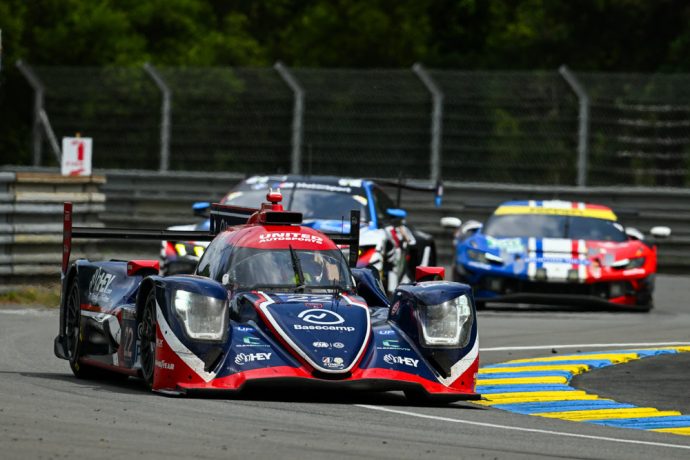
That buffer between the two classes has been maintained: This year’s top testing time was a 3:35.770 set by the #22 United Autosports ORECA 07 – a clear six seconds slower than the tail of the Hypercar field.

Looking at the best sectors, though, the LMP2 cars are not far away from breaking into the Hypercar times through Sector 1, which takes cars from the start/finish line through the Forest Esses and out to Tertre Rouge.
Tom Blomqvist’s 33.710 sector 1 in the #37 CLX/Pure Rxcing Oreca 07 was only half a second away from the tail of the Hypercar times through that sector.
What conclusions can we take away?
It looks like Alpine will be a formidable challenger this time around. However, the usual players look to have retaken their spots at the top of Hypercar. Despite slower times compared to last year, Penske Porsche had all three 963s sit comfortably in the top 10, as did Ferrari, and Toyota topped the timesheets by a margin.
In LMGT3, the gloves have come off. Last year’s winning team in LMGT3 was the last-placed car at the end of the Test Day, so presumably anything is still possible in this category.
Looking ahead, there are suggestions of rain for Hyperpole on Thursday, as well as Saturday afternoon for the race. All the carefully crafted programs could fall apart should significant showers arrive for the race.
There’s still plenty to play out as we approach the 2025 edition of the 24 Hours of Le Mans.