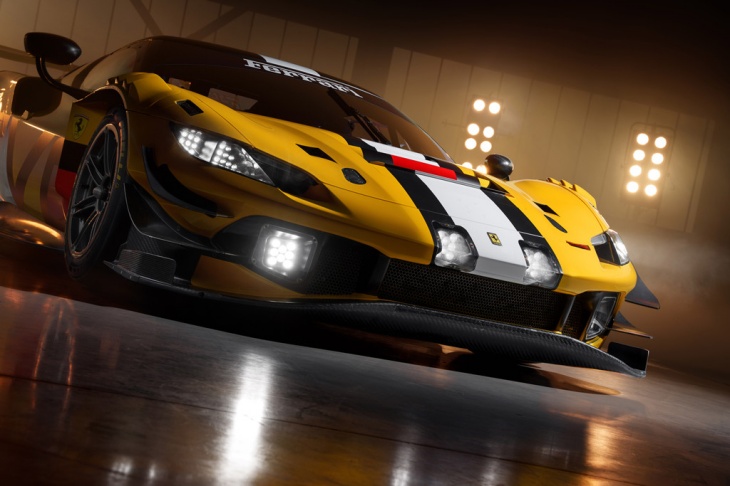

The Ferrari 296 GT3 has been a sales smash hit for the Prancing Horse since customer deliveries started at the end of 2022.
The Evo version for 2026, revealed at Spa Francorchamps today, was well telegraphed, but whilst visually the car looks little different, there are some key changes, many of them driven by customer feedback.
Alessandra Todeschini, Head of Endurance Programmes and Pista di Fiorano at Ferrari, told DSC:
“We asked for customer feedback and got plenty of positive responses. Many of them are addressed by the new Evo, not all of them are obvious visually.”
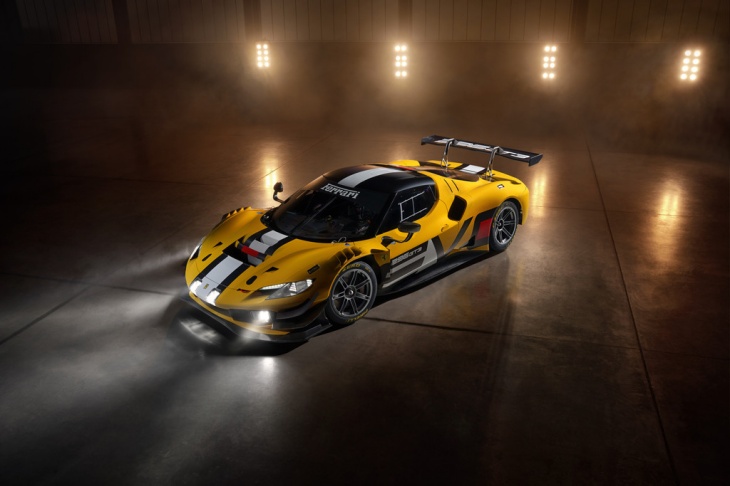
Two obvious visual changes will come with the rear wing reworked to allow easier adjustment whilst mounted on the car. The door mirrors have had a rethink too; the size and mounting method saw them vulnerable when the racing got close. Customers were clear with Ferrari that a change was required in that area.

There’s attention too to reduce ‘wake’ effect, with teams feeding back that the original car was suffering in close proximity to a leading car. As such, there are minor updates to the aero package and a suspension upgrade.
The car has a new brake cooling duct arrangement, which has a knock-on bonus for driver cooling, and benefits from a new, shorter ratio gearbox too.
“All of this is done within the permitted evolution under the car’s current homologation. We’ll begin production in the last quarter of 2025, and the Evo car will make its racing debut in 2026,” Todeschini adds.
All current cars will be able to be upgraded with a kit that is about to be launched alongside the new car builds.
As for the shelf life of the car – it has some way to go yet to better the service life of its predecessor the 488 GT3, that car was first raced in 2016 and lasted seven years in production through two ‘Evo’ upgrades and a late production, track-only, customer ‘Modificata’ version.
“We have a full order book, and our initial strategy to prioritise accommodating racing clients over more ‘lifestyle’ customers worked well,”
Six cars per month are produced, with the numbers produced now well over 100.
Ferrari, though, is famously unwilling to confirm production numbers of their race cars, but it is clear now that with the priority racing customers’ orders fulfilled, there is now scope to service non-racing and ‘track club’ clients.
The latter is an interesting customer set and has led to a separate rehomologation, as Todeschini confirmed.
“When we were talking to clients who did not wish to race their car, but rather to enjoy driving on track, we were asked by a number of them about a factory-provided ‘Biposto’ (two seater).
“That is an interesting challenge because whilst the car is clearly based upon a production two seater, the GT3 is a pure single seater racer, with in-car systems, and in particular the roll-cage, designed around that purpose. Accommodating a second seat meant a full rework of the interior of the car, including the cage. We did complete that work, though, and there is now a homologation in place for the ‘Biposto’ version.”
An Evo racer, a ‘Biposto’ version, and a growing customer base, the 296 GT3 platform looks set to be in good shape for years to come.
Images courtesy of Ferrari