Ewan Wane has been covering GT World Challenge Europe for DSC this year, principally from distance as he tackled his Final examinations at University.
Happily, though, with those behind him and with a predicted First Class degree in prospect (Well done, Ewan!), he had the time to get trackside at the Spa 24 Hours.
The DSC Editorial group though thought that sounded as if it could be improved upon, so instead of despatching Ewan to Spa Francorchamps midweek before the race proper, we sent him on an adventure that started the previous weekend – at the HQ of Steller Motorsport, close to Silverstone, from where their Corvette Z06 GT3R would be making its way to Belgium.
Over to you Ewan!
This year’s 24 hours of Spa saw Steller Motorsport contest its maiden 24-hour race, fielding a Corvette Z06 GT3.R on the American marque’s return to the race after 14 years away.
DSC joined the Buckinghamshire-based outfit for SRO’s blue-riband event, with unprecedented access into how a professional sportscar team tackles one of the world’s greatest endurance races.
From when the car left the workshop, until long after the checkered flag flew, DSC was there to document it all.
SATURDAY 21st JUNE
I arrived at Steller at 1PM on Saturday 21st June, over 170 hours before the start of the race.
The team was entering its final stages of preparation before departing for Belgium and was about to load its #24 Corvette Z06 GT3.R into the truck. And, conveniently for them, someone small enough to squeeze into a modern GT3 car had just arrived at their door!
As someone of relatively small stature, I was taken aback at how cramped the cockpit was, as I held the brake down to ensure the car didn’t move whilst it was being loaded up.
“Just so you know, this costs $[xxx,xxx]!” came a shout. Noted. No pressure then. Thankfully, I managed not to end the team’s 24 Hours of Spa effort immediately, and quickly vowed I’d do my best to stay away from the car for the rest of the week.
I would be travelling to Spa with Steller’s four-strong fleet of trucks, and more specifically aboard the hospitality unit, nicknamed ‘Black Betty’, and its driver Kyle.
“So, what are you doing in my truck?” he asks as soon as we hit the open road. It was a very good question.
The short answer was that I was here for the full experience. I could, of course, have shown up on Thursday morning, just before track action started, but this allowed me to get an insight into the work which goes on before that moment, and a world which was completely new to me.
Of course, the crew members who had spent the last few weeks preparing back at base, or those who had spent months planning everything, would debate this being the ‘start’, but it seemed like a logical point for me to join the Steller Motorsport camp.
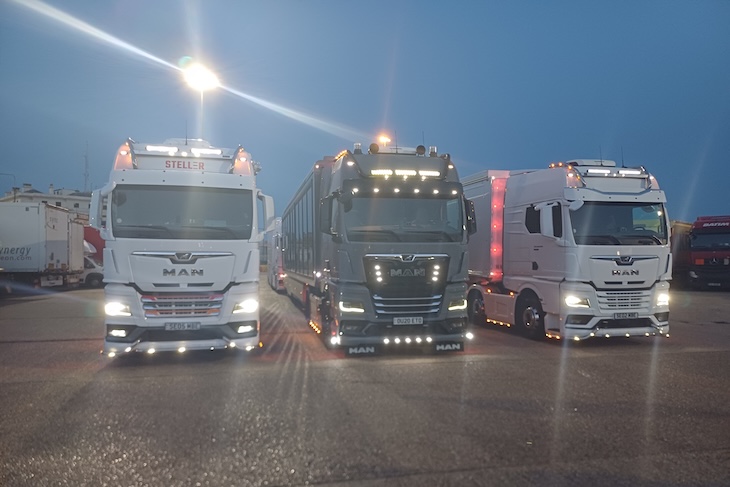
Unfortunately, I was in for a quick lesson on the challenges of international logistics, as delays around Dover meant we were unable to cross the English Channel until after midnight, several hours after we’d hoped to. We eventually parked up shortly after 3 am. For myself, it had become a 20-hour day, and I couldn’t remember the last time I was this exhausted. And the race was still over a week away!
SUNDAY 22nd JUNE
Sunday started late, with driving time restrictions ensuring it was the afternoon before we could depart Calais for the second and final leg of our trip to Spa. I was already appreciative that I’d joined the team for one of its shorter journeys. Other circuits on the GT World Challenge Europe calendar, such as the next round at Misano, are a three-day trek each way.
Fortunately, in the grand scheme of things, the late night hadn’t cost us much time, as we wouldn’t be able to enter the circuit until 7 pm due to the SRO Speedweek event taking place during the day.

From the passenger seat, the journey in the truck isn’t all too different from the one in the car, with a longer journey time and increased customs checks traded for a better view out of the window. I can tell, however, that the driving experience is completely different. In a vehicle which is several times longer, has multiple blind spots, brakes slower, turns worse and is less stable than a car, you are much more dependent on the cooperation of other road users, and therefore have to remain constantly vigilant as to what they are doing.
The process of loading the trucks into Spa is a slow one, with SRO ensuring teams enter in a set order based on where they’ll be based for the week. This involves a lot of sitting around, although thankfully, ‘Black Betty’ was near the top of the list of vehicles to be let in.
The paddock at the 24 Hours of Spa is packed, with the majority of teams and manufacturers bringing displays or hospitality, and as such, the space has been planned and chalked out by SRO in advance. It’s a game of inches, as we’re required to manoeuvre a pair of trucks – the kitchen and hospitality unit – so as to fit parallel into our allotted space. Given we only have about a foot of leeway to work with, it takes surprisingly few attempts.
This would be my first experience of the level of co-operation shown between teams. From lending one another tools, to pushing cars about, to temporarily letting people into your allotted space, fierce competitors on the track seemed more than happy to help one another if it meant making someone else’s day that little bit easier.
MONDAY 23rd JUNE
Monday was set-up day, and Steller’s crew was all too happy to take advantage of the extra pair of free hands.
Thankfully, they kept me away from most of the heavy lifting, but there was still plenty to get stuck into. With Steller’s hospitality unit located in prime position in the paddock, it had to be made spotless. My (non-exhaustive) job list for the day included cleaning the hospitality unit both inside and out, filling and placing water weights, putting tables and chairs out, and unloading and moving containers.

Key to the whole process was keeping the area tidy and organised. Not only does this make later jobs so much easier, but everything has to be packed away out of sight before the public arrives on Thursday.
The paddock at Spa tried to make our lives as difficult as possible, as we spent the day constantly fighting against the slope, gusts of wind and the occasional rain shower.
One of our first priorities was setting up the catering truck, ahead of the arrival of the catering team mid-morning. As well as Steller’s crew and guests, multiple other teams would be taking advantage of these facilities during the week. By the weekend, Steller would be serving over 100 people.
Our advanced party of six split in two, between hospitality and garage, as throughout the day, the majority of the rest of Steller’s 30-strong crew for the week arrived at the circuit to assist. Down at the garage, the team was based in the endurance pits, which offered its own set of challenges.
Space is reduced considerably compared to the newer Grand Prix pits, with the team given two garages in an attempt to compensate. One would house the car, the other the engineers, drivers and VIPs. During on-track sessions, four engineers – three from Steller, one from Corvette – would be permanently stationed here, with an impressive eight-screen setup. These would show timing, the broadcast and the track map, a live aerial feed of the pit box, the refuelling timer, and multiple pages of telemetry.
I checked my smart watch at the end of the day – 34,000 steps, 5000 calories burned, and I’d done the easy bits!
TUESDAY 24th JUNE
With the majority of the setup work complete, Tuesday was about refining the details for Steller Motorsport ahead of Scrutineering. Naturally, this meant I took a step back from hands-on duties – something told me I would be more of a hindrance than a help if I tried to get involved from here on out.
Just like I transitioned into my media role, the rest of the truckies took up their other jobs within the team. Each would be working in the garage from here on out, assisting with refuelling, taking care of tyres, and dealing with any other problems which arose.
The morning saw the first Team Meeting, with everyone gathering together as Max Daymond, Steller’s Team Manager, ran through the day’s plan and addressed any questions. From here on out, this would be a daily post-breakfast occurrence.
By lunch, Corvette Motorsport’s staff had arrived at the circuit, including GT3 Programme Manager Jessica Dane. They’d be splitting their time between Steller, and fellow customer team Johor Racing JMR, who were competing in the Bronze Cup.
The team worked its way through the afternoon job list – install updates from Chevrolet, apply the 24 Hours of Spa specific stickers, fit tyres and hammer the pit box markings into place – all under the watching eyes of the SRO officials who were patrolling the pitlane.
Tuesday evening saw the drivers arrive for the first time, ahead of Steller Motorsport’s Team Photoshoot, which would be used to launch its brand-new livery for the weekend ahead.
The Team Photo, like most things I’d experienced so far this week, was an event which took longer than I’d initially realised. The car needed to be positioned on a sloped, and – something I hadn’t noticed before – banked, La Source, something which was made even more difficult once Johor Racing’s car arrived for a Corvette family photo.

There was constant communication between photographers and crew, as cars were repositioned, and different shots were taken. Some of the car alone, some just with drivers, some with the full crew.
Driving back to the hotel in the evening, we took many of the roads which were scheduled to be part of the following days’ parade route. It’s fair to say that concern was high, with numerous potholes all uncomfortable in a road car, and potentially catastrophic if hit incorrectly in a Z06 GT3.R. The team were right to be worried, as 2024 had seen multiple cars miss much of the Thursday running as a consequence of the parade, and the forecast was just as hot this time around.
WEDNESDAY 25th JUNE
Wednesday morning offered me the opportunity to have a sit-down conversation with Max. Given my experience over the last few days, one of my first questions, naturally, related to the logistics in planning for a 24-hour race.
“It’s monumental,” he tells me. “The logistics of the whole thing are huge, especially when you start bringing catering into it.
“I think the crux of it is still the same as organising any other race, but you’ve got more staff, you’re here for longer and being such a well-attended event, you need to make sure that a lot of things are in place well in advance.
“Then you have to react to the inevitable timetable changes or changes in instruction from the championship, so having to organise all that ahead of time is no mean feat, but it’s all part of the enjoyment of going racing!”
We were again joined at lunch by Corvette’s staff, who are integrating well with the team socially as well as professionally. With the car now ready to go, the next stages of work can begin.
One of the key items on today’s agenda was practising the technical pit stop, a rule which features exclusively at the 24 Hours of Spa, and as such was brand new to Steller. The team experimented with different ways to tackle the full-service pitstop, which would require a brake change to be completed in under three minutes between the 11th and 15th hour marks of the race.
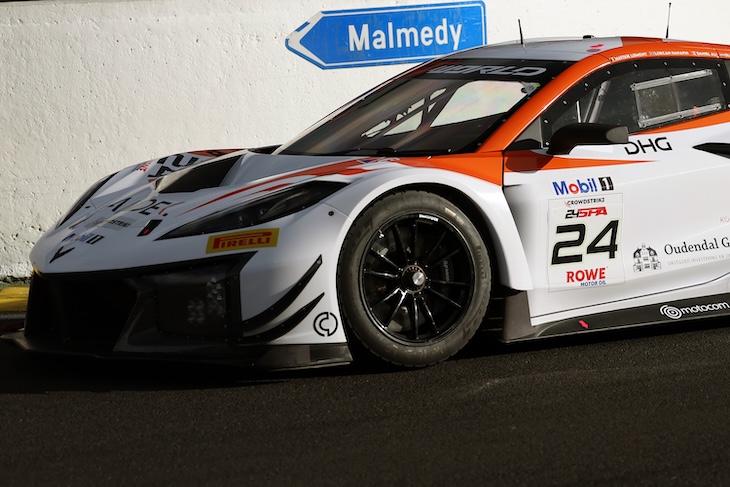
It was then time for the parade, with the majority of the Steller Motorsport crew joining the car in Spa town centre for a more relaxed evening. The logistics of the parade can prove a challenge for teams, with crew needed both at the garage and Spa town centre to release and receive the car.
This had to be pulled off despite the route between the circuit and town being closed, adding to the difficulty of getting people in the correct place at the right time.

Once we arrived, it was a festival atmosphere, with over 10,000 spectators enjoying sponsor activations, autograph sessions and the ability to get up close with their favourite machinery.
As the sun began to set, Steller’s Corvette was sent back on its way to the circuit. It looked like a successful evening, until…disaster. The car had stopped on the route back. It was a quick fix for an issue triggered by running a machine designed for 300km/h at a significantly lower speed, but it’s a problem no one wanted to deal with.
Unfortunately, problems with multiple other cars meant that all the tow trucks were already occupied, so the crew had to stick with the car until one became available. What should’ve been a simple evening quickly turned into an extra headache, and a longer night than planned…
Part 2 tomorrow sees track action get underway