In recent years, SRO Motorsports America President and CEO, Greg Gill, would address competitors and the media at Road America through a “State of the Series” event. This year, such an event did not take place, but Gill took time to speak with DSC this weekend about the changes within SRO America that will take place next season.
Most of the big announcements were already made during the CrowdStrike 24 Hours of Spa week anyway; the only missing pieces were two mid-summer calendar slots for GT World Challenge America in 2026, and its supporting series.
Those pieces were filled in with this week’s announcement that Road America would return to the calendar in August, and VIRginia International Raceway would be replaced by Michelin Raceway Road Atlanta, keeping in line with Gill’s philosophy of trying to add at least one new venue every few years.
“We were really excited with the opportunity to try a new venue,” Gill said of the change. “When the opportunity came to look at Road Atlanta, that meant that something else would have to go. That’s always the challenge.
“VIR is in our customers’ top ten favourite tracks. It was a hard call. And on the same token, we had a great run at VIR: Great group of people, fantastic racing, and an iconic circuit. It can certainly be argued the same thing is true for Road Atlanta. So it makes a natural trade to put Road Atlanta in, instead of VIR.”
Gill also gave assurance that a freak road accident near VIR, which knocked the power out at the circuit and erased the last few minutes of Sunday’s GT World America race broadcast, was not a factor. “We don’t call those acts of God, but they are unusual circumstances. We don’t hold the track responsible for those type of things happening. They happen to anybody at any time.
“We were particularly pleased, also, to get our renewal here with Road America,” he continued. It’s our top track that our customers love coming to. And by moving it a full 30 days away from the IMSA weekend, I think it gives us a little more clarity. We’re happy about the date change as well.”
It’s easy, as widely-appreciated heritage circuits, to justify the decision to keep Road America or add Road Atlanta to any sports car racing calendar (even if VIR is a significant loss). But why Road Atlanta in the middle of Georgia’s very hot transition from late spring to early summer – and, crucially, on the week of the Le Mans 24 Hours?
That curious choice wasn’t entirely deliberate. “It is not something that we would normally say, ‘Oh, let’s do that!’ It was the only available date, so we chose it,” as Gill explained. And as he pointed out, it’s not unprecedented in the 40-year history of what we now know as SRO America: “If you check out our history, we’ve raced on the 24 Hours of Spa weekend for ten years in a row. We’ve raced on Le Mans weekend many, many years in a row.
“Looking to 2027 and beyond, we would certainly prefer not to be on that weekend. But for this first time, we’ll have to be.”
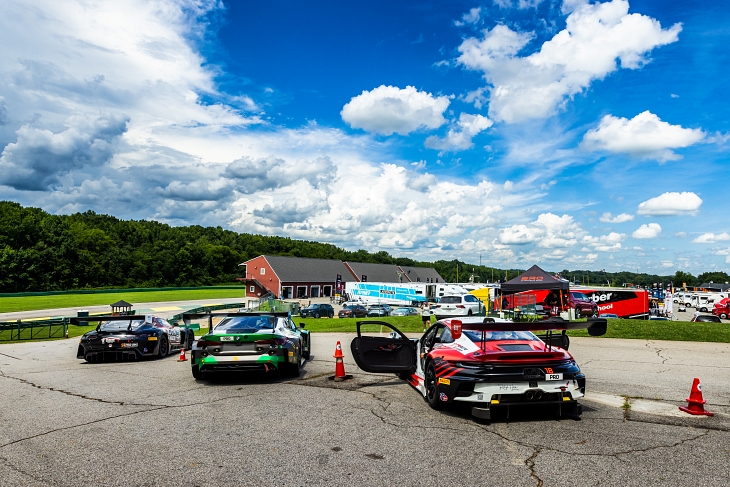
GT World Challenge America’s shift from two 90-minute races to a single three-hour race was another talking point after the Spa keynote. Gill has said that the change has been received well by teams, who will benefit from a shorter weekend.
“It’s something that we’ve looked at for a long time,” Gill said, as he talked about the differences between racing in Europe versus North America. “Stephane Ratel has made a great success in Europe, where we have a lot shorter travel distance for teams and drivers, of getting people in as late as Friday afternoon and getting them for two races on Saturday and Sunday. America is bigger; we can’t do that. But it’d been a long-time goal to get to three-day weekends.
“The paddock, we surveyed them about the format change, and going to the three-hour race for GT World Challenge, and it was a very large percentage in favour of doing that. This is something that we’ve talked about for over a year.
Gill said that last year at VIR, shifting to a 60-minute sprint format similar to the other GT World Challenge regional series was considered, but ultimately it was decided to give the teams the same amount of track time while reducing their obligated time at the circuit. “If you really think about it, it’s important for people to recognise: Two 90-minute races is our three-hour format. We haven’t increased their track time, but we are getting them less time at the circuit, and the same – if not more – time on track,” he added.
“It was a good economic benefit for the teams, and then for the fans, having one three-hour race, it makes Sunday much more of the ‘big race.’ Friday and Saturday are going to be absolutely jam-packed from 8 AM to 6 PM every day, but on Sunday, we really build up to a cool, neat race.
“Now we have a chance to really let GT4 America shine, like in Michelin Pilot Challenge. We’ve seen that, and it was an easy one for our teams and everyone to look at. Many of the people, particularly in TC America, they have full-time jobs – so if you can get them home so that they can go back to work Monday morning, good for them!”
It’s no secret that GT America, the spiritual successor of the Pirelli/Speed(vision) World Challenge of yesteryear, has had a difficult 2025 season when it comes to drawing and keeping entries. But the introduction of a new ‘Cup’ class for one-make racing vehicles has caught the interest of teams in Ferrari, Lamborghini, and Porsche’s one-make events – which could breathe new life into the sprint series.
“In times past – matter of fact, when we first started GT America (in 2021), we encouraged cup cars. We had a handful of cup cars, and it got to the point where we finally just dropped it, we said, ‘There doesn’t seem to be enough interest to do this,’ and we didn’t pursue it,” he admitted.
“Now, with the new Evos coming out, particularly for Porsche (Carrera Cup), people are saying: ‘I may not get an allocation. I want to race – where can I race?'”
Gill has also said that, along with the introduction of the new class, the All-Bronze GT America series would be stricter in terms of the drivers allowed to compete, no longer allowing young Silver drivers running as ‘derogated Bronzes’.
One other exciting addition for SRO America is the addition of Toyota GR Cup North America to the support bill of IndyCar’s inaugural Grand Prix of Arlington, which was announced in June.
“When Toyota went to Nashville with us on an IndyCar weekend, they really enjoyed it. The customers really enjoyed it. Toyota’s headquartered in Plano, Texas – it is a natural fit, by getting them involved with IndyCar. So what better way to showcase something that they’re also getting involved as a sponsor, but also bringing out their preeminent sports car series,” Gill said of the new street race based around the home of the NFL’s Dallas Cowboys.
“For us, it’s wonderful to be part of it, and we’re tickled to do it. The more people we can put on a broader stage looking at sports car racing, the better it is for everybody.”

And, towards the end, he recalled a fantastic experience at the 24 Hours of Spa, seeing several GT World America alumni running well in the race – including last year’s Pro champions, Adam Adelson and Elliott Skeer of Wright Motorsports, who took up the invitation to race at Spa as the reigning top class champions in GT World Challenge America.
“We’re inviting our championship winner, saying, ‘You get an entry,’ and we want more teams over there. It’s super important, and I think you’re only going to see more,” he said. “It’s on everyone’s bucket list – it’s the world’s greatest GT race.”
Images © Fabian Lagunas, JEP / SRO Motorsports Group