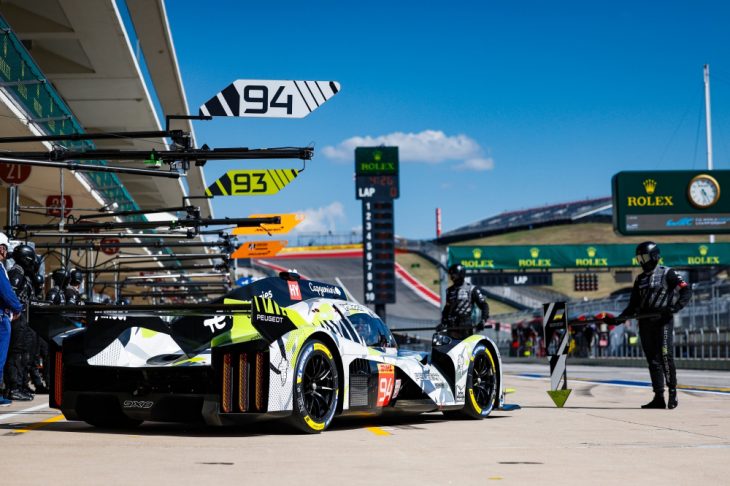

As discussions and debates over the potential for a move towards a new-look regulation set for the FIA WEC’s Hypercar category increase in frequency, Peugeot Sport finds itself at a crossroads.
The French brand, which is still seeking a first victory with its LMH-spec 9X8 prototype that has received several updates to improve its reliability and performance since it debuted in 2022, remains as committed as ever to becoming a Le Mans and title-winning team. It finds itself in what is currently believed to be a unique position as a brand actively seeking to bring a new car rather than extend the life of its current model as long as possible.
In an ideal world, it seems Peugeot would prefer to bring a brand-new car entirely rather than continue to update its current car to achieve its goals. But with uncertainty over the shape of the regulations in seasons to come, it is calling for clarity, and fast, so it can plan for the future.
The French brand’s technical director, Olivier Jansonnie, spoke to reporters last week in Austin before Lone Star Le Mans and outlined the tricky situation that Peugeot finds itself in.
“There are a lot of discussions now about regulations, performances, how we all make it work together for 2026,” he said when asked if Peugeot had yet received word from the rulemakers on whether or not it can introduce a new car.
“There will be more discussions to come with the manufacturers. It’s very dense in terms of discussions right now. It was already dense between Le Mans and São Paulo, and it’s becoming more and more again. I am assuming this will be clarified in the next few weeks now.”
DSC has been aware that Peugeot has been pushing to bring a new car in time for the 2027 season for a number of months. But with each passing week and month, if it is eventually granted permission, it becomes a tougher ask to meet that target.
The sticking point is the debate around the potential move to a single platform. The Hypercar regulations have been extended through to the end of the 2032 season, but even with that extension, there is no concrete plan on what the technical ruleset will look like by the end of the decade.
Thus, Peugeot requires assurance that if it brings a new car to the category, it won’t be immediately obsolete or require major development work to make it eligible. This would be the case if, for instance, the direction of travel saw the world championship adopt a set of rules that required the cars to be built to something close to the current LMDh ruleset, which has attracted more manufacturers than the LMH rules.
“The situation hasn’t changed very much since what we learned at Le Mans,” Jansonnie continued. “The technical regulations have been extended now, and some teams like us, who have been here since the beginning of the championship, somehow need to be given chances to update the cars. This is what has been discussed: to try to find the right balance between opening up a little bit and not opening it up too much, so we are not facing an overall cost increase, and trying to keep it fair between the newcomers and the teams that have been there for a long time.

“It’s not easy, by the way; that’s the reason why it takes so long. There are many things that the governing body has to make sure they protect somehow.”
When asked about the potential for a new car concept, Jansonnie added, “We are always evaluating. We always try to understand the weaknesses of the current car and what can be improved. This we do all the time. It’s constant development. It’s one of the differences we have between LMH and LMDh, that we are developing the cars. We are not allowed to homologate new cars every year, but we are still generating concepts.
“I think we are ready, and we are at least looking forward to being given a chance to do something?”
“My preference is to do something, whatever it is, on regulations that are written and clear,” he then remarked when asked if Peugeot’s preference is to design a new car or update the existing one.
“The thing that Peugeot needs to avoid 100 per cent is what happened to us at the beginning of the LMH regulations, when the regulations changed when the car was already designed.
“For us, the tricky point is that whatever happens needs to be clarified, and then the rules are completely clear for everybody. It means time and what you are allowed to do and not allowed to do. It has to be fair and consistent.”
Whether or not any new car would be LMH or LMDh, Jansonnie confirmed that LMH remains the most appealing option for the brand’s ambition with its programme.
“If you look back, we explained why we did the LMH rules and not the LMDh,” he said. “This hasn’t changed. Practically, the only thing that might have changed, is that we understand the LMH is more difficult generally in terms of technical ambition. You have to design a complete car; it is a more complicated project.
“But the reasons in terms of marketing and positioning with what we want to do in endurance racing for Peugeot have not changed. So for us LMH is the best regulation.
“Now we are also happy to discuss what could be the evolution of the regulations, with the chance that we converge everything, but for us, convergence doesn’t mean we go to LMDh. It means we really converge and try to make something in between. The question is when can we can do this, and is it actually realistic?”
DSC understands that a significant meeting between the FIA, ACO, IMSA, and the manufacturers involved in Hypercar and GTP has been scheduled to take place today in Paris. It is believed to have no firm agenda, and while it is unlikely to result in any concrete agreements, it aims to lay the foundations and general principles for the future.
Balance of Performance and its future, plus the current technical ruleset and its future, will be discussed in depth. Plenty of ideas to improve the on-track product are on the table as the band of stakeholders at the top end of sportscar racing look to maintain and build on the current wave of momentum for years to come.