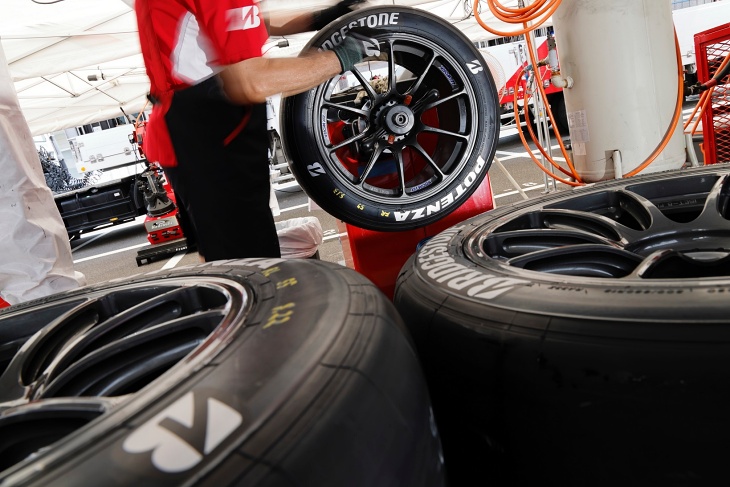
The Autobacs SUPER GT Series was one of the few remaining major sports car racing championships to have open tyre competition instead of a single supplier as of 2025. But after the 2026 season, that element of the series will be no more.
In a press conference held before Sunday’s SUPER GT Autopolis 3 Hours Race, GT Association (GTA) Chairman Masaaki Bandoh announced that the series will have a single tyre supplier in the GT500 and GT300 classes starting in 2027. Bandoh cited increasing costs as the primary reason for the change, not only from the side of supplying tyres to teams, but also from the side of the tyre manufacturers themselves.
“We’ve been working on cost reduction since 2008,” said Chairman Bandoh, who took over the role in 2007 amidst a debt crisis within the GTA. “We’ve engaged in fierce competition for a long time with the three manufacturers in the GT500 class and the tyre manufacturers in development. But within that context, environmental issues and the cost problems at each company have emerged.”
“The three manufacturers in GT500 (Toyota, Honda, and Nissan) have no intention of discontinuing their participation. But regarding tyres, Michelin has withdrawn from GT500. Meanwhile, Bridgestone, Yokohama, and Dunlop have consistently competed to invigorate Japanese motorsport and boost the industry, alongside Michelin in GT300.
“Yet the costs have undeniably soared, with tyre expenses for GT300 teams becoming considerably high. Differences between development tyres and commercial tyres have emerged once more, and we have been discussing this matter confidentially with the teams. Furthermore, certain requirements have arisen from the corporate perspective.
“After several discussions, both the GT500 and GT300 classes will adopt single-make tyres,” Bandoh said, calling the decision “extremely painful” as a former team owner. “Having pursued ‘real competition’ all along, this is an extremely painful and heart-wrenching decision, but I report that we have decided to proceed with its implementation.”
Multiple manufacturers have submitted bids to supply tyres to each category, with the high possibility of separate companies supplying either of the two categories. This would look similar to the current arrangement in the FIA World Endurance Championship, where Michelin supplies Hypercar tyres, and Goodyear supplies the LMGT3 class.
For all of SUPER GT’s history, dating back to 1994, Bridgestone has been the dominant tyre supplier in GT500. But Michelin was able to take multiple championships in the early 2010s, while Yokohama and Dunlop (Sumitomo) captured several race victories. The complexion of the GT500 tyre battle changed drastically after 2023, when Michelin withdrew as a GT500 tyre supplier. It meant that Bridgestone would supply 12 of the 15 GT500 teams, with Dunlop and Yokohama combining to supply just three cars and facing a massive deficit in most races.
DSC understands that one of the other two GT500 tyre suppliers (since revealed to be Yokohama) had considered leaving the class after 2025, but had chosen to stay for one more year.
There are also other potential pain points when it comes to teams that receive substantial backing from their chosen tyre suppliers. For instance, Modulo Nakajima Racing receives financial incentives to run as the sole Dunlop team in GT500, while Yokohama is a prominent and loyal sponsor of both TGR Team WedsSport Bandoh and Kondo Racing.
In contrast, Yokohama has won the majority of GT300 races and championships, but the competition with Bridgestone, Dunlop, and Michelin has been much closer. In 2022 and 2023, all four tyre makers won at least one race. Yokohama, Bridgestone, and Dunlop have all won races in 2024 and 2025, and have won at least one championship in the last ten years. Going back a bit further, BFGoodrich won a championship in GT300, and Hankook collected multiple race victories.
Hankook supplied control tyres for the exhibition SUPER GT x DTM Dream Race at Fuji Speedway in 2019.
While costs were cited as the main reason for taking this measure, the end of open tyre competition would also likely mean a reduction in total speed across both classes. GT500 cars have been able to achieve one-lap pace equal to or greater than contemporary top-tier prototypes competing in the FIA World Endurance Championship in part due to the high-grip tyres supplied by one of three manufacturers.
Similarly, FIA GT3 cars in the GT300 class have been able to surpass the lap times of GT3 cars in other control tyre series (FIA WEC, Asian Le Mans Series, GT World Challenge Asia) by significant margins.
Feature image courtesy of Bridgestone