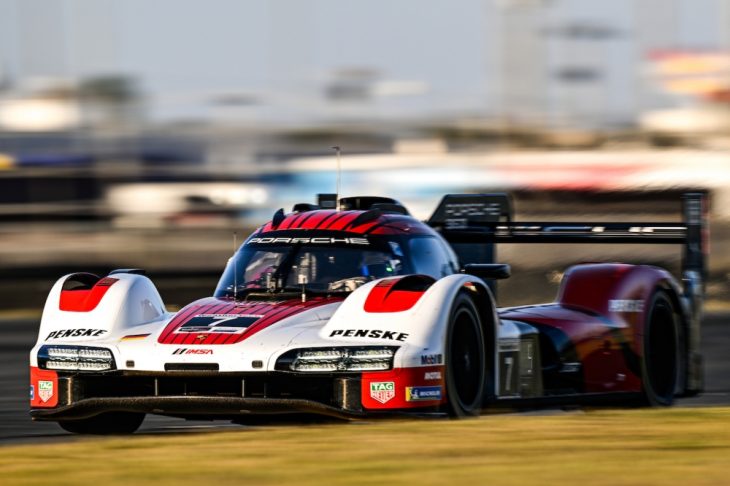
In 2025, Porsche Penske Motorsport won both the Daytona 24 Hours and Sebring 12 Hours, captured a clean sweep of IMSA GTP titles, and raised the bar in many areas to a new level in the process. In 2026, we’ll see whether the other manufacturers in the IMSA GTP class are now ready to fight back.
What was it that made the difference for Roger Penske’s team last term? Balance of Performance, of course, played its part, certainly early on during the team’s four-race win streak to start the season. Digging deeper, though, there were other key elements that should not be ignored. In the pits and on the strategy desk, the team was exceptional, the 963 itself matured nicely too with its Joker updates, and the driver crews in both cars were, on several occasions, the class of the field.
“The biggest thing I can say about the Porsche Penske Motorsport team in general is having both cars we enter operate at such a high level,” Team Penske President Jonathan Diuguid told DSC. “Both cars won races last year and stayed consistent late in the season when the competition grew stronger. It’s easy to be motivated when you’re winning races or on the podium; it’s difficult when a good day is measured by whether you reach fourth or fifth.
“I look back at the Watkins Glen weekend as an example,” he continued. “We were running last and second to last for the majority of the race, and through execution on pit road and making the right decisions, we came away with a fourth-place finish on a day when one of our direct competitors, the #93 Acura, got it wrong. There was no champagne or cheers for finishing fourth, but that’s what put us in a commanding position.”

For the new season, Porsche expects that its new-look full-season driver squad and the new Performance Joker update for its 963 will keep it fighting at the sharp end.
On the driver front, Porsche’s LMDh pack has been shuffled – and reduced in size – in the wake of WEC programme’s demise. From last year’s IMSA crop, Nick Tandy has shifted to GTD PRO with AO Racing, and reigning GTP champion Mathieu Jaminet has joined Genesis, meaning he will not defend his crown.
Those departures mean the #6 is being steered by WEC standouts Kevin Estre and Laurens Vanthoor this season, with Matt Campbell in for the longer races. And in the #7, Felipe Nasr returns, to work with Julien Andlauer and Laurin Heinrich.
There was some buzz about Penske’s line-up being expanded for Daytona to include Penske IndyCar drivers Scott McLaughlin and Josef Newgarden, after the duo tested with the team at last year’s post-season Sanctioned Test on the high banks. But Diuguid explained that their primary role was to give feedback on the car’s general direction from a fresh perspective, rather than prepare to race in the Rolex 24.
“It was good to give them exposure and some feedback on the car. We wanted to give them an opportunity so we could get their take on where the car is,” he said. “They’ve driven it periodically, so it’s valuable because they can give an assessment over a long period of time. They’re not involved day-to-day like other Porsche Penske Motorsport drivers, so they can get a feel for how big a step we’ve made.

“We can get fourth drivers in at Daytona, it’s an opportunity. This year, we decided not to do it for a variety of reasons; it wasn’t because we weren’t happy with how they performed. We just decided on three driver line-ups this year.”
Can their absence be attributed to an increased level of competition and intensity of the IMSA Michelin Endurance Cup races in GTP? Does Penske feel that it’s perhaps too risky to put superstar drivers in the fourth seat of its cars for one-offs, regardless of their ability and performance potential?
“With Josef and Scott, you are not taking a performance deficit if you have them in a car,” Diuguid responded. “It’s more about how much time each driver spends in the car in practice and those kinds of things. It’s not really a judgment or measurement of whether they brought value or not; they could bring value, but the additional management of having them in the car, when it comes to seat fitting in the car, getting enough time in practice….
Having stability with the drivers we have seemed like the right decision
“We just looked at it and felt that for this year, with all the changes going on, not just on the cars, but within the PPM programme, just having stability with the drivers we have seemed like the right decision.”
As for the car, another performance Joker has been deployed for 2026, adding to the previous updates to the car’s suspension and bodywork. The changes to the car for this season, which JDC-Miller will not use, include a reprofiled splitter and diffuser.
“Some tracks it’ll have a large impact, at others it will be pretty neutral,” Diuguid said of the evo. “These prototypes have big floors, big splitters, so they’re ride height sensitive, and the ride height profile at some of the IMSA tracks is very different.”

The update package was tested at Daytona back in November, and all things considered, the team felt the early signs were promising. Though Diuguid rightly pointed out that the Porsche team won’t know just how effective it is until we go racing, as the times set during the Sanctioned Test or this weekend’s Roar shouldn’t be used as an indicator of the hierarchy at the start of the season.
“Any track time at Daytona is valuable because the test days you have are reducing as the regulations mature,” he said. “It was certainly good to use the production spec 2026 Michelin tyre. We had exposure to it at previous test days, but those were hand-made, non-production specs.
“As far as benchmarking against others, we didn’t pay much attention to it. We had a run plan, focused on getting a double stint in so we could see how they performed and experimenting with the ride height window of the car with the new aero update.”
Upgrading a car that’s already proven to be a winning package over multiple seasons and refreshing the driver line-up can both be considered positives when evaluating Porsche’s chances of defending its titles and key race victories over the next ten months. The major question mark is the impact that the reduction to the overall PPM programme over the winter will have on its prospects going forward.
With the FIA WEC operation shut down as part of Porsche’s wider move to scale back its factory racing presence for 2026, PPM is now a considerably smaller operation. While the Mooresville and Mannheim bases previously operated the IMSA and WEC programmes autonomously, both sides benefited in several key ways from having a larger workforce, across two time zones, campaigning the same cars and working through data in two championships.

Though the Mannheim base isn’t entirely empty and shut down, North Carolina is now the epicentre. Meanwhile, most of PPM’s competitors are also bringing Joker updates to their cars, and Michelin is introducing new Hypercar and GTP tyres for the season ahead, setting up an intriguing set of storylines and, as Diuguid describes, a “reset” of sorts for the class. How much, then, will the WEC arm be missed?
“It’s definitely going to have an impact,” Diuguid concluded. “Any time you lose input from 50 people, it’ll have an impact. It’s people that are the heartbeat of the race team. One of the benefits of having such a large group was that we had a lot of approaches, thoughts and ideas. The WEC team is going to be missed, absolutely. It’s my job and the job of others in team management to minimise that as much as possible.
Any time you lose input from 50 people, it’ll have an impac
“We’ll have a core group of people in Mannheim, we’ll have a car or two based there, and we’ll still have people based there that will go to the DIL (driver in the loop) sessions and go to Weissach down the road and be present there.
“We’re trying to maintain a presence in Germany and maintain the relationship that defined the programme in the beginning. It’s severely reduced, ten people down from 50, but we’re trying to mitigate that as much as possible. We’re getting a reduction in test days, in running, but luckily, we’ve been able to retain a lot of key people who have delivered for us, and Porsche is still very committed to the project.
“Those people will be missed, though, because they contributed to the success of our programme globally.”
Image credit IMSA