
Several changes to the 2026 Autobacs SUPER GT Series Sporting Regulations have been published today through Japanese publication auto sport Web.
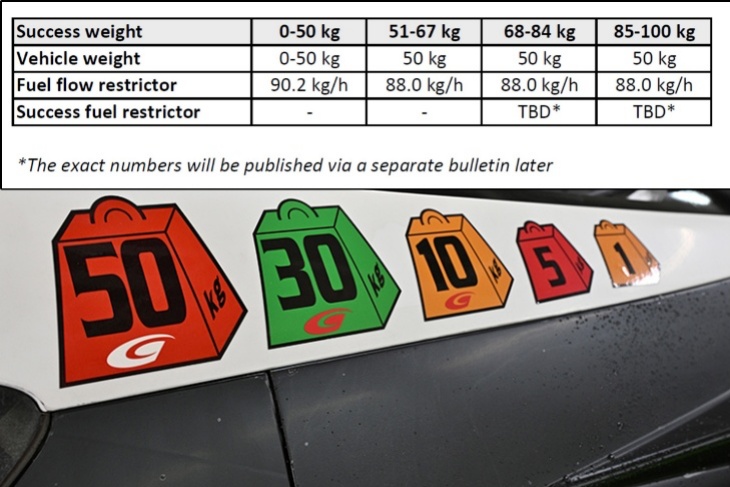
This includes a significant overhaul of the Success Weight system in GT500, one that will accommodate a lower standard fuel flow limit for the category, and introduces the “success refuelling restrictors” that were first used in GT300 last year.
The standard GT500 fuel flow limit has been reduced from 95 kilogrammes per hour, to 90.2 kg/h – the rate that was used for cars using the “Level 2” fuel flow restrictor as part of their Success Weight in previous years. Once a car exceeds 50 kilos of Success Weight, the engine fuel flow will be limited to 88 kg/h, with no further reductions – and no changes to the amount of physical Success Weight loaded onto the car.
At 68–84 kg of nominal Success Weight, a “Level 1” refuelling restrictor will be installed in the team’s fuel rig which will lengthen pit stop times, followed by a “Level 2” refuelling restrictor that will be used at 85–100 kg of Success Weight. The exact figures of these success fuel restrictors will be published in an upcoming official bulletin from the GT Association (GTA).
This change is also accompanied by a new limit of one engine per team in both GT500 and GT300 classes, a change that was first brought up by GTA Chairman Masaaki Bandoh in September, along with the move to freeze GT500 aero development through 2029.
With the lower fuel flow limit and the impending switch to single-supply control tyres in 2027, it means that the current GT500 course records may stand for many years.
Teams are normally allowed to change one of their two drivers from one round to the next; in the wake of Goodsmile Racing & TeamUKYO having to change both drivers due to a clash between the SUPER GT Malaysia Festival in Sepang and the 24 Hours of Spa last year, a clause has been added that states that the GTA can approve teams changing both of its drivers between rounds under special circumstances.
In GT300, teams will still be allowed to use their SUPER GT chassis in other series (such as the IGTC Suzuka 1000km, where Goodsmile Racing used its GT300 chassis) if they receive permission from the GTA. Starting in 2026, that special permission must be made public three months in advance.
Any individual can no longer be registered as both a regular racing driver and team director simultaneously, though any team director can still be nominated as a reserve driver.
Teams can also no longer change their vehicle number after the deadline to submit entries has passed, as JLOC did when its 2024 GT300 Championship-winning entry made a last minute change from #88 to #0 (reserved for the reigning GT300 Champion team).
Finally, the GTA has now asked that its competitors (including drivers and team representatives) must no longer attempt to influence changes in Balance of Performance through public statements in the press and on social media, with the GTA reserving the right to impose sanctions on any individual at any time during the competition.
IMSA has adopted a similar policy that prohibits competitors from making explicit public statements in an attempt to influence BOP changes, in line with a change that the FIA and ACO (Automobile Club de l’Ouest) made ahead of the 2023 FIA World Endurance Championship.

Images © GTA