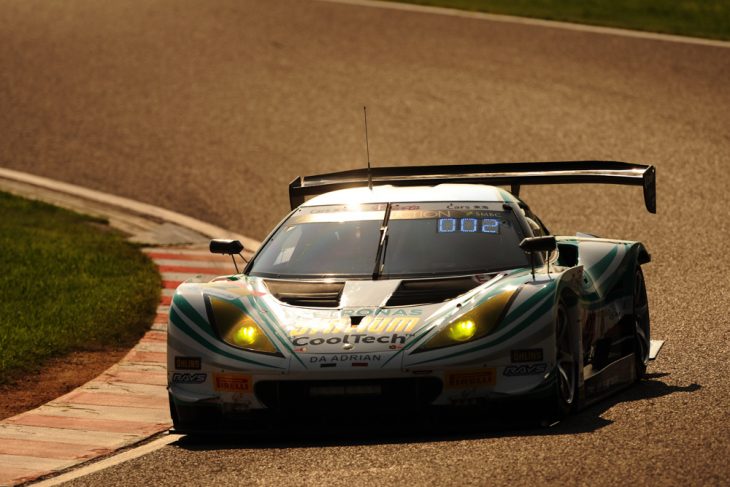
Japanese racing car constructor Mooncraft has announced that the company will be absorbed and dissolved into its parent company Toray Carbon Magic effective on 1 April 2026. This marks the end of an era for one of the most renowned constructors and racing teams, not only in Japan, but celebrated around the world for its unique and often successful works.
Mooncraft was established in 1975 by designer and driver Takuya Yura, originally building bodies for successful chassis in the Fuji Grand Champion Race series.

In 1977, Mooncraft introduced the closed-cockpit Shiden 77; though short-lived and fairly unsuccessful, it remains one of the company’s most important works, laying the groundwork for the single-seater MCS (Mooncraft Special) that was introduced in 1979.
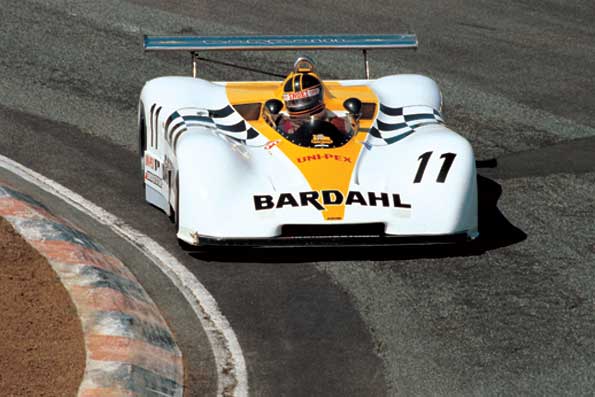
Using parts from the successful March 74S, the MCS won the 1980 Fuji Grand Champion title, and later versions of the MCS (built over Formula car chassis) would win every GC title until the series folded in 1989…and then Mooncraft designed the Formula 3-based GC-21 for the revived Grand Champion series, a car that would also have success in the short-lived Japan Le Mans Challenge.

In international sports car racing, Mooncraft collaborated with Mazdaspeed on the design of various Mazda RX-7s that raced at Le Mans, as well the body of the Mazda 717C. With its Group C Junior class win at the 1983 24 Hours of Le Mans, the Mooncraft-designed Mazda 717C became the first Japanese car to take a major class victory at the event.
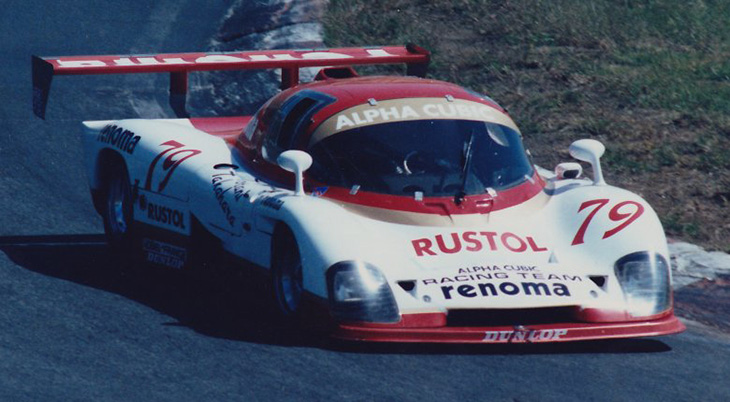
Mooncraft would also do the aero work for the subsequent 727C and 737C, and also constructed the MCS Guppy (pictured above), a popular choice among privateers in the All Japan Endurance/Sports Prototype Championship during the ’80s.
The company would soon turn its attention towards its in-house racing team, where it won the 1988 All Japan Formula 3000 Championship with Aguri Suzuki, two Japanese Touring Car Championships in 1993 and 1996, and from 1997 to 2004, Mooncraft supported Team Kunimitsu’s factory Honda GT500 programme in the All Japan GT Championship (JGTC).

As the JGTC turned to SUPER GT, Mooncraft returned in 2006 with the introduction of the Shiden MC/RT-16. It was one of GT300’s most controversial designs, using the frame of a Riley Mk.XI Daytona Prototype as its base.

The ‘new’ Shiden asserted itself as a strong contender every year winning the 2007 GT300 Teams’ Championship with Kazuho Takahashi and Hiroki Katoh behind the wheel for most of its seven years in SUPER GT.

After the Shiden, Mooncraft was an early adopter of the GT300 Mother Chassis platform, designing the mid-engine Lotus Evora MC for SUPER GT in 2015 (a revised version was constructed in 2018).

The Evora MC competed not only in SUPER GT but also the Intercontinental GT Challenge Suzuka 10 Hours, and in 2020, the car finally captured its first GT300 class win, followed by another in 2021, its final year of competition.
Mooncraft became a subsidiary of Toray Carbon Magic in November 2018 and continued its work in race car construction through the design of the second-generation FIA F4 Japanese Championship car, appropriately named the MCS4-24.
The Mooncraft facility will be retained by TCM as the “Toray Carbon Magic Gotemba Base” for future projects, while Yura announced that he plans to establish a new company and enter an outsourcing agreement with TCM.
Feature image © Peter “Pedro” May / dailysportscar.com
Additional images © Mooncraft, Mazda, Honda Mobilityland, GTA