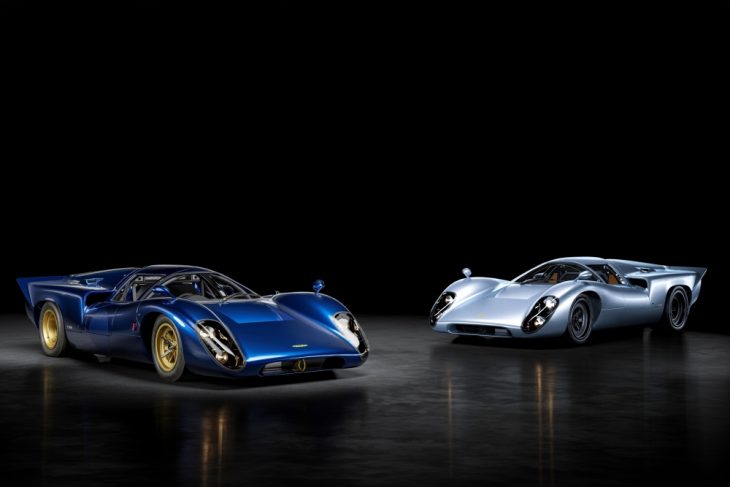

Lola Cars has been in the spotlight this week, launching the T70S and T70S GT, re-engineered versions of the iconic T70, utilising advanced manufacturing processes and pioneering sustainable materials.
Originally introduced in 1965 by renowned designer Eric Broadley, the Lola T70 dominated the inaugural Can-Am Championship in 1966. Perhaps its most famous win came in 1969 at the Daytona 24 Hours with Mark Donohue and Chuck Parsons for Team Penske — beating the factory Ford GT40s and Porsche 908s.
The T70S has been developed using original archival drawings, augmented by high-resolution scans of the finest period examples, to ensure complete authenticity. Every component has been re-engineered to meet contemporary standards of precision while remaining faithful to the original design. The result is a vehicle that preserves the characteristics of the T70, while benefiting from modern tech.
“The T70 is not only one of Lola’s greatest designs, but one of the most iconic racing cars ever built,” says Till Bechtolsheimer, the chairman of Lola Cars.
“The T70S represents an entirely unique example of preserving motorsport heritage while advancing sustainable innovation; a car identical to the original fire-spitting, Steve McQueen-era, V8 monster, but refined with advanced manufacturing processes, sustainable materials and an unparalleled attention to detail.”
Limited to 16 cars, the vehicle is available in two specifications – the T70S and T70S GT. The T70S is the competition version, supplied with an FIA Historic Technical Passport. At its heart is a lightweight aluminium monocoque chassis paired with a 5.0 litre small block Chevrolet V8 delivering 530bhp.
It can hit a top speed of 203mph and accelerates from 0 – 60mph in 2.5 seconds, with a power-to-weight ratio of 616bhp per tonne*. The drivetrain is complemented by a period-correct transaxle and double wishbone suspension system, ensuring that driving dynamics remain true to the original.
The GT meanwhile, is supplied UK road-registered. It features a 6.2 litre small block Chevrolet V8 which produces 500bhp, enabling a top speed of 200mph and acceleration of 0 – 60mph in 2.9 seconds.
It retains the fundamental DNA of the race car while incorporating subtle enhancements for usability, including refined ergonomics, climate control and limited storage solutions.
Also benefits from damper adjustments and a Lola specification engine and gearbox pairing, developed for road use. These modifications have been executed with restraint, ensuring that the vehicle’s character and driver-machine connection remain authentic and uncompromised.
A defining innovation of the T70S programme is the introduction of the Lola Natural Composite System (LNCS), a patent-pending bodywork solution representing a world-first in automotive applications. LNCS features a unique combination of all-natural plant and basalt fibres with a fully renewable resin system derived from sugar cane processing waste, resulting in a groundbreaking 100% ‘natural’ (petrochemical-free) bodywork system. It delivers a significant reduction in environmental impact and superior tensile strength and stiffness.
Mishern Chetty, CEO, Lola Cars, added: “The T70S project forms part of Lola’s broader strategic focus on cutting-edge performance technologies. Since 2022, as part of our mission to drive innovation through motorsport, we have invested heavily in the development of advanced materials, powertrain systems and supply chain innovations aimed at reducing the carbon footprint of high-performance vehicles.”
According to Lola, an independent assessment indicates that the T70S achieves a reduction of approximately 54% in CO₂ emissions compared with conventional manufacturing benchmarks; with certain components, such as magnesium alloy parts, demonstrating reductions of up to 80%.
These improvements have been realised through a comprehensive re-evaluation of traditional production processes, including the use of magnesium extrated from seatwater, new casting technques and the implementation of aloternative shielding gases.
Peter McCool, technical director, Lola Cars, concluded: “Driving the T70S will be a chance to experience the past and future of motorsport simultaneously. An entirely unique example of groundbreaking innovation in advanced sustainable materials, this project provides a blueprint for the future of historic motoring and motorsport.”
Image courtesy of Lola Cars