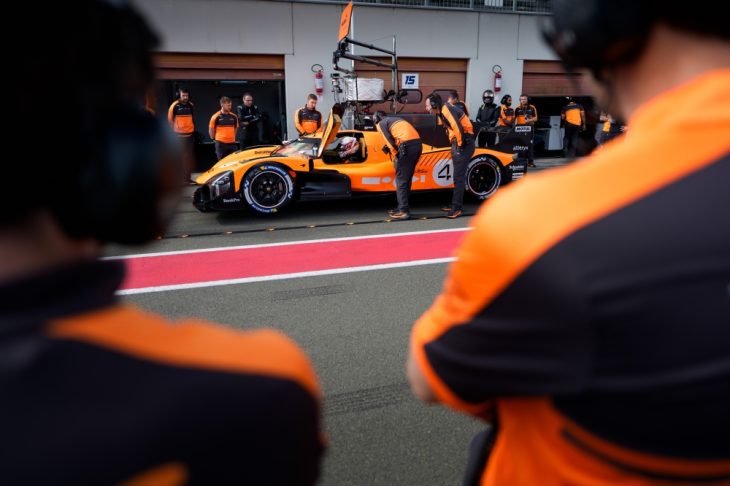
McLaren Racing’s FIA WEC Hypercar programme is moving forward quickly, with the news that its MCL-HY LMDh underwent a successful shakedown at the Autodromo Riccardo Paletti and that Laurens Vanthoor has joined its driver roster.
The coming months are vital as the manufacturer and its service provider, United Autosports, delve into the test programme and ramp up spending ahead of the car’s global race debut next season.
The two-day run in Italy to kick things off was hailed as a momentous occasion by programme boss James Barclay. “You can see me smiling because it’s a really big milestone,” he told reporters earlier this month at Spa.
Factory driver Mikkel Jensen and Gregoire Saucy from the McLaren Driver Development Programme took the wheel, with a large group of on-site personnel present for the historic moment, including key members of the supply chain.
“When projects like this start, you lay your plans out, and you have a timeline, and you don’t know what curveballs you’re going to get in that process, right?” Barclay reflected. “And, of course, there’s always a curveball in the supply chain. All sorts of things can happen.
“So to complete the rollout on the week we planned, the start of the week we planned, the fourth of May, was a really fantastic achievement from the team. I’m really pleased because it’s not easy to do. It takes a lot of discipline, a lot of management. And as planned, just after nine o’clock, we rolled out on track.
“The car rolled out on EV, the internal combustion engine fired up, and we did our first lap. It was very special. I’ve got it on my phone, and it’ll be a memory I keep with the rest of our team for a long time. It’s nice to see a McLaren top-category sportscar back on the track.”
On the subject of team size, it will comprise just under 100 staff members when the hiring process comes to a close in a few weeks. “There are a few final roles to fill in, but in terms of the core structure of the technical side and the operation side, they operated on site like a team that had been working together for some time now. That’s actually one of this week’s successes (during the rollout),” Barclay commented.
Over the course of the two-day shakedown, despite weather disrupting the timetable, Barclay said the team still managed to maximise the opportunity to gather some early data.
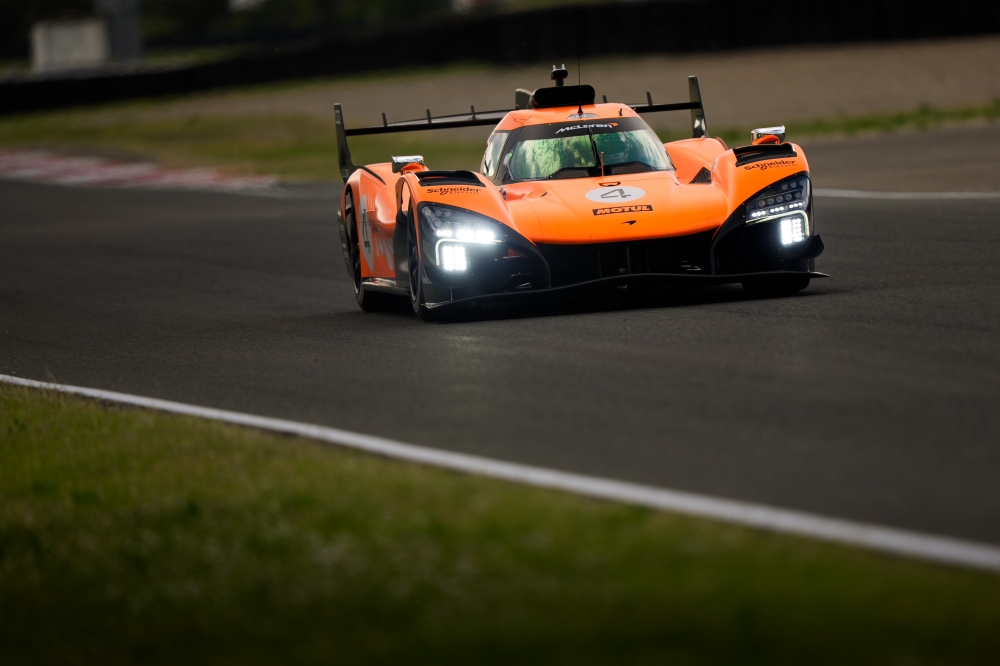
“These cars are really complicated,” Barclay added. “We heard about some of our competitors having very difficult rollouts at the start of their programmes. So we had a long to-do list to get through, which we did. We had a bit of rain on day two, but that was the only tricky thing. We got to full power laps on both days, and that was the big goal.
“Nothing was leaking, there were no show-stoppers, no major hardware failures, we didn’t have any of that, so it’s really positive.”
With the shakedown in the rear-view mirror, the mileage counter will begin to tick up rapidly in the coming weeks and months.
The test plan, which will see the Dallara-based MCL-HY put through its paces across Europe and the Middle East ahead of homologation, is mapped out, with all circuits booked.
The schedule includes a mixture of circuits that feature on the WEC calendar, and tracks that don’t but remain useful, such as Portimão. And there is, of course, a contingency plan if the Middle East remains a no-go zone through the end of the calendar year.
“This month, we do our straight line testing, then we do our first full track test in the last week of May,” Barclay revealed.
“It’s a good test calendar, and our plan now is to get through that long road ahead. We had normal tests, two, three, four days, then we will have an endurance test as well this year. We have a lot of miles to do.”
Down the line, the team will introduce a second test car to accelerate the process, but only once it reaches homologation spec, to avoid putting resources into producing excess parts that become obsolete.
Additional drivers will also get involved as the end of the calendar year approaches, including Ben Hanley, Richard Verschoor, new superstar signee Laurens Vanthoor and additional names that haven’t yet been revealed for the full-time roster.
Why use Development Programme drivers at such a critical stage? “We’re not here for one year or two years; it’s a longer-term view from our perspective. So having drivers around us at a younger point in their career is a positive long-term,” Barclay noted.
“If you want a full line-up of experienced Hypercar drivers, you can’t have them for the test programme because they have other contracts. So it’s a combination of ones who can join us, like Mikkel, but also young drivers who have an opportunity to be with us in the future.”
Perhaps the number one takeaway from the images and video footage of the MCL-Hy’s rollout was the car’s aero, which, as expected, had received a substantial update from the original show car seen at Le Mans last year.
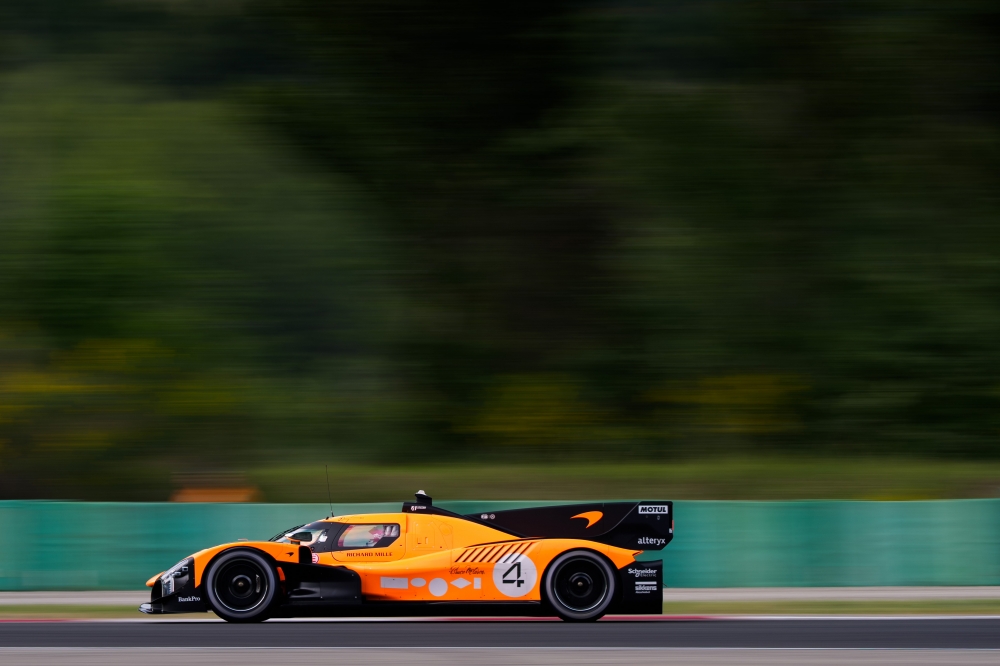
It certainly looks more like a McLaren, particularly at the front end. But are the refinements expected to have a positive effect on the car’s performance potential as well as its aesthetics?
“It was a fantastic job in a very short timeframe to create the concept, which we unveiled,” Barclay said. “The concept had DNA elements, then it was about performance as a priority, and working with our McLaren Automotive partners in the design team. One of the nice things is you have to show the DNA in your car, you can’t just make a car that looks nothing like your brand DNA.
“There’s always a complete alignment on performance being the priority, then bringing the styling side along. I think we’ve achieved both. The styling side is clearly McLaren; the ACO were very happy. Some things might evolve, but what you see is clearly a McLaren, with a DNA to it, and performance-wise, we think we have a great starting point.”
Much of the car’s performance potential comes from what’s under the bodywork, though, and McLaren has chosen to work with Autotecnica Motori for its V6 twin-turbo power plant. For many, it was a left-field choice to partner with the Italian constructor, but Barclay feels that the early signs suggest that this is a relationship that will pay dividends in the long run.
“We had lots of options when it came to the engine,” he concluded. “We looked at the overall, global picture of the car. How do we think we’re going to get to the best overall package for the car? We wanted an engine which would have the attributes you wanted, packaging, positioning in the car, weight, all those factors, efficiency.
“So we started with an architecture engine, which, which ATM had. And to be honest, together we’ve developed it. So it’s an all-new engine. This is not an engine they had. We were jointly developing it. We’re still developing it. That’s been a really enjoyable process. They’re super open-minded in how they’re doing this with us.
“We’ll homologate a really bespoke McLaren solution, but with the background expertise of ATM, with a core 2.9 litre twin-turbo V6. That’s where we should end up unless we want a drastic change (to capacity).”
Images courtesy of McLaren