


Robert Kubica arrives at Le Mans this year carrying a distinction few drivers ever experience: returning to the Circuit de la Sarthe as a defending overall winner.
The 41-year-old Pole was at the wheel when AF Corse’s privately entered Ferrari 499P secured victory in last year’s 24 Hours of Le Mans, delivering Ferrari a third consecutive overall win and earning Kubica, Ye Yifei and Phil Hanson their first triumph in the world’s greatest endurance race.
But while Kubica’s personal story is compelling, the wider significance of Ferrari’s current run at Le Mans looms over the 2025 event.
Three consecutive victories have already established the 499P as the benchmark at La Sarthe in the Hypercar era. A fourth would further cement Ferrari’s place in modern Le Mans history while inevitably intensifying scrutiny of a Balance of Performance-regulated category designed to promote parity among a record manufacturer field.
With six different manufacturers winning the last seven FIA WEC races and Ferrari yet to stand on the top step since last year’s Le Mans, the competitive picture appears more open than at any point since Hypercar’s arrival. Yet both Ferrari factory entries and the AF Corse-operated #83 have repeatedly demonstrated an ability to deliver when the stakes are highest.

Whatever the broader debates surrounding the category’s future regulations, they are unlikely to concern Kubica and the #83 crew, who head to France in the spotlight. Their focus remains fixed on repeating what many now regard as one of the standout achievements of the Hypercar era.
Viewed through the lens of time, AF Corse’s 2025 victory arguably appears even more impressive than it did on race day. The yellow Ferrari, en route to its only victory of the WEC season, defeated not only the two factory 499Ps that had won the previous two editions, but also a Porsche Penske Motorsport operation determined to deliver Roger Penske a long-awaited overall Le Mans victory and Porsche its 20th.
It also came in one of the most intense editions of the race in recent memory, which featured just one safety car and therefore little opportunity to recover from mistakes.
“We came into the race after a disappointing 2024 edition, because we were competitive and retired with technical issues. It’s such a big challenge, but as a team we prepared so well, it’s an event that requires a lot of energy,” Kubica reflects.
“You have to be confident, and we were, but I have respect for the race and this paddock. You know that if someone has a better day and makes fewer mistakes, they will beat you. And last year was such a fast race, with four cars close together in the final hours.
In a way, the Porsche made it less stressful
“There was a mixture of feelings for me. I was aware of what was going on, what we were facing and what we could have achieved, but in the end, we were in the mix for most of the race and managed to execute perfectly.”
The closing stages demanded not only pace but risk management.
“I think I did a reasonable job in the car. There was a point in the race where if we built enough of a gap, we were able to fit another set of tyres for the last stint, which took away the risk of puncture. In a way, the Porsche made it less stressful; if it didn’t slot between us, who knows? I think it made my life easier!
“Sometimes when you have pressure, you become more tense and think too much. But I was pretty calm and straightforward, and actually, I felt that pressure gave me more motivation.”
For Kubica, however, the defining memory came after taking the chequered flag.

“What stands out is after the race,” he explains. “When I was recovering from my accident (in 2011) and had a lot of time to think, I felt I regretted not celebrating too much. I get happy, but I am not a big showman or a party guy. So with Canada, when I won my first race in F1, it was a big achievement, but I took my first possible flight back to Europe to test in Barcelona, and I was the only driver present on Tuesday morning.
“Now, I realise that there are moments in your life when you should give a bit of celebration, in respect of what you achieved, for yourself and your team. So I promised myself I would celebrate if I won something big again.
“But I crossed the line, and it was relief, it was like a balloon, all the air was gone. I was so, so tired, listening to the radio, and I drove slowly to the Esses and realised I hadn’t even said anything to the team over a minute after crossing the line. I look back at pictures…. and I admit you cannot force yourself to do things that don’t come naturally. I was happy, and it was different to Canada, actually, because of the tiredness, but there was so much stress in and out of the car.”
The triumph launched the #83 crew into title contention, but the second half of the season failed to deliver on its promise. A difficult run of races, operational mistakes and missed opportunities ultimately left Kubica, Hanson and Ye second in the standings.
It’s a privilege of my motorsport life to have opportunities to go to Le Mans
Looking back, Kubica sees parallels with his standout 2008 Formula One campaign with BMW Sauber.
“Honestly, there are a few things which I cannot get into,” he says. “Last year was just a waste. It was similar to 2008, but for different reasons. Back then, we won Canada, and it should have been a chance to build on a strong result, but it wasn’t, and this felt like that.
“We were trying to stay in the fight. But it was difficult to win it, and we made mistakes. I think of Austin, we messed up in the pit lane, lost a lot of positions and momentum, and we had another issue that cost us around 30 seconds in the pits. After that, in racing, everything is possible, but in order for us to win it, the #51 crew would have needed bad luck somewhere, and that’s not the way you would want to achieve it.”
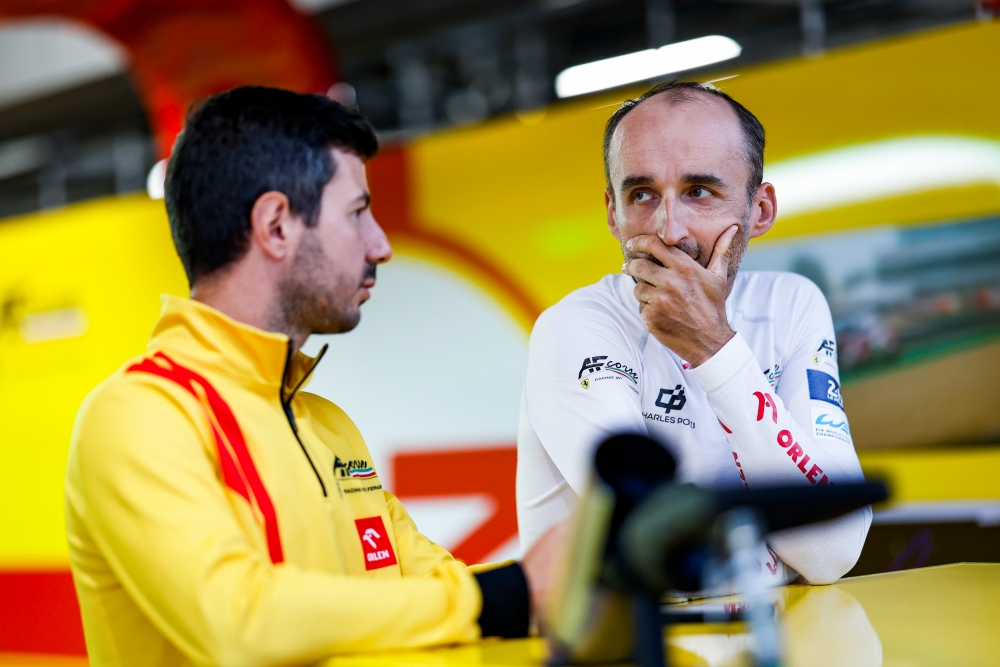
Despite questions surrounding the future of Ferrari’s customer Hypercar programme and widespread speculation about his own future towards the end of the campaign, Kubica elected to return for another. The reason, he says, was straightforward.
“Honestly, there is one reason I came back. I did not have many chances in my life to come back to a race that I won the year before. It’s a privilege of my motorsport life to have opportunities to go to Le Mans.
“There was a certain period, post-Le Mans, where I thought I might look at something else to do, but I want to race Le Mans. I want to experience it again, and I will regret it if I don’t do it and miss the opportunity to go racing in a competitive package as a race winner of the year before for such an iconic race.”
His objectives for this year’s race are simple.
“I think there is pressure on everyone ahead of Le Mans, pressure to face the challenge, to finish the race, to bring home a result,” he says.
“Le Mans is more than winning; it’s about the challenge and going home happy knowing it was the maximum you could achieve.
“My goal this year is to continue this positive trend I’m on at the race. I go back with more experience, more knowledge, and I would say I feel even more prepared than I was last year.”
Featured image and Kubica portrait courtesy of DPPI


