The 2026 edition of the 24 Hours of Le Mans had its first track action yesterday, with the official Test Day seeing all cars out on track ahead of the 94th edition of the Grand Prix of Endurance.
While there were plenty of headlines around the top times of the weekend, there’s a lot more to look at up and down the timesheets, across all three classes.
So here are some key points to consider coming out of the Le Mans Test.
Considerations and speculations
Before we start, it’s important to consider that, without direct confirmation from a team, it is impossible to know what sort of programs were being run, and thus how much outright pace was being shown. Therefore, at best, the points made are all based in speculation. While that speculation is based on data and lap times from the test, it must be noted that ultimately, the test day is not a direct representation of the hierarchy of performance in any class.
This point will be revisited throughout this analysis.
Setting a baseline
This year’s Test Day took place in beautiful conditions, with a sunny, clear day on a green track, providing perfect conditions for testing for the week ahead.
With no major changes in performance or tyre compound since last year’s Le Mans, the LMP2 class can be used as a baseline indicator for the conditions as compared to last year, which took place under similar conditions.
Last year, the best placed LMP2 car was the #22 United Autosports Oreca 07 at the hands of Pietro Fittipaldi, who set a 3:35.770 to go fastest in the second test session. Fittipaldi was the only driver in the 3:35’s on that occasion.

This year, the top lap time was a 3:35.344 set by Job Van Uitert in the #28 IDEC Sport Oreca, late in the second session. Van Uitert’s lap was a qualifying sim, set on his second flying lap late in the second session.
Van Uitert was joined in the 3:35’s by Matthias Beche in the #14 TDS Racing car, who set a 3:35.519. Looking at theoretical best laps, however, taken by stitching the best sector times for each car, puts the TDS car ahead, with Beche’s best sectors good enough to set a 3:35.094. That time is almost 7 tenths faster than last year’s theoretical best LMP2 time; a 3:35.75 by the #23 United Autosports Car.
In fact, looking at theoretical best lap times, every LMP2 car was capable of setting a lap in the 3:37’s, while last year, some cars struggled to break into that bracket.
What this indicates is that the track conditions across the test look marginally better than they did for last year’s test day; the entirety of this year’s LMP2 field would have placed in the top half of last year’s test.
Can we expect a similar increase in pace for each of the classes? Maybe there are plenty of factors at play, so extracting track conditions as a variable is a difficult task. But what it does show, at the very least, is that the LMP2 field has broadly gained some pace, and is going to be extremely competitive throughout the entire field.
At the head of the field – Hypercar
Plenty has changed in the Hypercar class since last year’s 24 Hours of Le Mans. Firstly, Michelin has brought new tyres, which are a significant variable when comparing lap times to last year. Furthermore, the re-homologation of the entire field in the Windshear Wind Tunnel in North Carolina has seen significant changes to portions of the field. Notably, the Ferrari 499P underwent significant revisions as part of ‘repositioning’ the 499P within the defined performance window.
In practice, the changes to the Hypercar class mean that differences in lap time compared to last year could be due to a variety of factors. Is it tyres? Is it re-homologation? Is it improvements from the team? Evo packages? Better set up and engineering? Track conditions on the day? Anything could play a factor. Even the “baseline” improvement seen in LMP2 is not guaranteed, as so much of the Hypercar package has changed in the off-season.
So, who made the biggest strides compared to 2025?
Realising the room for improvement
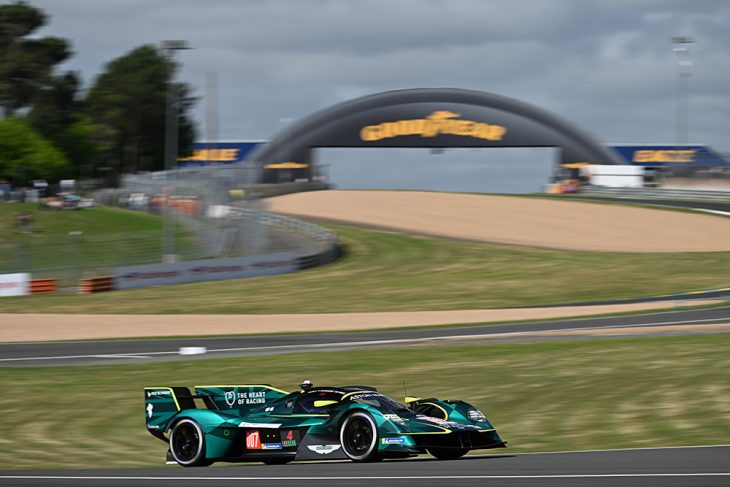
Perhaps unsurprisingly, the cars that have shown the largest improvements were the cars that had the largest room for improvement over their 2025 efforts. Topping the test day with a 3:26.293 was the Tom Gamble-driven #007 Aston Martin Valkyrie, with Gamble’s best lap almost a full 3 seconds faster than the car could manage in the same session last year. The work that The Heart Of Racing have done in developing that car has clearly paid off in spades as Aston Martin approaches their second Le Mans in the Hypercar class.
“We’ve worked super hard over the winter,” said Harry Tinknell, driver of the #007 Valkyrie. “The car feels really good in the corners, good on the brakes.
“It’s definitely a really positive day.”
According to Tinknell, a more comfortable front end is what’s brought on the big improvement from last year.
“When I think back to last year, it’s a huge improvement.
“The [electronic] systems makes a huge difference. What those systems are doing is giving us more front end. I think that’s really the big difference from last year.
“The car is turning really well in the corners, which enables us to get back on the throttle nice and early, and get the exits as well.”

The next best improvement came from the Peugeot 9X8, with Stoffel Vandoorne ending the day in 11th place, setting a 3:27.208. While, on paper, that lap doesn’t set the world alight, it is a two-second improvement over where the 9X8 was last year, where they firmly brought up the rear of the Hypercar field.
Cadillac, BMW and Alpine each made small improvements over last year, with Cadillac setting the best time of the three brands; the #12 V Series.R finishing the day in the 3:26’s with Norman Nato setting a 26.8, just ahead of the #35 Alpine A424, who also scraped into the 3:26’s with a 3:26.938 at the hands of Ferdinand Habsburg. It is interesting to note that the improvements from Alpine and BMW were smaller than the “baseline” improvement of around half-a-second we’ve assumed from the LMP2 data.
New is always better? Maybe not
Broadly, the cars that have utilised ‘joker’ upgrades or have made Evo changes (or in the case of Toyota, have changed their cars significantly) haven’t made the same gains as those who have maintained their platform from last year.

While both Alpine and BMW improved on their times from last year, the improvements were relatively small: 0.375 and 0.415 of a second, respectively. Even compared to Cadillac’s 0.767 of a second, the gain of less than half a second is not a huge step forward.
On the other hand, despite finishing the test day in second overall, Toyota couldn’t match their best lap time from the 2025 test; the new TR010 set a time of 3:26.401, just behind the GR010’s effort of 3:26.246 last season. It is important to note however that Toyota set the best time in the 2025 test, and that time was not matched this year, with Aston Martin’s #007 falling half-a-tenth short.

The big surprise from the test was the relative lack of pace from the Ferrari 499P, with the best-placed 499P finishing the day in 8th overall with a 3:27.167 – almost 4 tenths slower than their pace last year. What’s even more peculiar about the lap time from Alessandro Pier Guidi is that it was set in the midst of a longer run in the #51 car, which only completed 27 laps in the second session – the lowest number of any Hypercar – while the qualifying sim laps from the #50 and #83 cars couldn’t match the best lap from the #51.
Should this be of concern for Ferrari? It’s hard to tell – there’s still a long way to go before hyperpole, and even longer before the race, so there is plenty of time to make adjustments to find more pace in the 499P.
Aston Martin the best of the theoretical bests
Looking at the theoretical best lap times, once again, taken from stitching the best sector for each car – the story gets even better for Aston Martin and the Valkyrie.
Despite finishing the test day with the 13th best time overall, the #009 Aston Martin Valkyrie tops the theoretical best lap chart, with Marco Sorenson’s first and second sector combining with Alex Riberas’ session best final sector to result in a 3:25.999 – the only car to dip into the 3:25’s. Tom Gamble’s middle sector gets replaced by one from Ross Gunn to put the #007 Valkyrie into second with a 2-tenth improvement, completing an Aston Martin 1-2 on the theoretical best charts.
The Valkyrie was the strongest car in the first and final sectors, and improved over 2.3 seconds from their ideal lap in 2025.

Cadillac is the next best improver on their ideal lap time from 2025; Norman Nato’s first and third sector combined with Louis Deletraz’s middle sector improves their time from a 3:26.853 to a 3:26.039, just behind the #007 Aston Martin, and an improvement of 1.57 seconds from 2025.
Peugeot’s improvement over their 2025 pace is reflected in an ideal lap over 1.5 seconds faster than last year, while BMW’s ideal lap is a more significant improvement over their best lap, with a 7-tenth improvement compared to 2025.
Once again, despite finishing fourth and fifth in the theoretical best lap times, the Toyota TR010 – with both cars setting an identical theoretical best of 3:26.200 – is a shade slower than their ideal time from 2025, where their theoretical best was a 3:25.844 to top the time sheets.

And for Ferrari, the drop off is even more; with Pier Guidi setting the #51’s best sectors all on the same lap, there’s no improvement to their theoretical best lap. Pier Guidi’s 3:27.167 drops outside the top 10, with Ferrari 499P’s ideal laps sitting in 13th, 14th and 15th, almost 8 tenths slower than 2025.
However, the pointy end of Hypercar is much closer this year than it was last year; while Ferrari’s 3:27.167 is only good enough for 13th place this year, compared to last year’s time, it would have slotted into 6th place. In fact, 16 of the 18 Hypercars had ideal laps within 1.5 seconds of the lead car. So, while the absolute pace might be a touch slower in Hypercar compared to last year, the field is a lot tighter!
What about Genesis?
The Genesis Magma GMR-001 made its first run at Le Mans, and performed admirably, finishing the day with the 10th best time – a 3:27.174 – just behind the best placed Ferrari 499P and ahead of both Peugeot 9X8’s. Placing solidly mid-pack is a great achievement for the team in their first year of the program, especially compared to where other teams finished in the first years of their programs. Aston Martin, for example, was over 3 seconds off the pace in their first test day, which is extremely encouraging for the Genesis program.

“I think we have a great day overall,” said Paul-Loup Chatin after the second session of the day. “First time for Genesis at Le Mans, on this amazing track, and we had zero issues, which is what’s most important for the day.
“Of course, we still have a lot of things to analyse and work on, but we are quite happy with how the car behaves, even though we are confident that we can improve the car.
“It’s an amazing job from all of the drivers, all of the engineers, all of the mechanics. So let’s keep going!”
Looking at theoretical bests, the combination of Paul Loup Chatin and Daniel Juncadella gives the #19 Genesis GMR-001 a 3:26.744. This time sits 11th on the ideal lap chart, faster than both Peugeot 9X8’s, all three Ferrari 499Ps, and just behind the best-placed BMW M Hybrid V8.
It’s still very early days, but it is a very encouraging starting point for the South Korean brand!
So, are Aston Martin favourites then?
Not exactly.
While topping the test day is a great sign and attracts the odd headline or two, in recent times, the test day has not been a reliable indicator of either outright pace or race pace come next weekend.
For example, last year, the best lap improved by over 4 seconds between the Test Day and the Hyperpole session. Furthermore, the two fastest cars on one-lap pace – the Cadillac V Series.R and the BMW M Hybrid V8 – both placed outside the top 10 in last year’s test, before topping the Hypercar times.
It must be reiterated that at this point in the week, all we can do is speculate based on what has been observed from the test. Without inside knowledge of the programs each team were running, it’s impossible to know how the Hypercar field stacks up, and how happy each team are with their pace.
Once the lap times start to matter – Wednesday Night’s Qualifying sessions – the teams will start to show their true pace, and the hierarchy will be much clearer.
Every GT3 car within 2 seconds of the class lead
While the pace in Hypercar will garner a lot of attention, it’s worth taking a quick look at the LMGT3 field to see how the pace matches up in the traditionally BoP’d class.
While the outright pace is marginally slower in LMGT3 compared to last year (a 3:56.646 this year vs a 3:55.276 last year), what is remarkable is just how close the entire field is in outright pace.

Francesco Castelacci set the best time of the test day – a 3:56.646 – in the #54 Vista AF Corse Ferrari 296. Behind him were 4 further cars in the 3:56’s – the #91 Porsche of Manthey DK Engineering, two Corvettes thanks to #33 TF Sport and #13 13 Autosport, and the #69 Team WRT BMW – followed by the entire rest of the field in the 3:57’s bar the #74 Kessel Racing Ferrari. That’s 24 out of 25 cars within 1.5 seconds of the fastest time, and all 9 brands within a second of the fastest time.

Looking at the theoretical best laps paints a similar picture; 21 of the 25 cars sit within a second of the lead on their ideal lap, which is a 3:56.219 from the #91 Manthey DK Engineering Porsche. It could be anyone’s race in LMGT3, with the pace of the race very clearly in the hands of the Bronze drivers.
Alright, so what does this all mean then?
At the end of the test day, there are very often many more questions than answers. While you can point at the teams that have made strides forward, or the teams that have maybe not gone as well as you’d expect, there are plenty of reasons why some or all of that may not be the full picture.
What is clear is that the lap times are very crowded at the front, in all three classes. Whether it be Hypercar, LMP2 or LMGT3, the margins between the very top and very tail of the field are amongst the smallest they have ever been, which puts more emphasis on the teams, strategists, mechanics, and drivers in the cars to extract the maximum they can out of the race.
It will be a race won (and, as history has shown us time and time again, lost too) by the little details, excellence will prevail, and that is something we can all look forward to!