

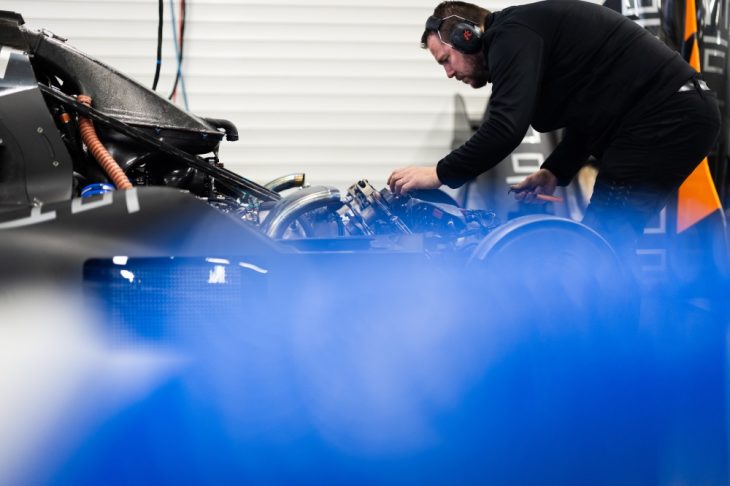

Love them or loathe them, the BoP regulations within the WEC’s top Hypercar class have led to the greatest diversity of engine types at Le Mans for a long time. You can, within reason, bolt pretty much any motor you like in your Hypercar, confident that the system should let you be competitive.
Obviously there are limits, you need something that can hit the 500kW power limit (there’s no point building a super lightweight I4 for example, with less power, because you will just have to make the weight up somewhere else), but beyond that, the sky is the limit. That’s why we currently have everything from turbocharged V6s to naturally aspirated V12s, plus most things in between (sadly no V10s though).
Unlike in the LMP1 days, efficiency is not really an issue as the rules effectively set your stint length and refuelling time, regardless of how much fuel you actually need to put in the car. There are still some marginal benefits to be had of having to run less fuel per stint, you can keep the car a bit lighter, potentially helping with tyre usage, but beyond that, it’s a case of use as much as you like.

If this wasn’t the case, pretty much every car would be running a twin-turbo, V6 at around 2.5-3.5-litres as this appears to be the goldilocks recipe for packaging size and efficiency within a sports prototype. With some slight variations, this is the route Ferrari, Toyota, Alpine and Peugeot have gone, as will McLaren in 2027 with its Autotechnica Motori-built V6.
Generation game
The engines on the grid range from positively prehistoric to brand-new, cutting edge designs. The engine with the oldest roots is now sadly missing from the WEC, but still battling in IMSA; Porsche’s V8 in its 963. That engine was also unique (until Aston Martin turned up) as it was truly based on a roadcar unit, with the 4.6-litre, 90-degree V8 sourced from the company’s 918 hypercar. However, its origin story can be traced even further back to the Porsche Spyder LMP2 of the mid-2000s. Quite a contrast to the company’s last sports prototype engine in a 919, which was an entirely bespoke and exceptionally efficient V4!
So why did Porsche pick that particular dinosaur? It fitted the need almost perfectly and, with the addition of some mild turbocharging could comfortably hit the required power figures. Even more impressive, the production cylinder block was quite happy being used as a stressed member, albeit with some additional reinforcement.

Fellow German marque BMW also raided its back catalogue for the M Hybrid V8, again adding turbos to something of a dinosaur. In this case, the P.66, a 4.0-litre V8 that first appeared in the M3 DTM car back in 2011. Like Porsche, there were some changes needed to accommodate added boost and, despite a very tight timeframe, two iterations – the P.66.2 and P.66.3 – were developed, the first simply adding turbos to prove the base engine could handle them, the second bringing direct injection into the mix.
Unlike Porsche, where the naturally aspirated engine was not too far off the required power and only gentle boosting was needed, BMW had to go a little more extreme with its engine as in DTM guise it was only around 500bhp. However, that DTM unit was super-optimized as it ran in period with an air-restrictor, so there was plenty of headroom to play with. As an interesting aside, BMW did look at taking the route Genesis has followed for its V8, marrying together a pair of its later DTM I4s, but chose not too due to time constraints.
Talking of the Genesis engine, which arrived with the GMR-001 this year, it has chosen another interesting take on recycling existing tech, lifting the combustion concept and cylinder head design from its 1600cc, I4 WRC engines, which run in the i20, and mating this to a ground-up bottom end to create a 3.2-litre V8.
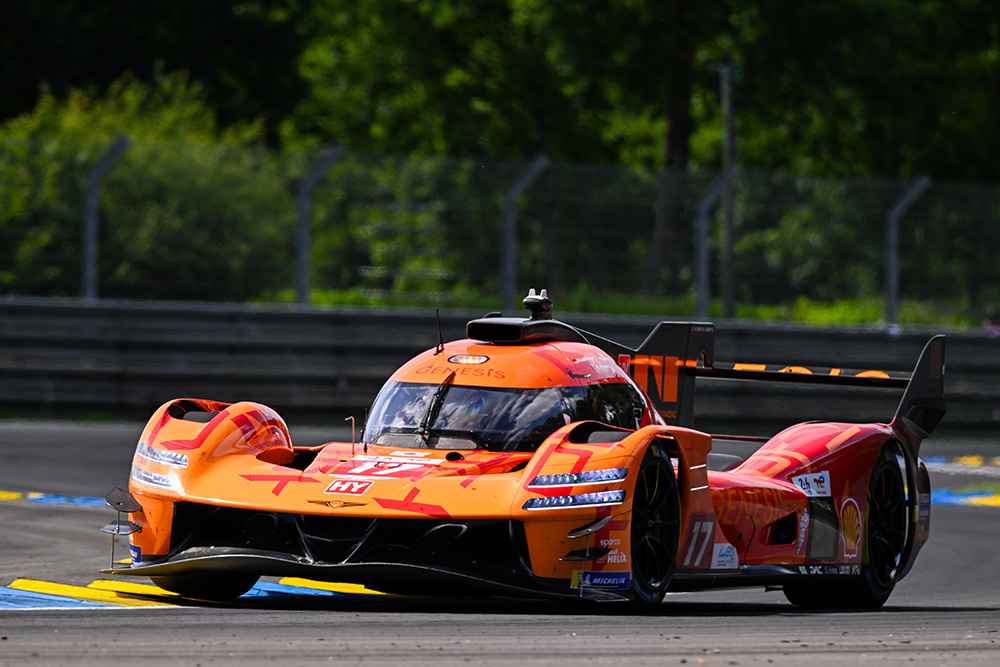
The thinking is sound. One of the most time consuming parts of any engine development program is finessing the combustion system and with over a decade refining its WRC product, this was a logical approach. It is also a testament to the growth of Hyundai Motorsport’s in-house abilities, evolving from being a customer of Pipo Moteurs back in 2016, to producing its own, ground-up endurance engine.
No substitute for CCs
This brings us to the big bruisers of the pack, Cadillac and Aston Martin, though the gulf between the two manufacturers’ approaches could not be wider.
Starting with the bespoke, Cosworth–developed V12 of the Valkyrie, this is inherently a roadcar engine, but one that was developed along the principles of a race engine from the outset. In fact, they had to dial back the performance markedly in order to put it in a racecar and, uniquely, it is also the only non-hybrid. Why? One reason is simply size and weight – the BoP can only go so far. There is a limit to how small and light you can make a 6.5-litre V12 and adding in the weight and complexity of a front hybrid system (as required by the rules for a Hypercar) would have been too much.

If the Valkyrie has a philosophically ‘European’ race engine, the Cadillac V-Series.R is about as quintessentially American as they come (it could only be more so if it was a pushrod, which the team did consider). The formula was straight forward, 5.5-litres of Keep It Simple Stupid. With no turbos to worry about, the installation is easier, and there is less to go wrong.
One interesting design choice was to go with a cross rather than flat-plane crank. A flat-plane crank is lighter, allows the engine to rev more freely, but, because of the firing intervals (with the crank pins 180-degrees apart, rather than 90) engines so equipped simply don’t sound very American.
The cross plane Cadillac on the other hand, sounds muscle car to the core. And that hits at the heart of the current regs, if performance was everything, Caddy would not have been able to bring its aural signature to the track.
Control is everything
So there we have it, the current Le Mans grid incorporates nearly every engine configuration going. And, while strict homologation rules limit what teams can do with them, do not think for one minute there is no development. It’s just the areas they can work on go unseen. The most important is torque control.
Each car has a BoP-mandated maximum power and power curve, which is monitored using torque sensors on the driven axles. The sensors are a spec component supplied by MagCanica and work on the principle of magnetoelasticity – twisting a piece of magnetised material warps the magnetic field and the level of warping can be tied to a torque value.. Exceeding the specified torque limits on-track nets teams punitive penalties.
The implementation of these sensors has changed the game when it comes to powertrain development. Rather than seeking to extract maximum performance, as in the past, the development war is now all about running as close to the set limit as possible, for the greatest percentage of a lap. While it’s not difficult to control the torque in steady-state running down a straight, out of corners and over kerbs, there is wheel slip, which creates oscillations and torque spikes in the drivetrain.
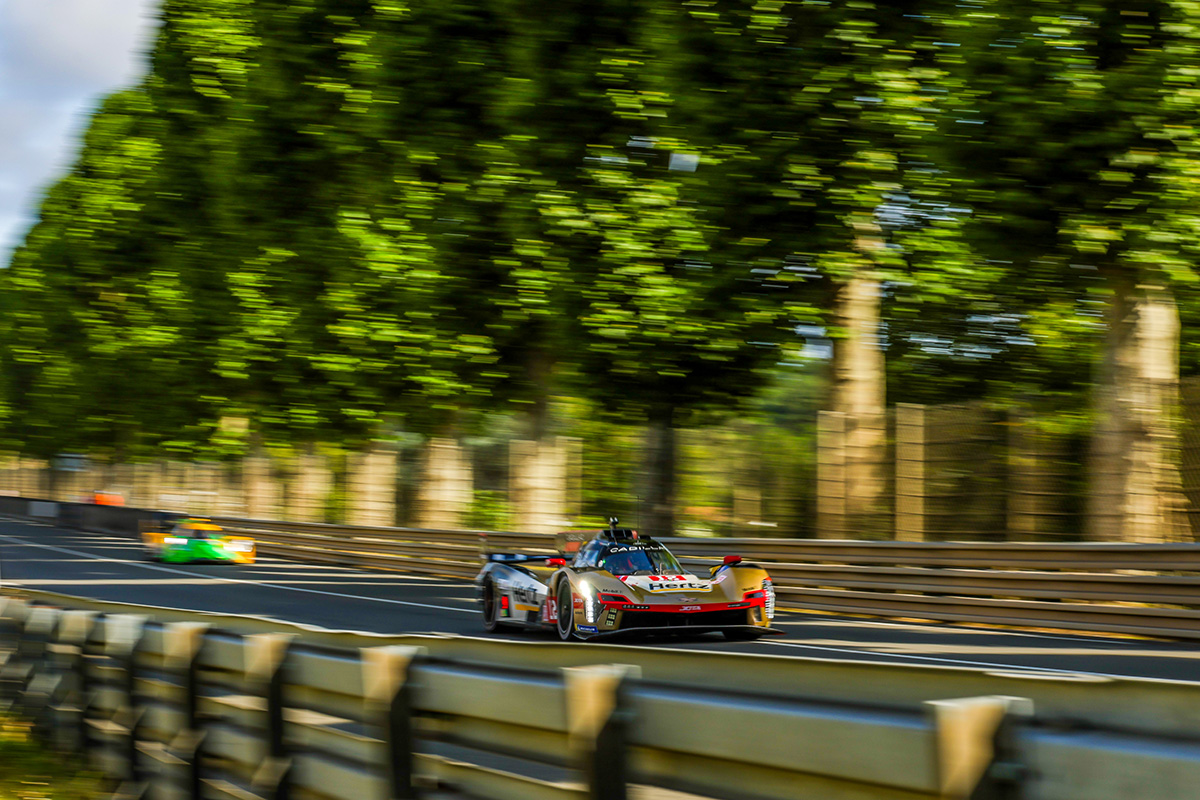
Every team is working on maximising this performance on the edge of these limits. The control strategies for the ICE and hybrid systems are obviously integral to this, and strategies for a given race are tweaked on a corner-by-corner basis. As track and weather conditions change, the strategies evolve, much of which is now automated in the control software.
The mechanical elements of the driveline cannot be ignored either, you wouldn’t think of parts like driveshafts as ‘elastic’ but they are; winding up and relaxing as power is added and removed.
For example, if the tyre grips and then releases, the built-up energy in the driveshaft, clutch, and even hybrid system can release, pushing over the torque limit. Get your control algorithms right, and you can grab a small, but ultimately significant advantage over the competition; even a fraction of a % more power can make a decisive difference over 24 hours.
Come Saturday’s race, you can be sure that engineers will be poring over the data gathered through Test Day and Qualifying, fettling and refining the control systems to eke every last hp out as the track evolves.
Images courtesy of Paul Foster, Peter May, Genesis
DSC’s technical column series from Lawrence Butcher is powered by the industry-only PMW Expo in Cologne, which is set to take place this year on November 11th and 12th at the Köln Messe.
You can register your interest HERE and enquire about exhibiting HERE.


