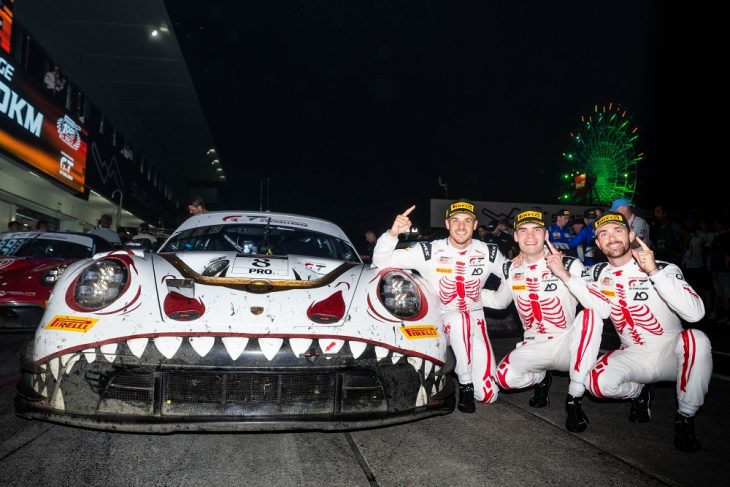
It was a milestone victory for Porsche and the joint-entered AO by Absolute Racing “Bushi Rex” 911 GT3 R in the 50th Suzuka 1000km on Sunday.
Porsche extended its record as the most successful marque in the history of the Suzuka 1000km with its 12th overall win, and first since 1994 when Larbre Competition drivers Jesús Pareja, Jean-Pierre Jarier, and Bob Wollek won in their Porsche 911 Turbo S LM-GT.
As confirmed when the Star Spangled Banner played during the overall podium ceremonies, AO by Absolute Racing became the first American-flagged entry to win the Suzuka 1000km outright, and on AO Racing’s first attempt at the race.
This also extends Absolute Racing’s incremental climb up the podium at Suzuka over the last three editions: With Porsche, the truly multi-national squad’s leading car finished third in the 2019 Suzuka 10 Hours, second in the 2025 Suzuka 1000km, and first in 2026 – all with completely different driver line-ups.
Via Absolute Racing’s third-place finish with its #7 Porsche, it’s the first double (overall) podium finish for a team since 2003 when Dome Racing Team’s two Honda NSX-GTs finished 1-2.
It goes without saying that this is the first Suzuka 1000km overall win for drivers Alessio Picariello, Laurin Heinrich, and Julien Andlauer, and all three drivers’ first IGTC race wins.
“I’m super happy to score not only my first IGTC win ever, but also to do that with Bushi Rex and AO Racing, in my first-ever race with Absolute Racing, it’s a tremendous result,” said Heinrich. “I was always looking forward to come back racing with Rexy and to do it in style.
“In a new championship for Rexy, it was a tough, tough challenge. I think we did a great turnaround of the weekend, and in the end, we just had the best execution in the race. And I can’t thank AO Racing and Porsche Motorsport Asia Pacific enough to make this one possible. And also, the fan support has been something incredible this weekend.”

In their first race running the Ford Mustang GT3 Evo, Miedecke Motorsport by Team MPC (Melbourne Performance Centre) finished second overall.
This marks Ford’s best-ever IGTC result in its first season of competing for the Manufacturers’ championship, surpassing HRT’s seventh-place finish at the Nürburgring 24 Hours earlier this year, and best result at the Suzuka 1000km, surpassing Les Lindley and Bob Sopey’s fourth-place run in 1993 aboard Lindley’s Ford Mustang GTO.
And in what’s sure to be the delight of the Ford Motor Company, it’s the best-ever finish for an American car in the history of the Suzuka 1000km – surpassing Chevrolet’s third place last year with the Johor Motorsports Racing Corvette Z06 GT3.R.
“I have to say, we came with not the highest expectations, but it’s all gone super-well,” said Olsen. “Ford Racing, Multimatic, and MPC really built a good car for us and did a really good execution of the race. We didn’t have any issues, we didn’t have any faults, no mistakes in the pit stops. And that gave us a little bit easier task in the race.
“Definitely the Porsches had a lot of pace, they suddenly found some pace from yesterday. Where that came from, I don’t know. But I think we really tried to maximise everything that we had with our car, and with the very limited time and preparation for the team, I think we did an amazing result.”
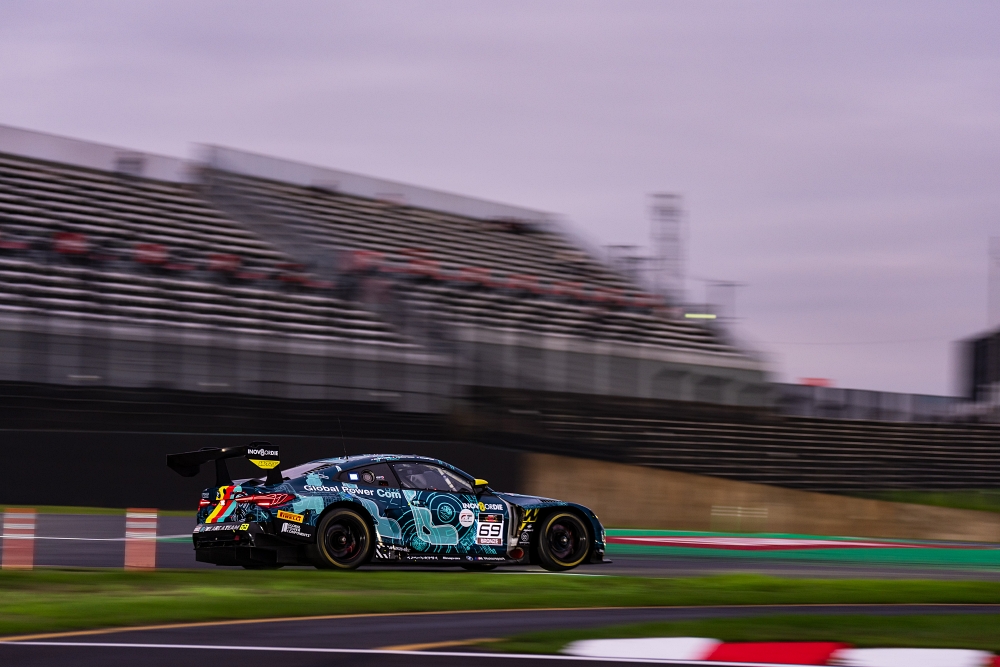
Team WRT has now taken a winners’ trophy in each of the last three Suzuka summer endurance races, following up its consecutive overall wins in 2019 (with Audi) and 2025 (with BMW) with a Bronze Cup win for drivers Anthony McIntosh, Parker Thompson, and Dan Harper.
“To be the winners of that [race] is absolutely super-special, and I’ll remember it forever,” said McIntosh, who came to Suzuka after a tough WEC Lone Star Le Mans at COTA. “COTA was tough, some would say I was reborn out of the car. But we fought ’til the end, and then we came here and righted the ship. So we’re super-stoked, and can’t wait for the rest of the year.”
“I’ve said at almost every track we’ve been through this year that this is my new favourite – and Suzuka is now currently the new favourite. This place is amazing!” exclaimed Thompson. “I love racing in Japan, I think this place might even surpass some of the Italian racing that Tony and I have done.”
“We had a technical issue on my first stop which led to me thinking that the race was maybe over. But in WRT fashion, they somehow found a way to capitalise on a Full Course Yellow, get us right back in the thick of it, and then Dan and I did a great job in the second half. Anthony, though, set us up to get the car at the front.”
LM corsa has taken its second class victory at the Suzuka 1000km: The Pro-Am class win was its first in the event since 2014, when its BMW Z4 GT3 won the GT300 class in the team’s first-ever appearance at the event. Shigekazu Wakisaka adds a class victory to his two overall wins from 2001/2002, and the reclusive “event specialist” Kei Nakanishi also got his first Suzuka 1000km class win.
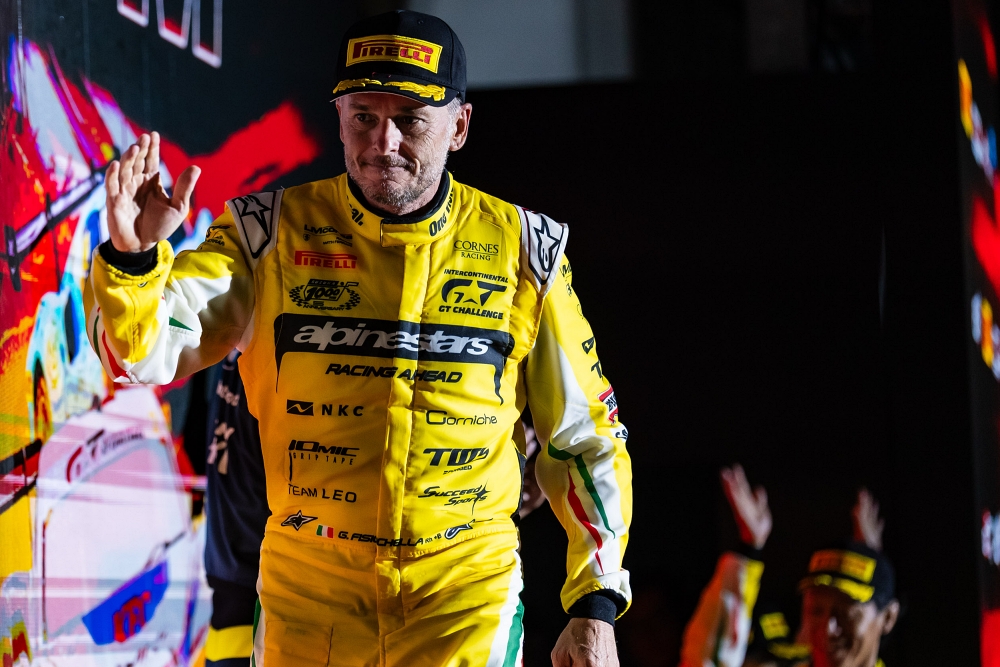
But the star of the #60 Ferrari’s race was Giancarlo Fisichella, who finally got to stand on the top step of the Suzuka podium 21 years after being on the wrong end of one of Formula 1’s most famous finishes at this same venue.
“It’s just great,” said Fisichella, who enjoyed a massive amount of support from the local fans this past weekend. “It was my target this year because apart from the two Italian GT Championship races, this is the only other race I did this season. So it was very important to us. I really thank my teammates, both of them, the team, and the car. The pit stops were fantastic and, we made it!”
“To come back here after last year where we had a chance to win, but we had some problems, I’m so happy about it.”
And although they only had to finish the race to do it, RunUp Sports (Tomei Sports) won the Am class for the second consecutive year – though it was hardly guaranteed after having to switch to a backup chassis following Atsushi Tanaka’s Pre-Qualifying crash.
Other prizes were given to the top-finishing eligible teams from GT World Challenge Asia and SRO Japan Cup: Maezawa Racing took to the top step of the podium in Japan Cup, and PLUS with BMW M Team Studie did the same in GT World Challenge Asia.
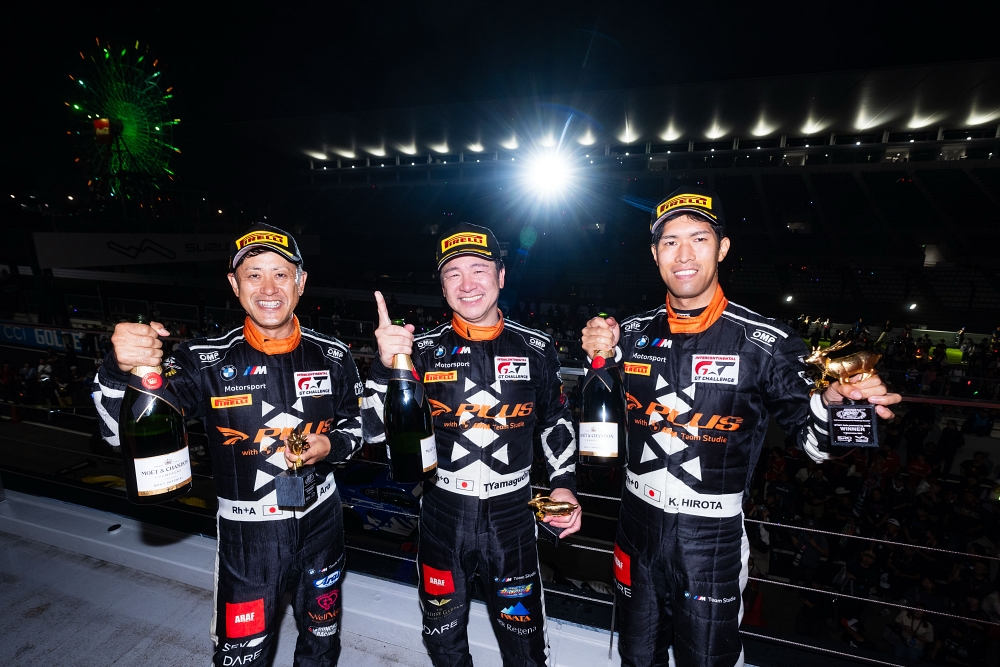
But Tomohide Yamaguchi, Kizuku Hirota, and Seiji Ara’s GT World Asia prize victory for Studie proved to be bittersweet: Studie AG Chairman Yasuaki “Bob” Suzuki wrote Monday on his personal blog that not only would this be the team’s last race of the 2026 season, but that his company has no plans to return to racing in the future, which would bring Studie’s 18-year racing history to a close.
Studie debuted in SUPER GT in 2008 with sponsorship from Goodsmile Company and featuring the famous Hatsune Miku Vocaloid character. The partnership of Studie and Goodsmile Racing & TeamUKYO won the 2011 GT300 championship. Studie also won back-to-back GT World Challenge Asia GT4 championships in 2018 and 2019.
In the Intercontinental GT Challenge Manufacturers’ Championship, Porsche has extended its lead over Mercedes-AMG to 38 points going into the Indianapolis 8 Hour, and needs just six points in the final race to win the title. Mercedes-AMG would have to win the race and have one other car on the podium to have any chance at dethroning Porsche.
Mercedes-AMG driver Maro Engel can still win the IGTC Drivers’ Championship while “sitting on the bench” as the Bathurst and Nürburgring winner still has a seven-point lead over fellow AMG Performance Driver Luca Stolz, and an eight-point lead over Maxime Martin.
Laurin Heinrich, meanwhile, has jumped into a tie for fifth in the standings with Ricardo Feller, and trails championship leader Engel by 22 points.
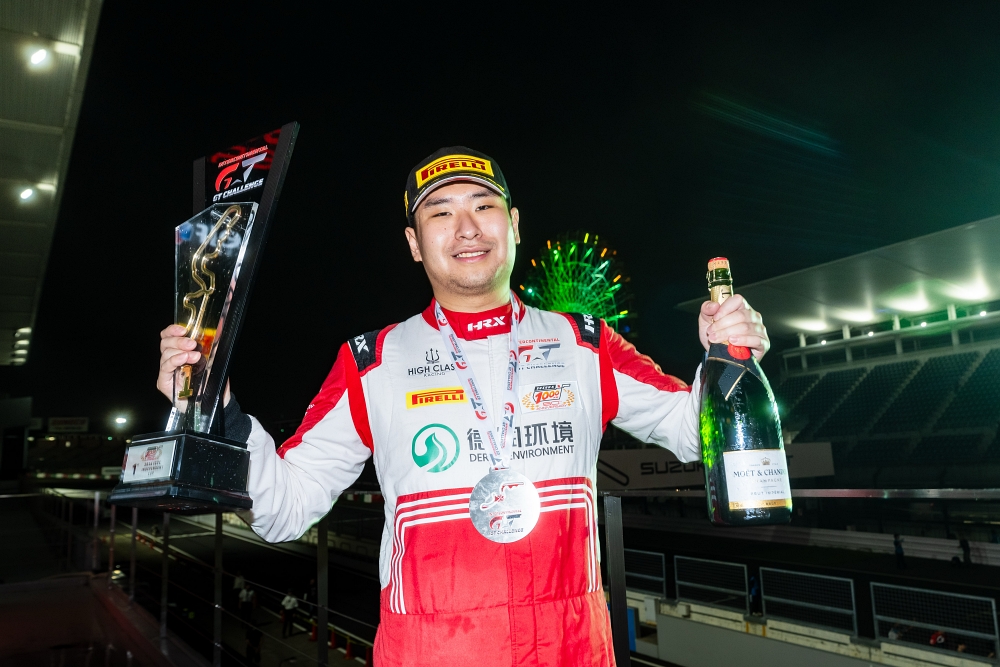
High Class Racing driver Li Kerong clinched the IGTC Independent Cup as the top-ranked eligible driver, finishing eighth overall; it’s the Chinese/American driver’s third Independent Cup victory of the year.
Li becomes the fourth different driver to win the Independent Cup since it replaced the Pro-Am championship in 2023, following Jonathan Hui, Antares Au, and Kenny Habul.
Sunday’s race was the fastest Suzuka 1000km/10 Hours in the IGTC era, run at an average speed of 163.83 kilometres per hour over 184 laps (1068.48 kilometres). This surpasses the 2018 Suzuka 10 Hours, where the average speed over 276 laps was 160.13 km/h.
Ayhancan Güven’s best lap of the race, a 1:59.966, is not only a new race lap record for GT3 cars (outside of SUPER GT), but the first sub-two minute race lap at Suzuka for any SRO-sanctioned competition.
28 out of 30 cars were classified at the end of the Suzuka 1000km, the highest percentage of classified cars (93.33%) in the history of the race – surpassing the previous benchmark set in 2011 when 34 out of 38 starters (89.47%) were classified.

Sadly, the one record set during the 50th running Suzuka 1000km is the one that has gotten the most discussion since it was posted during Sunday’s race: After this year’s Bathurst 12 Hour, 24H Nürburgring and 24 Hours of Spa all posted all-time high weekend attendance numbers in 2026, the Suzuka 1000km’s two-day official attendance figure was 20,000, the lowest figure in the history of the event, breaking the previous low of 24,000 first set in 1966 and tied last year. (No official attendance figures for 1973 and 1997 have ever been disclosed.)
The Sunday attendance figure of 11,500 is also the lowest, surpassing last year’s low point of 15,000. For reference, the 2018 and 2019 Suzuka 10 Hours each drew 27,000 spectators on race day, and during the entire SUPER GT championship era of 2006–2017, the average Sunday attendance was 35,166.
The poor weather conditions of race week, including severe flooding in parts of Nagoya, did not help – and neither did the proximity to Japan’s Silver Week holiday. One also must wonder what impact the absence of several top sports car drivers due to the many calendar clashes of the weekend had on attendance. At the same time, there seemed to be almost no local promotional activities for the race happening anywhere outside Suzuka Circuit’s gates, outside of Absolute Racing’s tour of Tokyo the week before.
The SRO is hopeful that the addition of top SUPER GT GT300 teams next year will be a boost to the event, with the GTA (GT Association) expected to take a bigger role in promoting the race as it had in 2018 and 2019.
We can only hope that whatever changes may come next year will lead to a healthier audience for the 51st edition, because even if the Suzuka 1000km is never meant to be as big as the 24-hour races at Nürburgring and Spa, an event with this much history taking place at such an appealing venue should never be in a position where it risks falling off the racing calendar – potentially for good – due to lack of interest.
Images © SRO Motorsports Group / Honda Mobilityland