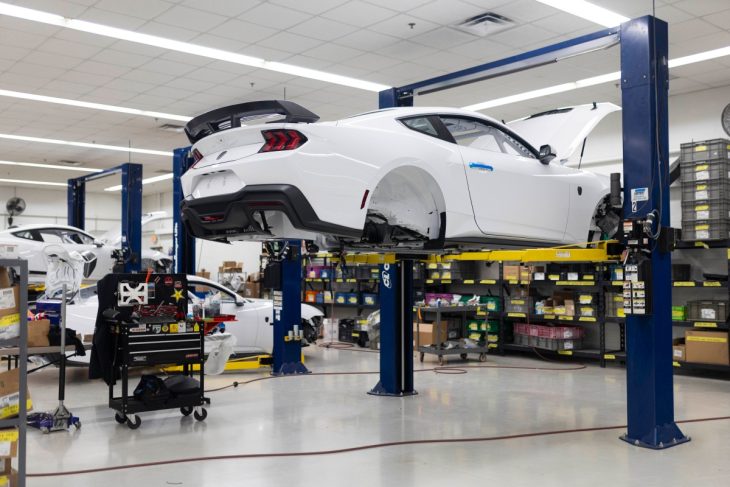
In the greater Detroit area, equidistant between Ford’s global headquarters in Dearborn and the 2.9-million-square-foot Flat Rock Assembly Plant, sits the Watson Racing engineering facility, the birthplace of the Mustang Challenge Dark Horse R race cars.
The engineering company is a highly specialised automotive parts manufacturer that now works with the blue oval to convert road-ready Ford Mustangs into race cars that hit the track for IMSA Mustang Challenge race weekends. It’s a complex task.
To find out more about the scale of the operation, DSC toured the Watson facility, led by Ford Racing’s motorsports program supervisor, Dave Born.
Watson Racing has had a special partnership with Ford Racing since 2008, when the two parties collaborated on the Ford Cobra Jet high-performance V8 engine. In 2013, Ford and Watson took their partnership off-site to their current facility.
“We were doing things in a small building off-site but not in the main plant at Flat Rock. We used to have Watson guys come down and support the union production workers who put the car together, and it was great but difficult. It made sense for us all to move it out of that facility and into a Watson facility,” said Born.
The facility itself is immaculate. From its well-landscaped exterior to a front-of-house office space that doesn’t suggest welding torches or drill guns are being fired up just a couple hundred feet away. Entering the assembly section of the shop, visitors are greeted by five done-up Challenge cars ready to hit the road, across from partially complete shells ready to house the fourth-generation naturally aspirated 5.0-litre Coyote V8 engine.
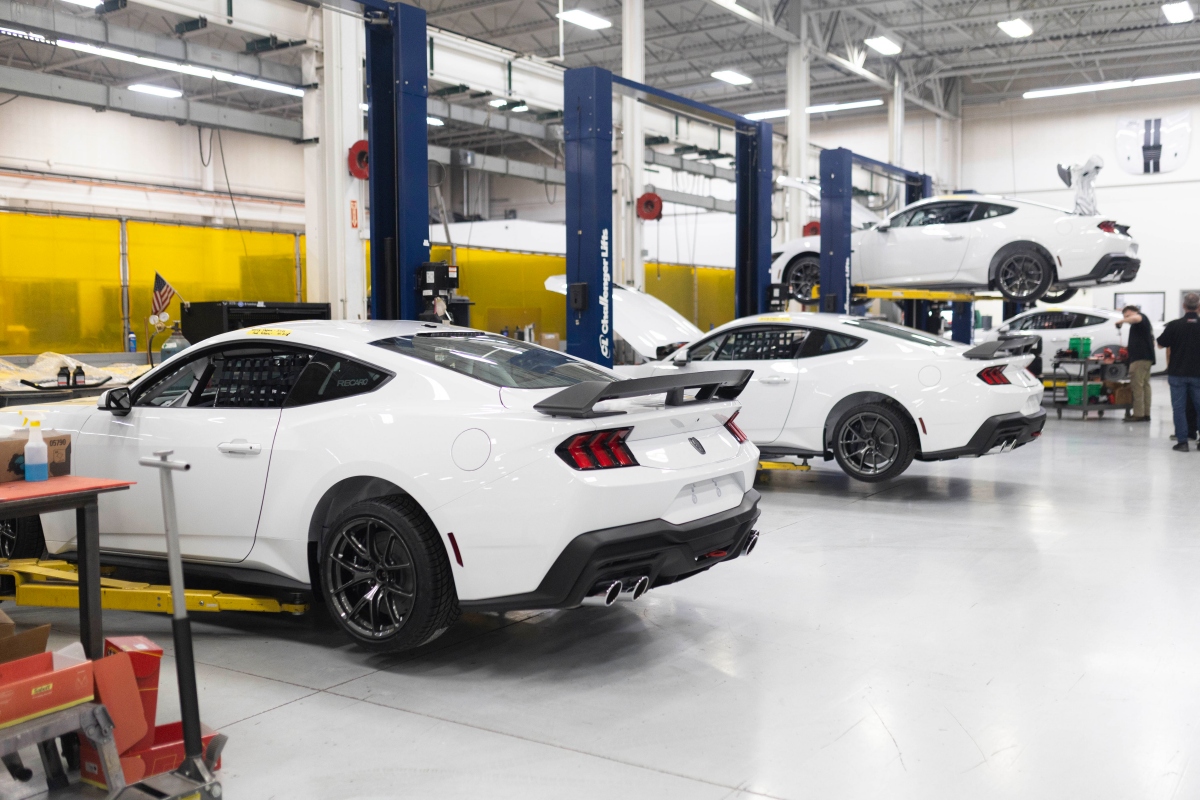
Moving into the main part of the facility, where all the modifications and manufacturing take place, it is immediately obvious that the skilled technicians and mechanics who work there take pride in what they do. Every workstation is organised. Every car component and tool is in its right place, categorised and sorted for maximum efficiency.
It takes about twenty sets of hands to turn these Dark Horse Rs from road cars into race cars at the Watson facility, compared to the massive production line at Flat Rock 15 kilometres down the road, which lends itself to the intricacies of the modification process.
In total, the Watson facility in its current iteration has produced over 100 Mustang Challenge-ready vehicles since the series’ inception, with the first hitting the track in 2024.
“I think we’re up to car #120 currently, so they have been doing it for a while; they have a pretty good process down, and they know how to get these things together,” Born added.
“We try to work on four of them at a time. We’ll have parts constraints and things like that that mean we get to a point and get stuck, so we want to take advantage of the people’s time we have so that we may move on to others.”
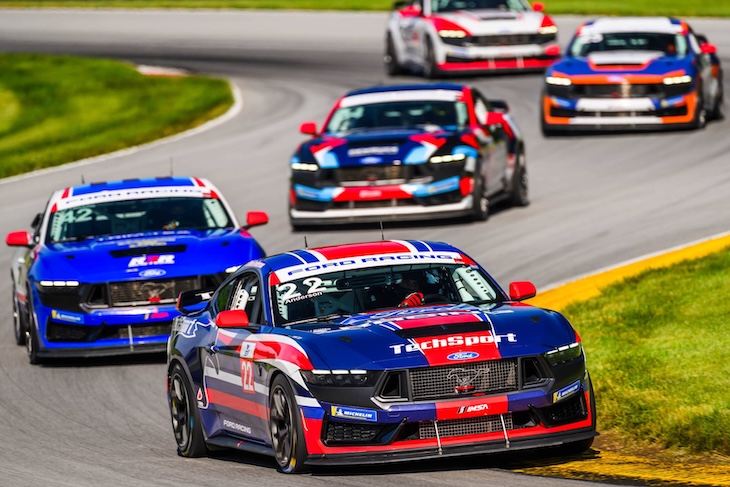
The team has worked on these cars consistently since Mustang Challenge’s first season and was only ever nearly overloaded at the very beginning. For reference, a whopping 26 Dark Horse Rs entered the first-ever Mustang Challenge series race at Mid-Ohio in 2024, and all of them came through the Watson Racing facility.
“Right now we’re in great shape, but there have been times when, you know, the series kicked off, where we struggled to get all the cars out to the customers ahead of our very first race. We got everybody who wanted one, a car, but it was definitely a full-court press the last few months when we were trying to get things launched,” Born commented.
The technicians working on these cars take pride not only in their individual contribution to the process, but also in the end result, where their collective hard work pays off as they watch these 500+ horsepower machines come alive on track.

Aside from the station where the Mustang frame is hollowed out and customised, spotters’ guides to the Mustang Challenge field were posted on a workbench and proudly displayed. Coming across a welding station, IMSA WeatherTech GT-class stickers decorated welders’ helmets.
When asked about the spotters’ guide, Born smiled, “We always bring these things back to the guys. They are very proud of their work. There are a lot of Monday conversations about what happened in the race.”
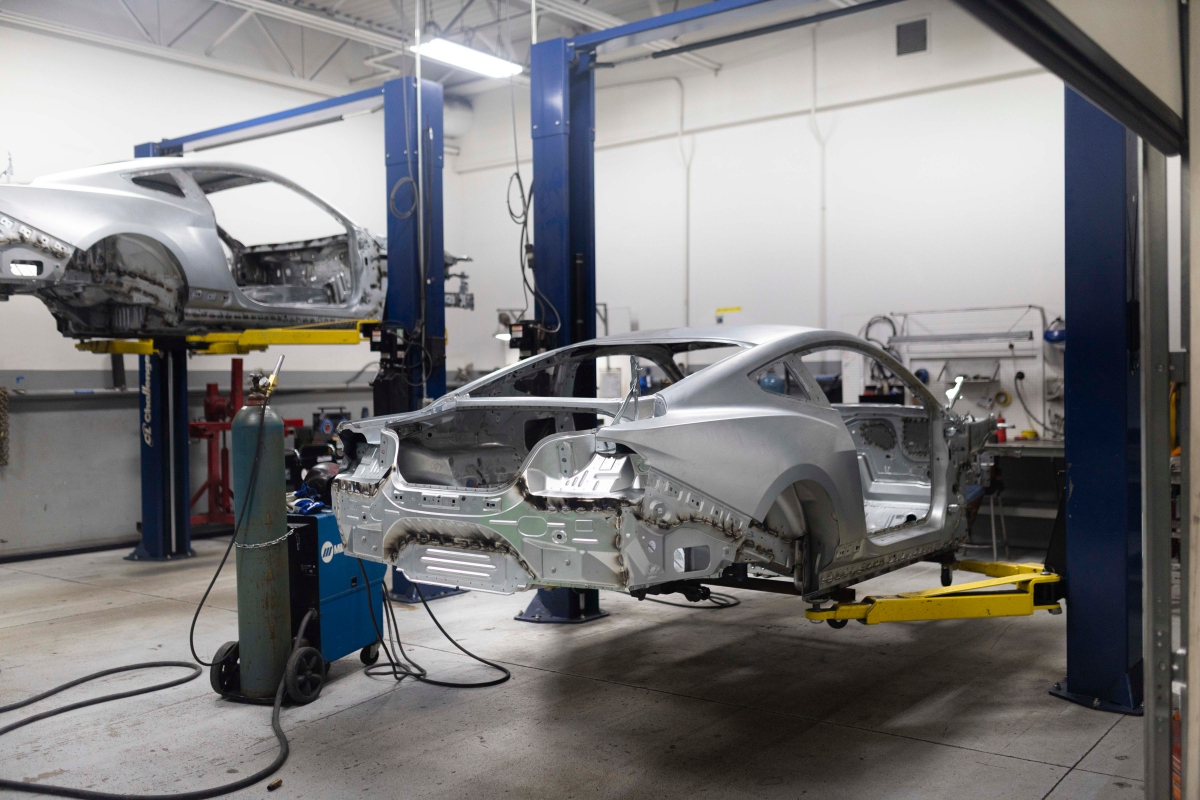
The first stage of the modification process at Watson Racing looks like a full overhaul of the frame, installing a roll cage and using precision welds to reinforce sections that take the most stress on the race track.
With the door panel removed, a series of bored-out holes are visible along the interior of the frame, reducing overall weight and allowing the Watson technicians to work around and within the car’s bones. These welders are incredibly skilled individuals, often working at awkward angles to reach the niches that require reinforcement or alteration.
Next up is stripping the remaining components where the commuter comforts from the road car would be supported. All non-essential interior details and excess components are removed to begin the modification process.
One of the biggest initial changes the Watson facility makes is installing a large rear fuel cell where the car’s boot would be. This change required collaboration with the road-car designers to simplify the process, altering the original design directly on the production line.
“This is the first time we’ve had to have something physically change for the plant just for the racetrack,” said Born. “This was the first time we’ve been able to work with them and make changes specifically to run our race cars, so it’s a big win. I was really happy to be able to get that done.”
At this point in the production of these Mustangs, several minor conveniences are created straight from the plant that aid the process, including specific dimensions that have no consequence in the road car, which Born considers “a big win” for the folks at the shop.
“There are [ground] clearances, because the race car sticks down further, and there are sensors and things like that that had to be changed and adjusted to do what they were meant to do, and not get in the way of [the racing-specific components].”
This shows the continual conversation between the main production line, the design teams, and the Watson Racing facility. The work that they do matters to the Ford team, and their feedback is valued in the form of making physical changes to original concepts on the cars, which says a lot about the significance of this relatively boutique, niche operation.

“They’re great techs, great mechanics, so they’re good at noticing the little things, right? If there are things they don’t like, they’ll feed that back to all the Ford engineers, and then the Ford engineers are the ones that are making the decisions on designing the other things. We do some development work with them too.”
Watson Racing completes a lot of fabrication in-house that benefits both the builds they complete and broader Ford operations.
“There’s a ton of fabrication work and manufacturing things for us. If there’s a new part we need to build, we have fabricators and guys here who are good at that kind of stuff, and we’ll go to them with our concept and say, ‘We want this to look like this; can you build that?’ And we’ll work collaboratively between our engineers and their fabricators and technicians to get things designed and developed.”
With the bodywork on the modified race cars staying consistent with their road car counterparts, the modified frames head into the interior and sub assembly part of the process, which takes place in a bright, spotless room where the walls are lined with Ford Racing and Mustang Challenge flags and logos, creating a backdrop for the almost-complete cars sitting adjacent to about five race cars ready for customers to take racing.
Without their liveries, these souped-up Mustangs look like wolves in sheep’s clothing in factory white.
Like the main shop, every nut and bolt of the powertrain, plumbing, and electrical is accounted for and arranged in a specific way. Parts may sit on the floor surrounding the hoisted frame, but it is done with intention. There is a fine art to ensuring there is consistency in this phase of the process.
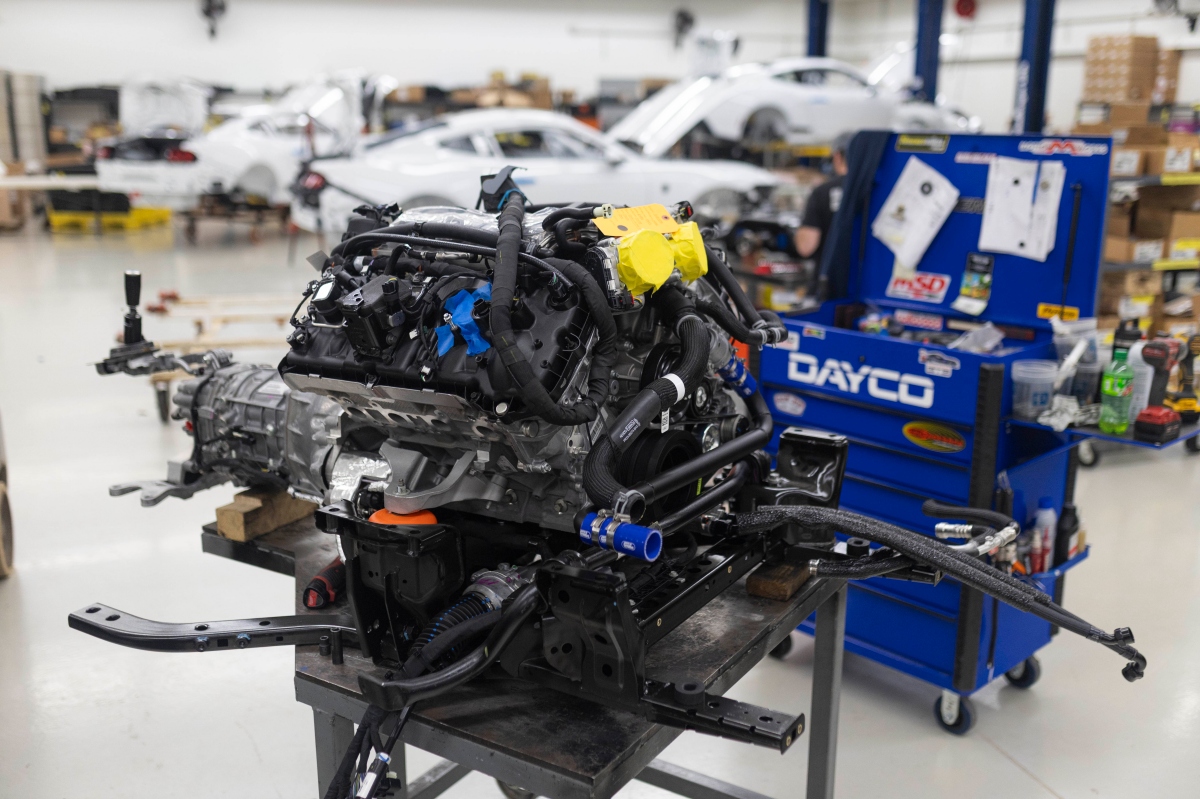
“You can see the walls are lined with parts; they’re kind of everywhere. You’re stepping over parts everywhere in here, but they’re laid out strategically. All the guys that are working on the cars know where they are, so that they can be efficient about how they do their assembly,” Born noted.
Here, the assembly part of the process begins after the Mustang is properly outfitted with frame upgrades in preparation for installation.
“It starts with wiring, and then there are other ancillary things that they start to bolt on, like suspension pieces. Then they do sub-assemblies. Here, you can see an engine with a clutch on it, the headers on it, the steering rack, and the front subframe is all sitting over there [beside the car it’s about to be mounted in],” Born said.
Sub assembly helps by letting multiple technicians tackle different stages of building the chassis at once, meaning the same car’s engine and steering rack may sit on opposite sides of the shop while being prepared simultaneously.
“Same with the rear of the car, rear subframe, rear differential, half shafts, things like that. That’s all built as a sub assembly,” Born added.
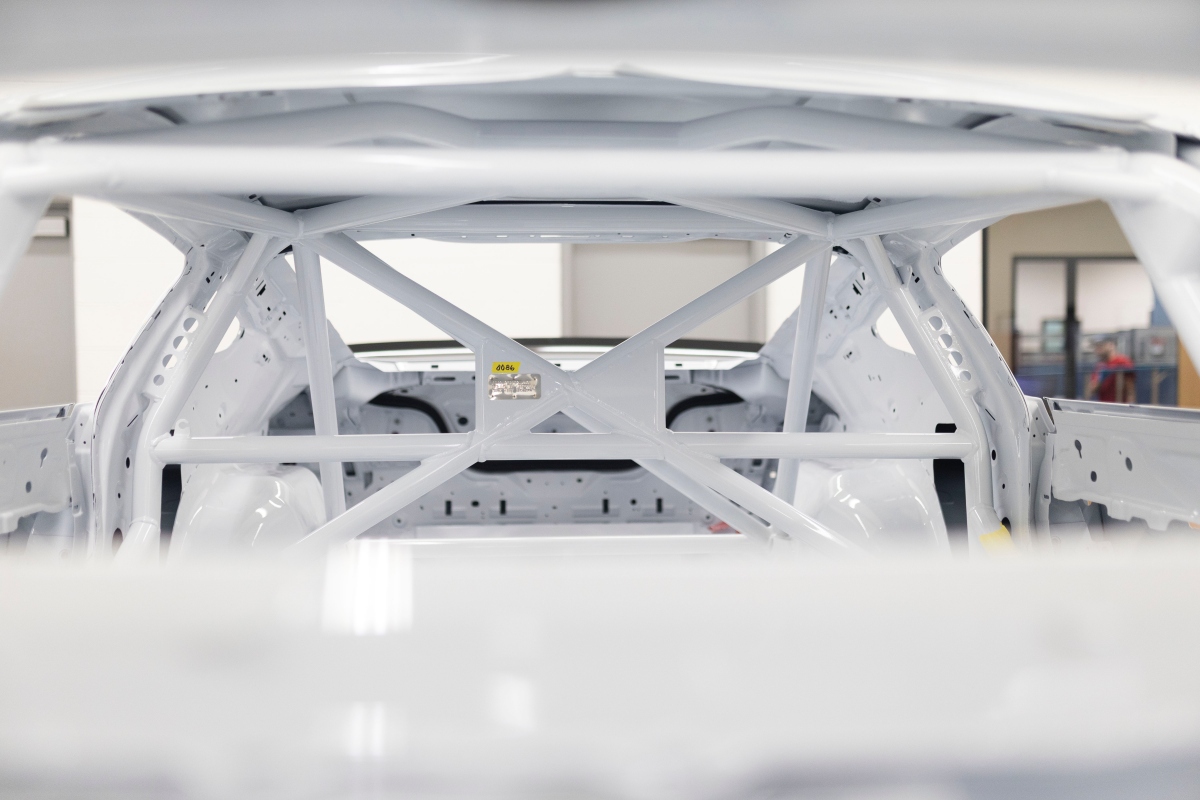
“There’s a lot of stuff that can be done that way, which is nice because you’ll have different people working on different things. As I said, there’s a lot of manufacturing that’s done here; a lot of things are sub assembled here as well by the Watson guys.”
Once the puzzle of sub assembled car parts is put together, the Dark Horse Rs go through an intense technical inspection and checking process. Born even has a hand in this part of the process, adding an extra layer of authentication.
“We do a lot of hand-checks. All of the PCM codes get checked and validated, those kinds of things. We have an extensive checklist. All the engineers have their own section of the car, and we go through and inspect everyone, and then I come around behind everybody; I don’t recheck everything, but I recheck a lot of things. We’ve got a pretty good way to make sure we know [everything is ready to go].”
From here, the Mustangs are signed off to interested customers looking to go racing in the series, either for one-off or full-season entries. The process of acquiring one of these race cars takes a couple of weeks, according to Born, with all of the sales going through Multimatic. Watson Racing is responsible for getting the cars ready to load into customers’ trailers, giving them a touch-up, and having staff roll the cars out of the shop.

Born shouted out a member of the Watson team as the one responsible for the final step of the process: “Sam, our welder down there who was putting the cages in, is also our resident driver. Any car that goes out the door, he gets to be the one to climb in it and load it into the trailer, depending on what the customer wants.”
While the track-ready Mustang Dark Horse R looks nearly identical to the road-going version on the outside, its modified interior delivers the power-to-weight ratio fundamental to the one-make series’ success, allowing competitors to reach blistering top speeds at some of North America’s premier racing venues.
With a manual transmission and a roaring V8, this Ford race car provides drivers with a powerful and challenging platform to go racing whether they are on the rise, using this series to launch a career in sports car racing, or are driven purely by their love of racing.
Between Ford Global and Watson Racing Engineering, a seamless collaboration of production, modification, and innovation has been forged, carrying a passion for motorsport throughout the process of building these Mustang Challenge race cars, which is on full display when touring the Michigan-based Watson Racing facility.
Images courtesy of Ford Racing