Dailysportscar’s Aussie reporter Sam Tickell sat down with Pascal Couasnon, Director of Michelin Motorsport. But this isn’t necessarily an article about Michelin, rather it is an article about why tyre companies go racing and what it can bring to a company as a whole.
We hear a lot about tyres. It seems like a hard game to win, you’re damned if you want open competition, you’re damned if you want a spec tyre. You get lambasted if the product fails but the research and skill that go into tyres is immense and without them, and their support to motorsport, we wouldn’t be racing.
Tyre companies are far more visible than their component supplier friends and in competition there products can differ from car to car, nonetheless series to series.
It is not a simple game to play and it invades our daily lives with the cars we drive. We rarely leave the tyre brand to our mechanic and they can seen as an expensive necessity, some consumers not stopping to think that tyres are the last line of defence between your car and disaster.
But the long held culture in the industry – that of relentless innovation and competition remains strong even if there are differences in how they achieve their end goals.
From new comers and those from emerging economies like MRF Tyres and DMack to long time frontrunners like Dunlop, Pirelli and Michelin – the drive for competition remains.
For Michelin they demand competition. It is no secret that they like to test themselves against other manufacturers but they test themselves against themselves.
“We are very glad to see competition. It’s an opportunity to explain our philosophy of single spec or open competition,” said Pascal Couasnon Director of Michelin Motorsport to Dailysportscar.
“For a long time we’ve said if there is no competition we are not interested. You might say, “Why are you now in Moto GP or Formula E where it’s a single spec formula?’”
“I think what’s very important is, and what’s not changed is, that we are in racing to meet challenges. That’s really the thing.”
“If there is no challenge we are not interested.”
But the challenges of tyre competition are not only for entries to a new series or to develop a tyre concept that has never been raced on before.
Where Michelin have found themselves alone, they have set new challenges, to better themselves and keep a corporate culture they hold dear.
“I’ll give you two examples where we were pretty much alone and we said, “Hey, by working the rules we’re going to bring to ourselves some challenges.’ WRC again, if you remember 2008 and 2012, decrease number of tires by 20%. Two years in a row.”

“We didn’t have to do that. Some people said, ‘Are you crazy?’ You’re there, you win. What do you want to make it more difficult. Why exactly … For what I’m saying is that we want a challenge and going as fast and as well I would say, and longer, was very useful for our engineers and very good for the trust for the manufacturers. That’s that.
“Le Mans is another, I guess, interesting example. At one point they could refuel and change tires at the same time. We said, ‘Hey, how can we give us extra challenge? Especially in terms of longevity?’”
“We like a tire which is very fast, very constant in term of performance, and lasts a long time. Work with the ACO/FIA, and say, “Okay, how about if we could not refuel and change the tire at the same time, and you limit the number of mechanics to change the tire?” Results? If you do that in Le Mans, if you change tires, it’s a penalty of about 25 seconds compared to refueling and going again on the track.”
“We and the ACO agreed to put that to a rule together.”
“Immediately Audi, Toyota, Peugeot, at that time came to us and said, “Okay, now you need to give us a tire for two, three, four stints.” We did it.”

But this sporting culture hasn’t come from nothing. The culture of Michelin and indeed, all tyre companies, are at odds with other industries like the tech industry where planned obslenece is a widely held practice.
In this industry, the product has to last, and has to improve with each development.
In essence, the strategy in the tyre industry is to replace the product less often. Counter intuitive for today’s consumerist society.
“One of the biggest obstacles inside the company when we invented the Radial Tyre in 1946 was people saying, are you crazy, you want to put in a market, a tier, which is going to last 30% longer. You’re going to kill the company!”
“We were number 10 at that time. We became number 1.”
And that culture on and off track is what brings car manufacturers and tyre manufactures together. Business to business relationships are important and as car manufacturers become bigger, conglomerated entities, the need to be a preferred partners is important.
Through investment in motorsport and investing in their road tyres has allowed Michelin to get a closer relationship with their key partners than they would have otherwise.
Through racing, Michelin have become key partners to Audi, Porsche, Toyota, Ferrari, Corvette, Ford in ACO competition, Volkswagen, Citroen, Hyundai, Ford, Skoda, Peugeot in rallying and joining Renault, DS Automobiles, VW and other emerging partners in Formula E brings advantages. Naturally this brings important R&D and business agreements to the road cars we drive every day.
And obviously the French are not the only ones to do that. There is always the threat from Goodyear/Dunlop, Bridgestone/Firestone, Pirelli and from emerging companies in their markets.
What is also important is the product we all use on our daily drives. This is where the differences between industries truely comes into its own.
And where business relationships and consumer relations are held in high regard.
“The philosophy is really look at what’s good for the consumer. I’m not saying Apple is doing something wrong. As a matter of fact if the consumers say hey, I want a fashion thing and it’s nice and in two years I want to have the latest whatever, why not.”
“We believe in terms of tires, safety, longevity and performance are really things … Performance, which are the most important. Which has been required for a long time and still valid.”
Which directly translates to their philosophy in motorsport. To create the competition for themselves and encourage their competitors to do the same.
They want the challenge and have welcomed Dunlop into the LMGTE competition in ACO racing, to LMP1 and LMP2 competition. They welcome the challenge from Pirelli and DMack in the WRC.
Their SuperGT efforts in Japan demands a lot of resources for just a couple of cars on track.

Sometimes, through it doesn’t go right. Your competitor steals a march on you. It happened in LMP2 where Dunlop is the tyre to have. It happened at the Bathurst 12 Hours this year where Pirelli were the tyre that won, took pole and the fastest lap.
And that latter one hurt. It is a race that both Michelin and Pirelli believe in. Last year Pirelli’s big boss, Paul Hembrey was in rural New South Wales for the race. This year it was Michelin’s front man.
“It would be kind of strange if I told you I’d open and I’m for tire competition and then be very sad or not happy at all… On one side we’re pretty happy to have this battle created.”
This may drive up development costs and pace and this is perceived as an issue. Cousanon struggled to see how a Balance of Performance situation could be applied to tyres sighting cost and safety issues.
They prefer the competition and have the upmost respect for those on track with them.
We know the F1 situation – Michelin said they would come in if it suited them. It suits Pirelli and provides challenges that work for their organisation and their philosophy of competition. It may be different but creating a tyre that drops off at a precise moment for very complicated cars without testing does take a lot of corporate intelligence.
The fact that this philosophy doesn’t meet that of Michelin is F1’s loss is certainly sportscar’s gain – and Cousanon is very firm on the subject.
“I’m convinced that single spec kills the show. It’s a license for major critique, I’m sorry to say that…if you don’t spare enough money to improve your tire or your product overall and spend the majority of your budget in marketing, to sign the big check to get the spec, and to put banners around the track, what’s the deal?”
“We are not there for pure advertisement. We’re there, really, for improving the tire of tomorrow. We believe that the best lab, because racing is really an accelerator of innovation. When you have passionate people they never stop, you know?
“The teams are very demanding with us. We love it. That’s what we want to do.”
This is just a fraction of why companies go racing and with psychology like this, there is still a lot of value in motorsport.
It goes beyond a win-sell Sunday-Monday mentality. It goes to development, marketing, business relationships, safety and of course competition.
Honda used to use motorsport to train their engineers. Dunlop are taking on the might of Michelin despite a few tough years in the corporate world. Ford built the GTE car to demonstrate their history and culture. Nissan thought outside the box – sometimes it worked, sometimes it didn’t.
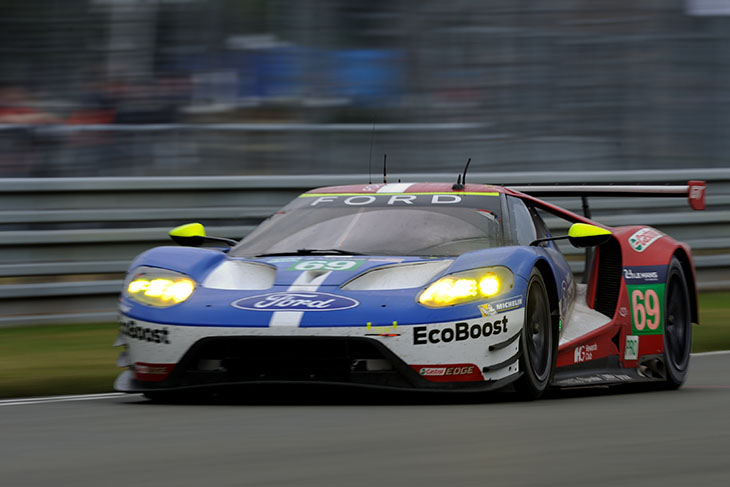
But it all goes to show how competition influences a company and how a company can be successful.
After all, Michelin was created in 1889. In 1891, they won their first long distance race. Goodyear ran in the Indy 500 in 1913. Dunlop was winning races in 1889. Pirelli have been winning car races since 1907.
The psychology of competition runs deeper than the board room.