From Disaster To Victory
Black Falcon Racing crushed all before them and took a commanding victory at the Dunlop 24 Hours of Dubai. Their #1 Mercedes, crewed by Jeroen Bleekemolen, Sean Edwards, Bernd Schneider and Khaled Al Qubaisi, completed 600 laps, two more than their nearest competitor. It was a remarkable victory, considering that their original chassis was totalled just one day before the race started.
It was the second victory in a row at this event for the team and drivers Bleekemolen, Edwards and Al Qubaisi, and with the win Bleekemolen becomes the most successful driver in the history of the event.
“I’m not sure it’s quite time to call me an equivalent to what we call Tom Kristensen,” he grinned post-race. “He’s Mr Le Mans but I’m not quite Mr Dubai yet.”
Parts of the story were ripped straight out of a Hollywood script. The intense (but well spirited) regional rivalry with Saudi Falcons, the shot at two wins in a row and the remarkable turnaround on Wednesday and Thursday. In optional testing on Wednesday, Al Qubaisi had a large off, completely ruining the chassis they had intended to start the race with.
“We had a car that was so bad it was out of the race – that was rock bottom,” explained Abu Dhabi based driver Al Qubaisi. Their saviour, in fact, was yards away – the Jones brothers’ Preci Spark spare Mercedes. By chance, the British team had tested the spare (sprint) car, meant for British GT, on the day of the accident.

“We had even considered flying in a car from the Yas Marina experience, but the Jones’ option was best,” said Al Qubaisi.
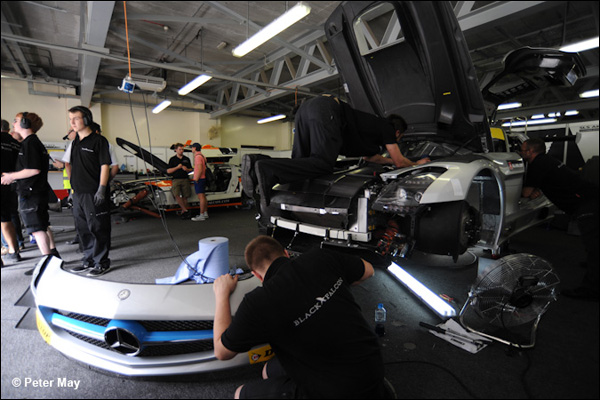
A deal was done, which involved the silver car making its way to Black Falcon to replace the wrecked white, black and orange machine. The car was then transformed from sprint specification to endurance, with only 20-30% of the original car appearing for qualifying – the rest was all Black Falcon parts.
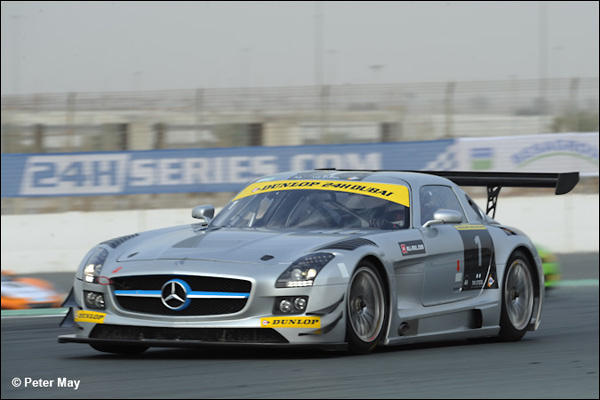
“The car we’ve taken from the Joneses is a sprint car, (our oldest, in fact the first delivered to a customer),” said Schneider on the deal. “But it’s designed for sprint racing with different fuel pumps and headlights amongst other things. It’s a great effort, the guys have already done their 24 hour race – everything is new now.”
With this machine, Bleekemolen was given the tough ask of going out to qualify it as best he could. The best he could do, it turned out, was take pole position by 0.4 seconds.
“It’s amazing, the guys have done such an incredible job,” said the Dutchman after his pole position. “They worked non-stop and it was good from the word ‘go’ – even in perfect conditions we never expected to be so quick. I had Bernd as my crash test dummy to check the car was fine for a couple of laps before I drove it, so I wasn’t too nervous!”
A huge effort from the Black Falcon crew, who saw very, very little sleep over the two nights (Wednesday and Thursday) saw the car almost completely transformed come the start on Friday. It was even late onto the grid, with the team adjusting the car ‘literally seconds’ before the start of the race.
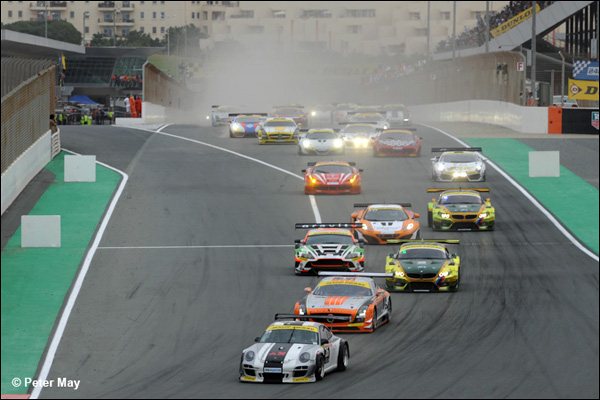
It was a race that got off to a fantastic start, for spectators if not for Abu Dhabi by Black Falcon. Cautious at first with the new car, Bleekemolen was overhauled by fellow front row man Nicki Thiim, in the #26 Attempto Racing Porsche, on the run into the first turn. By the end of the lap he was third, Claudia Hürtgen carving through in the #24 Saudi Falcons BMW as the rear of the Mercedes slid around, seemingly struggling to get warmth, and thus traction, into the rubber.
With the fascinating battle between ‘pro’ cars (those taking a BoP penalty for being allowed to lap under 2:05) and ‘am’ cars (those who were limited to 2:05, with a maximum of ten ‘joker’ faster laptimes allowed, per car, over the course of the event) dominating much discussion before the race, it became immediately apparent just how hard it would be to pick a winner from the field. Rob Barff, in the #88 Dragon Racing ‘am’ Ferrari, used two of his ‘jokers’ in the first four laps – a deliberate ploy to avoid bunching traffic and causing accidents.

But he was by no means the only one pushing. Hürtgen and Thiim were both pushing mighty hard, exchanging fast laps. With the German lady seemingly ready to pounce, the battle was decided when Dane Thiim began to struggle badly for grip. The rear of his Attempto Racing Porsche was suddenly wagging and Hürtgen had no difficulty finding a way through. A few minutes later, the #26 car disappeared from the screens altogether – Thiim had pulled over on fire.
“I had a fuel leak,” explained the Dane on the issue. “I could feel it on my tyres so I dropped back a little and the BMW came past. Then the car caught fire.”
Though it was returned to the garage on a flatbed, the car was withdrawn, too badly damaged to continue.
Despite the loss of the leader, the BMW was not going to have it easy in the lead by any means. Bleekemolen had got his tyres up to temperature and, pushing hard, found a way through. Also following his charge were Darren Turner in third and AF Corse’s Lorenzo Case in fourth. The Briton, making his first start at this race with fellow debutants Craft Racing AMR, had started relatively cautiously but was right in the thick of the lead battle. In one move, he looked to have taken both leaders, but had to back right off for yellow flags.
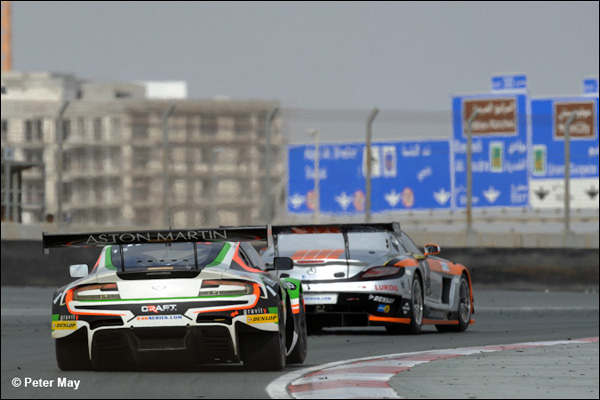
“I hadn’t seen the flags when I began the move,” explained Turner. “I got a shot at the BMW so I took it, but then the Mercedes backed off and I was thinking ‘Something’s up here’ so I had a good look around, saw the flags and backed out.
“I was unsure what to expect from this race, because on the grid I was surrounded by drivers who’ve done this race before, but I enjoyed it,” he continued. “It went pretty well. We’d never done a long stint on the tyres, so it was a bit of an adventure really. I think the Mercedes still has the legs on us, but it’s moments before you’re back in traffic again so as long as you make it through the traffic as smoothly as they do then you don’t lose any time.”
The fascinating fuel battle, which saw ‘am’ cars allowed five extra litres of fuel each fill at the pumps, was a key pre-race theme, and was one of the key factors at the end of the hour. A Code 60, where drivers are required to circulate at 60 km/h without passing rather than following a safety car, caused mayhem just after the hour mark. With only ten pumps available (there is no refuelling in the pitlane), coming in at the wrong time could prove disastrous – and did, for the top three cars.

Black Falcon, Saudi Falcons and Craft were all badly delayed, having come in first, second and third. They would rejoin well down, and in fact laps down.
“It’s a shame that it works like that,” grumbled Turner, echoing the thoughts of many drivers and observers alike. “In sportscar racing, it’s pretty common for cars in class to be screwed – I should know – but it’s not on when it’s the leaders of the race. It really spoiled the battle.”

It changed the face of the race completely. Thanks to a stroke of luck Gulf Racing’s Lamborghini, with Fabien Giroix aboard, found itself with around half a lap’s lead to the Saudi Falcons’ #12, which was second having been seventh before the stops. However, under Code 60 (again), Giroix fell foul of one of one of the great contentious points of the Code 60 regulations. With different cars’ speedometers calibrated differently, Giroix began to get extremely frustrated that the queue ahead of him was going too slowly.
Whether this was the case or not, Giroix’s following actions were still curious, as well as illegal – he passed a number of cars, gesticulating wildly from his door window as he did so. Remarkably, the organisers did not see fit to punish the Middle East-based French driver, though their book would be thrown at a number of others in short order.
Notably among them was Bleekemolen, who was penalised for speeding under Code 60. However, the period had begun as he crossed the line, with no flag on the straight. He received a flag at the first turn, duly slowed down, but was adjudged to have breached the regulations. Sean Edwards served the penalty, and was not best pleased.
“We’re not happy at all,” he raged on Radio Le Mans. “We’ve come all the way from Europe, and we don’t want to have our race ruined by a stupid mistake like this. I know other cars contending for the win have had it too – it’s ridiculous.”

One of those caught under the same regulation was Dirk Adorf in the #12 BMW who, with no laptime information on his dash, was a touch too fast under another nullified period and suffered a 60 second stop go at the end of his stint. Having driven strongly, the penalty undid a lot of good work and once more reversed the team’s cars with #12 ending the third hour tenth and #24 third.
The star of the second and third hours (and more to come) was the #20 Stadler Motorsport Porsche. Marco Seefried, in particular, shone brightly. In the 2:05 ‘am’ class, the car strode to the top of the sheets and hovered there or thereabouts throughout thanks to shrewd decision making. The tactics of many, to grab fuel under any Code 60, started to heavily backfire as cars were forced to queue for fuel, costing minutes at a time – playing into the hands of the cars who get more fuel each time, as well as those with good timing.
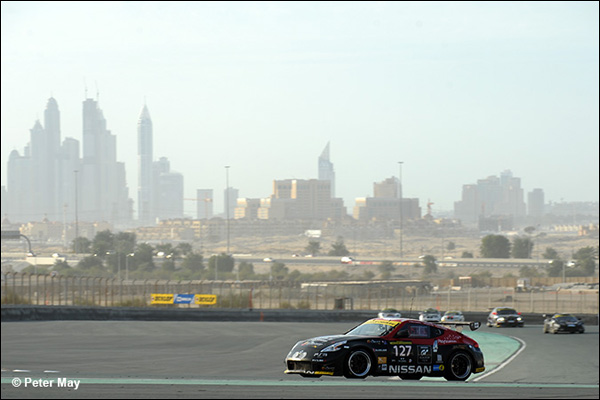
Class battles over the first few hours fluctuated heavily. The well-populated SP3 class, featuring Nissan’s GT Academy 370Zs, was a good example. Having qualified first and second and held station throughout the first hour, the two Japanese run cars were also caught under Code 60 fuel madness and ended hour two fifth and tenth in class. The big winners were Optimum and Cor Euser Racing, with Lee Mowle’s team and their Ginetta taking the lead and then disputing it with the Dutch squad’s Lotus Evora for some hours to come. At the end of the fourth hour, the #127 Nissan with Ordoñez and the more Russian crew had managed to make it back into second.
Back at the front, and Stadler had moved into the race lead. In fact, they would not lose it until the seventh hour; a remarkable feat for what was, before the race, a relatively unknown team and driving squad. Despite being restricted to 2:05 laps and having the varied talents of the Saudi Falcons’ #24 right behind them (Müllers Dirk and Jörg both applying relentless pressure and ably assisted by Abdulaziz Alfaisal), they continued to use as little fuel as possible and run as smoothly as they possibly could. It was working.
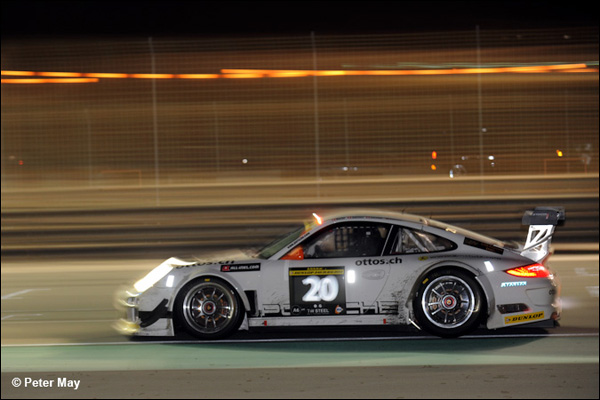
They returned to the top at the end of the eighth hour, with a lap’s advantage from the #24, and the belief that the ‘am’ option could not win the race was questioned quite severely. That belief was strengthened by the strong run of Dragon Racing. Barff and teammates Matt Griffin, Leon Price and Jordan Grogor, were beginning to show strongly with consistent stints. In the night, it was also proving extremely difficult for anyone to go faster than the bogey time, thanks to heavy traffic and Code 60 running.
“It’s pretty hard for anyone to go any faster than 2:05,” explained Rob Barff. “Our average is about 2:08, and it’s working really well. The car is amazing on fuel and it’s paying off for us, too – we came off badly in the very first Code 60, queuing for fuel, but with the second one we got very lucky and we’ve been good ever since.”
RAM Racing’s early promise, having run consistently in and around the top ten, would start to shake with a curious incident between Johnny Mowlem and Dominik Baumann in the #12 BMW. The exact details of the coming together were sketchy at best – as the accounts of each driver differed considerably. Mowlem, who believed the Code 60 period had ended, put his foot down and went to pass Baumann. The Austrian, though, was of a rather different opinion and, having seen no green flag, was vigorously weaving to warm his tyres. The ensuing contact put the #12 out of contention for a win, needing extensive repairs.
However, the damage to the Z4 was worse than just broken suspension. Though Dominik Schwager returned to the track, it did not take him long to return and the car was retired with holes in the exhaust headers.
“It would take more than five hours to fix, we’d have to replace the whole engine and exhausts,” explained Faisal Binladen, who shared the car. “Realistically, we wouldn’t gain anything from that work. All our hopes are with #24 now.”
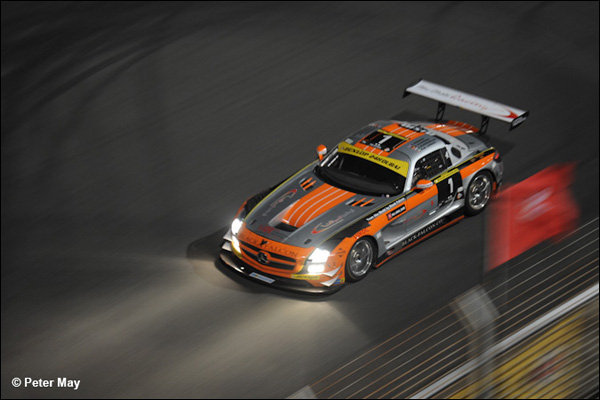
The time had come for experience, with Bernd Schneider proving the man to show it. The veteran Mercedes pilot, who had not won a 24 hour race (he believed) since 1988, was clearly keen to do so in 2013, and was on a charge. He put in a mesmerising series of 2:03 laps in a breathless period that saw the Black Falcon #1 climb back into contention once more.
He was chasing Hürtgen who, not for the first time, was standing head and shoulders above her competition. Though Dirk Müller had taken the lead from Stadler’s Rolf Ineichen, the Swiss driver had fought back and it was Hürtgen’s job to restore #24 to the head of the field. Having done so, she became the first person to extend a lead to any great distance in the race so far.
The two German chargers had relegated Stadler to a (still impressive) third place, but, as the race turned its mid-point, they had dropped away. Mechanical issues dropped them a number of laps and would herald a troubled run from there.
At the mid-point it was, in fact, Ferrari who led, but the Italian marque saw its challenge weakened at around the same time. AF Corse’s Cioci, Salo, Case and Carvalho headed the field but RAM were out.
The Italian team had put in a near faultless run for a couple of hours, with Salo and Cioci in particular putting in a series of mega laps to jump up the order and, using a largely caution free period, were able to do so at a much more consistent rate. The ‘pro’ class was beginning to have the upper hand.
RAM, though, were less fortunate. Having fallen back a little due to repairs after the incident with the Falcons, they suffered a big crash with Guy Smith at the wheel. Coming out of the final bend Smith was surprised to find a number of slow cars in his way, reducing speed to comply with a Code 60, triggered by a burning BMW in a lower class. As he swerved and braked to avoid a crash, he was collected in dramatic circumstances by the #144 GC Automotive silhouette. Remarkably, neither driver was injured despite the GC being nearly completely destroyed and the Ferrari suffering a badly damaged rear suspension.
Incredibly, the GC silhouette would later return to the race but, despite indications in the immediate aftermath that RAM would use the remainder of the race as an extended test, the 458 was too badly wounded to continue.
Another 458 in trouble was Dragon’s. Having been without power steering for some hours, the car was parked during the Code 60 for the RAM accident by Matt Griffin. The team had seen smoke from the car and asked the Irishman to stop and receive a tow back to the pits to analyse the issue. The car was withdrawn a short time later, a sad end for what had been a valiant ‘am’ effort.
Hürtgen, again, was soon at the centre of the action to close down Lorenzo Case’s Ferrari. The Italian was showing speed but no shortage of wild spirit, and took a number of big risks in his battle with the BMW. It cost him, as he bumped the Di Lorenzi Mercedes and lost the lead – though he would shortly retake it.
By now, SP3 was becoming stagnant at the very sharp end – only Cor Euser’s Lotus continued to be trouble free, after accidents for both Nissans and driveshaft issues for Optimum. First Nissan to strike trouble was new boy Wolfgang Reip’s #127. The tall Belgian was unfortunate to find himself collecting an errant wheel (the second that the KG BMW 1 series had lost) and causing heavy frontal damage. There was absolutely nothing he could have done to avoid the incident, but the car was badly delayed, with chances of a win reduced to almost nothing.
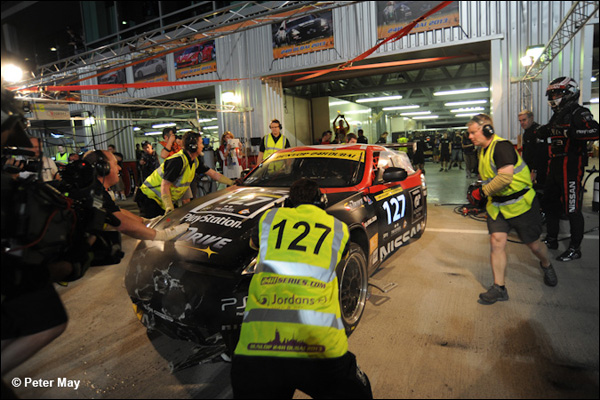
The other Nissan was also crashed, but this time all on its own. Pushing hard to regain lost time thanks to fuel queues, Sabine Schmitz made a small error and her (now shorter) 370Z was brought back to the garage for repairs. The car was completely out of contention for the class win.
For last season’s untroubled victors Optimum, having been strong early on, the driveshaft problems that had blighted their Britcar 24 run struck again and left them struggling to regain time. Barwell, meanwhile, had quietly brought their Aston Martin into third, but six laps down. Bonk’s BMW M3 was second.
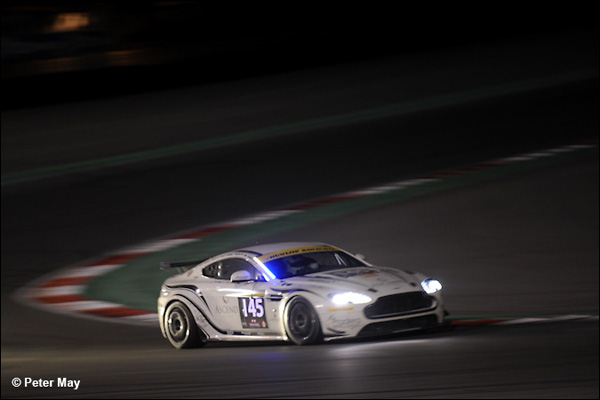
At the halfway point, Fach Auto Tech’s #8 Porsche led Am, Crucible Sport the dedicated 997 class, Equipe Verschuur’s Mégane Trophy the SP2 class and JR Motorsport’s BMW led A5. Kuepper Racing were top in A4, while the Racing Divas (running remarkably strongly) were clear at the head of A3T by 20 laps. Besaplast’s Mini held first in A2 and Red Camel / Jordans.nl in D1.
Having been advancing on the leaders for many hours, the Black Falcon Mercedes was beginning to loom large. Schneider’s masterclass in endurance driving, combined with similarly strong performances from Edwards and Bleekemolen, saw them back on the lead lap, less than a minute from the lead as the thirteenth hour turned over, with their team mates just behind. The less fancied #2 car had not dropped away much having been overtaken, with Knapp, Simonsen, Afanasiev, Jans and Al Qubaisi (who had driven #2 but was yet to drive #1) far from out of the reckoning.
By the fifteenth hour, the #1 car had snuck ahead under darkness – and it was a lead it did not lose. Behind, AF Corse were holding station but were soon two laps down, the relentless pace of the Black Falcon crew leaving little room for doubting the result.
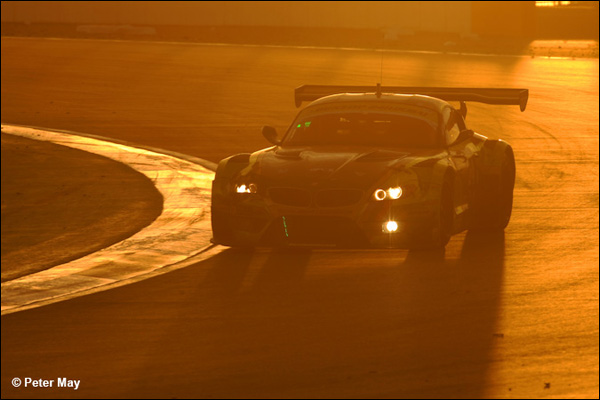
Their greatest challenge looked most likely to come from the Saudi Falcons #24. Having lost one car already, the Schubert run team’s hopes were all on their (arguably stronger) remaining car. However, despite a lack of Code 60s allowing for faster laps, the car needed more brake changes than the Mercedes. Having changed (against the wishes of Jörg Müller) on nine hours, they once again changed on two thirds’ distance and lost the momentum of the chase, despite Hürtgen again going under two minutes. She was still the only person to do so.

The challenge of #2 faded badly, as the unfortunate Al Qubaisi was forced to limp back to the pits with a puncture, which heavily damaged the car. The car lost twenty laps for repairs and any chance of a podium finish was gone.
If it was bad for Black Falcon, it was worse for birds of prey of a Saudi disposition. With just over four hours remaining, the #24 stopped moving on the timing screens. The car was stationary on track, and there was no rush to action from the Schubert team – the car was done.
“I’ve done a lot of 24 hour races,” mused the unfortunate Müller. “Honestly, I tell you, it’s a lot worse when it happens fifteen minutes from the end! What happened with the car? I’m just a driver, I can’t tell you. Ok, so I know – but I’m not sure I’m allowed to tell you!”
Team mate Faisal Binladen suggested that the engine had failed, whereas Müller said that, with an oil light on the dash, he was instructed to switch the unit off. A short time later, the official version was released: a faulty oil pump caused an engine failure, and there would be no more challenge from the green car.
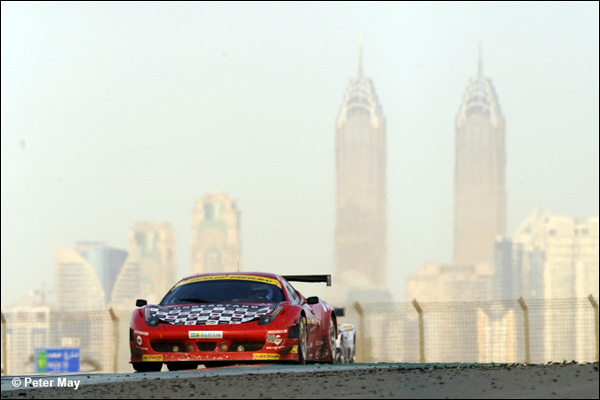
With that, the game was pretty much up. AF Corse’s challenge dissipated when Cioci was forced to pit to repair a broken disc, and from there the Italian admitted his team were settling for a podium. A race that had looked promising at halfway was now all but decided.
In fact, the same was true in just about every class. In SP3, the #127 Nissan had managed to pull back into second place but there could be no further progress with the Cor Euser Lotus having such a large advantage thanks to a phenomenally clean run. Despite being clattered by a Lamborghini and losing the lead of the class, the Racing Divas had control of A3T, while SVDP had put their BMW top of D1 after overcoming the challenge of the Red Camel Seat. Equipe Verschuur led SP2, as they had for just about the entire duration.
The only battle left was for third place, between ‘am’ and ‘pro’. The ‘am’ car, lying in third place with two hours to go, was Fach Auto Tech’s #8. Martin Ragginger had starred in the car but would prove no match for Stefan Mücke’s Aston Martin, especially given that no ‘joker’ laps were allowed for ‘am’ cars inside the final two hours. In his chase, Mücke set the fastest lap and became the second person under two minutes in the process. FAT would not be challenged for their ‘am’ victory before the finish.
With a huge advantage, it was left to Al Qubaisi to step into the #1 car to take the finish and round off a rollercoaster of emotions for the Abu Dhabi driver. There was still time for the car to make an unscheduled stop in the final hour, with fluid poured into the passenger door – but the car continued. The traditional winner’s camel ride was waiting and Al Qubaisi did not disappoint, crossing the line two laps clear.
The emotion was clear on his face as he was in tears as he held the Abu Dhabi flag aloft down the pitlane, surrounded by well-wishers and no shortage of partisan local support.
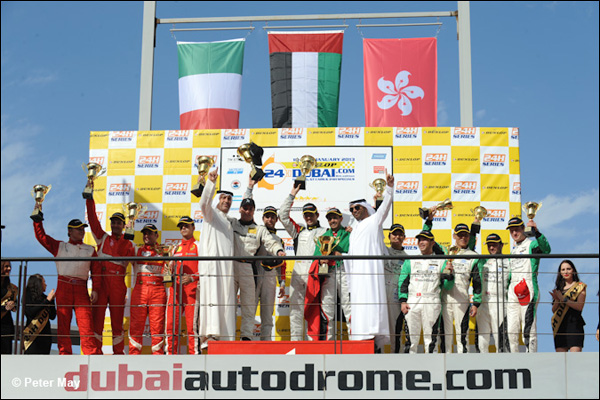
“This is one of the toughest races I have been through, starting on Wednesday when we had an incident with the car, right through to the very last lap there was pressure and tension throughout,” smiled the now two time winner. It took him more than half an hour before he was able to overcome the emotion and talk to the media. “I needed time to rest and be alone as everything sunk in. Still I cannot explain my feelings, which are the best I have ever had. I must thank everyone in the team, and I dedicate this victory to Abu Dhabi because without them we would not be here.”
Team mate Edwards was also a very happy man. “The car was perfect. We were the fastest there and could go faster there if we needed to. All credit to the team for giving us a perfect car. I can’t believe after what happened on that first day that we would be finishing that race, let alone winning it.
“Being three laps behind in the beginning, we got really hampered by the first two Code 60s,” he added. “Then eventually it came in our favour and we ran faultlessly. The car didn’t miss a single beat – that’s just a testament to Mercedes.”
“First of all, we thought it was over,” smiled Bleekemolen, whose remarkable pole position put the team back on track. “When the crash happened, the car looked so bad, we thought we were out of it. It’s unbelievable how they put it together, making the deal with the other team to get the chassis and then building it up, getting it ready for qualifying and then preparing it for the race. We just made it out on time on the grid. The car was perfect. The race gets better every year, so I hope we can come back again next year. It’s such a special win.”
Second place was no small reward for AF Corse. The Italian team had an arguably slower car with the 458 GT3 and yet, despite that, held the challenge up for a number of hours thanks to solid work from all the drivers but Cioci and Salo in particular.
“It’s been good,” said ex-F1 driving Finn Salo. “The car worked well and none of us made any mistakes. It was a tough race, tough 24 hours because of the traffic and all the slow cars. I’m happy that the Ferrari worked well. It’s not the win, but it’s a good result nonetheless and, really, first place was too fast today.”
“There were no problems,” reckoned Lorenzo Case.
“Except the DJ playing music through the night…” finished Salo.
“[Laughs] For sure our car was not the fastest on the track but we have a very competitive team,” Case continued. “We pushed very hard during the night and then lost time in the morning with brake problems but we are very happy with this second place.”
And in their first ever 24 hour race, Craft Racing Eurasia came home third – a strong result for the Hong Kong team and their Aston Martin V12 Vantage GT3. Frank Yu, Tomonobu Fujii, Darryl O’Young and AMR works drivers Darren Turner and Stefan Mücke drove strongly for a top three.
“I’m not sure if there was a plan at the beginning of the week,” shrugged Turner when asked if they’d planned to win. “The first time this team’s done a 24 hour, we’ve all come together this week, some have got experience of the circuit and some haven’t, so there couldn’t have been too much of a plan. But if someone had said at the beginning of the week, ‘you’re going to be on the podium’, that would’ve been a little better than we expected. It’s really nice for the team, it’s their first event, it’s been a great effort. It’s the first time the car’s run at this event, and a lot of these teams had more experience than us here, and the car never missed a beat.”
“This my third time in Dubai,” added Frank Yu. “Yes, it’s a really great result and one we didn’t expect. It’s the first time we ran the car here, and actually the driving team was put together right here – I’d worked with Darryl and Fujii before but not Stefan or Darren. We’re really pleased to have the works support, and Aston Martin Racing.”
“Frank’s done a great job putting this team together, the first time in Dubai for this team, and the first time a Hong Kong team has been on the podium,” said Darryl O’Young. “It’s a very good result for all of us. We’re looking for more results this year in the Asian Le Mans Series.”
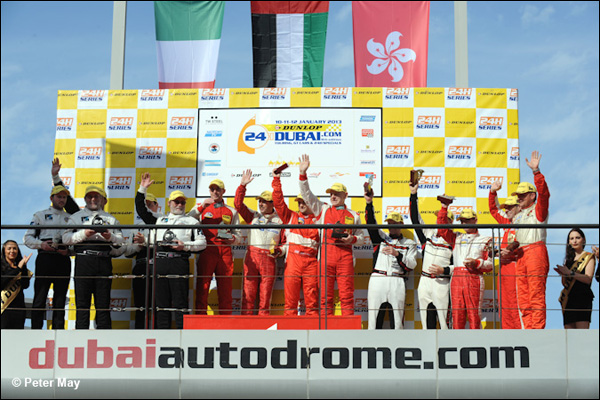
FAT’s #8 was fourth, and top amateur. The Porsche, crewed by Germans Otto Klohs and Jens Richter, Austrian Martin Ragginger and Swiss Carlo Lusser, was in command of the ‘am’ class as soon as the #20 Stadler car had faded and comfortably took the win. Quietly appearing for second in class was the family Jones, the Preci Spark Mercedes finishing fifth overall.
“This is the sixth 24 hour race we’ve done, and we’ve finished three, so that’s not too bad,” smiled one of the Jones twins – though this correspondent is ready to admit it is nigh on impossible to tell which. “It’s my first Dubai 24 Hours, and it was good. It’s different to Spa, obviously, but I think we’ve enjoyed it more than we expected to. It’s been really good.”
Will we be seeing the younger Jones additions again? “We’d like to do more racing, but we’ve got some hard work to do first! It’s all down to the directors…”
JR Motorsport took A5 with their BMW M3 and Pieter van Soelen, Harry Hilders, Koen Bogaerts and Bas Schouten, while Kuepper Racing took A4. Bernd Kuepper, Michael Kroll, Martin Kroll, Chantal Kroll and Roland Eggimann drove the team’s BMW M3.
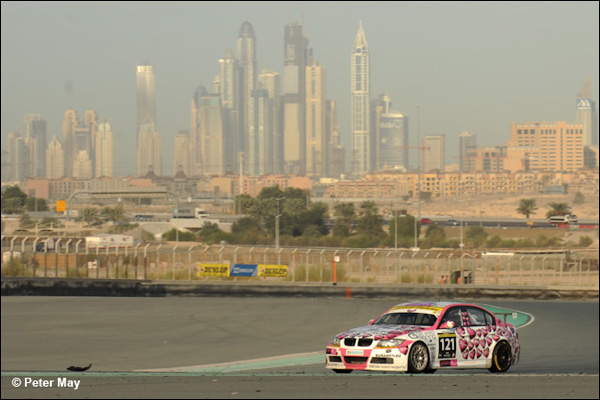
A3T went the way of the Racing Divas; Lisette Braams, Sheila Verschuur, Gaby Uljee, Paulien Zwart and Sandra van der Sloot driving near faultlessly to dominate a class in which the opposition was extremely limited. Local team Lap 57 took A2 with their Honda Integra, crewed by Mohammed AlOwais, Umair Khan, Omran AlOwais, Rupesh Chanake and Saeed Al Mehairi.

D1 fell to SVDP, who shook off the Red Camel challenge to win. Jonathan Mullan, Spencer van der Pal, Wubbe Herlaar, Jason O’Keefe and Kris Budnik drove their BMW 120D. The dedicated 997 class was won by Crucible Sport, their 997 Cup driven by Francois Glenmor, Sébastien Cruciblé, ‘Mr John of B’ and well known star Soheil Ayari.
Equipe Verschuur were dominant in SP2, their Renault Mégane rarely headed thanks to the sterling efforts of drivers Luc Braams, Duncan Huisman, Oliver Freymuth and Max Braams. SP3 was a runaway win for Cor Euser Racing and their Lotus Evora. Vic Rice, Shane Lewis, Henk Thijssen and Trevor Knight did the steering.

“From qualifying on, we kinda knew that we just had to take care of the car,” said Lewis. “But it wasn’t easy. It looked dominant but it was not. We had some good breaks in the pits, some good pit stops and I had phenomenal co-drivers that took care of the car and that’s what it was about here.”
Remarkably, the #127 Nissan was in second place, Lucas Ordoñez joining recent GT Academy graduates Wolfgang Reip, Steve Doherty and Mark Schulzhitskiy as well as Roman Rusinov on the podium.

“It feels fantastic – again we are on the podium here,” beamed a clearly excited Ordoñez. “Last year we finished third in our class with a full GT Academy line up, and now we are here back again on the podium. It’s so exciting to see new boys coming from the GT Academy and finishing on the podium. It could be better, we had that unfortunate incident, that tyre rolling in the middle of the track and Wolfie couldn’t avoid it. When the car came in in that state, I thought that from that position winning the race would be nearly impossible, but the guys did an amazing job to put the car back on track as soon as they could. It’s amazing to be on the podium because we were in ninth when we had this problem and we had to fight during the night and the rest of the day to be there.”
So what of the defeated? For Abdulaziz Alfaisal, whose Saudi Falcons squad had looked so strong but wilted for the second time in succession, it was not easy.
“When [the car retired], I went upstairs to lay down and I just didn’t want to talk to anybody – it’s just sad, after all this hard work. We had a really good car and a really good pace, and then we end up with something we can do nothing about. I guess that’s motorsport, you know? What would you change? You can’t change anything. You can’t predict something like this.
On a positive side, we’ve learned that we can push hard, and that the driver and team combination worked really well. Maybe I will have better luck at Le Mans, as long as I sort a deal…!”
The Dunlop 24 Hours of Dubai is a great way to start the year and, even though the competition faded, the race was a fantastic spectacle for a number of hours. Besides, it’s a great winter break for race drivers, teams and fans bored of sitting and waiting for the season to start. What a way to start 2013!
Jake Yorath