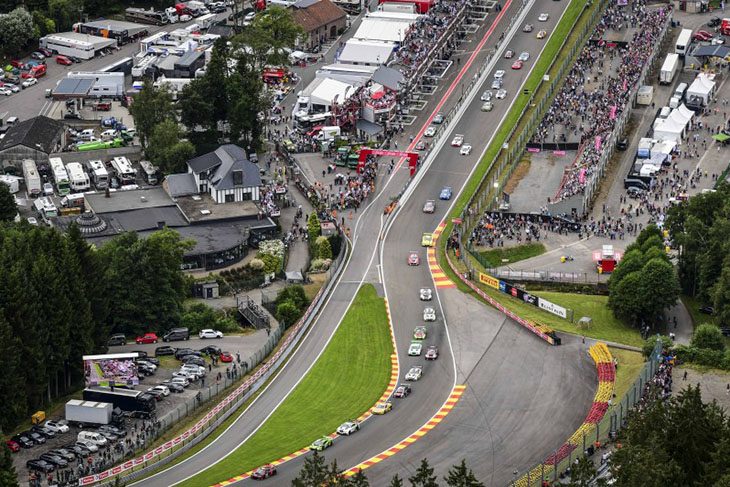
The 2016 Spa 24 Hours was my 15th, I have missed just one since the dawn of the GT racing era in 2001.
It has been a race that has seldom failed to excite with close, wheel-to-wheel action on track, heroics in the pitlane and garages, and, at times, genius on the pit wall all playing a part.
This year though was different, though the measures taken after the 2014 race have helped to improve the inherent safety of the race (2014’s event goes down in my personal archive as a pretty dreadful experience with repeated incidents and accidents that we were fortunate did not see worse injuries than emerged), recent changes have seen some extremely important aspects of the race disappear, and the race was hurt by that.
The rulemakers’ response to clever interpretation by WRT earlier this season of pit-stop times has been to enforce a pretty inflexible ‘template’ of allowed times, including the five-minute ‘technical’ stop effectively for a brake change, partially safety-related, but mainly to try to prevent the teams (and manufacturers) from escalating the cost of GT3 racing with ever-more exotic solutions.
Add in the iron-clad 65-minute maximum single stint per driver and what we effectively had doled out for hour after hour was a repeated series of Sprint races, with little or nothing that the pit crew could contribute positively.
One team member from a prominent (German) team said to me yesterday: “The way this now works means that we are not challenged by the process, in fact we are holding the car for several seconds simply to comply with the rules. The other side though is that we are heavily punished for any mistake. That means we feel we can play little part in making a difference for a win, but are immediately blamed if there is a problem with a penalty that often far outweighs the issue.”
The race saw more than 50 changes for the lead, countless more in the significant positions behind, but very few actually happened on track. A rhythm to the race was a long, long time in coming, particularly after several teams moved out of sequence responding to some of the early Full Course Yellow periods, effectively putting the leading group into three, then two, duelling sub-groups, exchanging positions in the pits for hour after hour.
The final four hours saw rain make an appearance and a different set of factors intervening, to that point though the race had been anything other than easy to watch and to understand, even from a position as a pretty well informed and resourced observer.
A substantial rethink is needed.
AMG Dodges A Bullet
Another aspect that needs a rethink is the way in which the punishment for Mercedes-AMG was doled out.
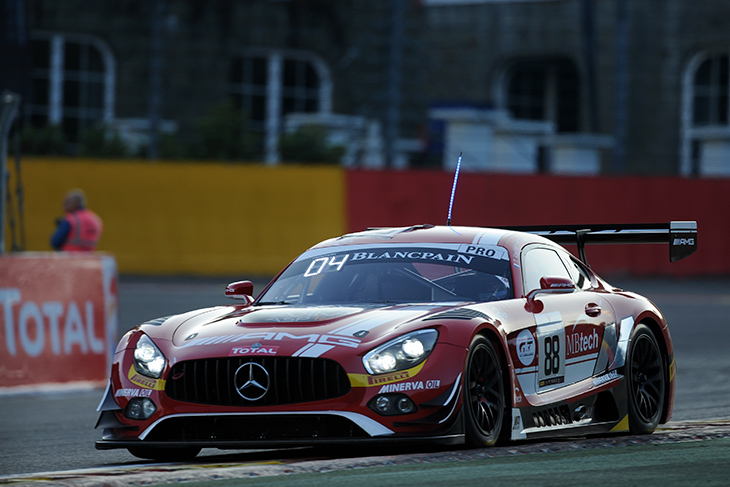
All six AMG GT3s that took part in Friday evening’s Superpole had their times removed and a five minute stop-and-hold imposed after it was discovered that the cars’ ignition timing was outside the permitted parameters of their homologation.
Indeed DSC was told by a senior source that there were several other aspects of the car’s settings that were found to be outside the permitted values.
Mercedes-AMG’s response said the following:
“The background of the decision is an interpretation of the FIA homologation of the aforementioned cars that was deemed to be incorrect from the stewards’ perspective.
“Mercedes-AMG thoroughly analysed the complex accusations. There are varying opinions about the interpretation of the homologation. After thorough investigation of the complaints, we decided to submit a protest. Unfortunately, however, this was not accepted anymore as the deadline had passed.”
Effectively that says that Mercedes-AMG believe that in part or in whole, their actions, whether a reprogramming of the car’s ECUs or a replacement of the component, were within the rules.
That, of course, leaves an important question hanging, have Mercedes-AMG, and indeed other GT3 manufacturers, done this before?
The other question from the incident surround the penalties doled out. Certainly it seems that AMG were fortunate not to be excluded for the infraction, but the intention of the five-minute stop-and-hold was to heavily impact the ability of the cars to contest potential winning positions.
For the first four cars to pit that simply didn’t happen.
The #00, #84, #86 and #88 pitted at the end of the first racing lap, but with #333 Ferrari in the gravel later on the same lap, the remainder of the field came immediately under Full Course Yellow, but the clock for the AMGs on pitlane was not extended to reflect the advantage that would be taken, as the cars were losing less ground than otherwise would have been the case.
A five-minute stop-and-hold under green-flag conditions would have cost the cars around 2.5 laps of track position, in fact the four lost a little over a single lap.
The other pair stopped later, under green, with the #56 also requiring a further stop for a puncture.
By the checkered flag three of the first four had made their way back into the top 10, the fourth finishing in 20th place, the other pair ended the race laps down, for much of the race (see above) delayed cars finding it impossible to make much meaningful progress on pure pace, much of the progress coming in the final hours as wet weather and tyre choice came to bear.
That should not get in the way though of some outstanding individual performances: Maxi Götz was his usual stunning self, Gary Paffett surely has a GT racing era in his career now ahead of him and young Felix Rosenqvist showed real class to put the #88 into a podium position.
A polite enquiry over whether the stop-and-holds had been correctly imposed remained unanswered, but even if they were (and we now believe that WAS the case), this surely presents a serious question over whether such a penalty can be effectively managed in a racing format that depends so much on the management of caution periods.
The two challenges then are clear:
How can we truly be sure that we are seeing action on track from compliant cars?
And what can, and should, be done to ensure that penalties imposed are not partially negated by good fortune on timing?
Bentley Blows It
There were doubtless some interesting conversations and meetings at Bentley Motorsport during and after the Spa 24 Hours.
Make no mistake this was a race that Bentley should have won, and that they repeatedly saw slip through their fingers.
Four drive-through penalties is four too many and cost the front-running #8 Continental GT3 well over a racing lap that would have easily have been enough to take victory.

One for a pitstop infringement (a wheel was dropped by a mechanic, behind the white line, but that was enough), one for a full-course yellow infringement, then two for driver stint length infringements, one when Wolfgang Reip was blocked from pitting by a slow-running Porsche, the other due to a miscalculation by the team, who apparently did not realise that the time on pitlane counted towards the stint!
Add in a misinterpretation of the (admittedly complex) pitstop rules in the closing stages of the race and even a podium slipped out of Crewe’s fingers, though the team assert that the stop would in any case have dropped them out of the top three.
Whilst some of the issues were either unfortunate, or beyond Bentley’s control, it was the overall picture that (correctly) garnered attention.
That said, the concentration of some of my media colleagues on individualised blame calling was pretty inexcusable. The official TV stream in particular should hang their heads in shame over their ‘calling out’ of Leena Gade, in particular because there had been no attempt by that commentary team to enquire as to the reasons behind the issues.
Bentley will bounce back of course, but the wise heads within the team recognise all too well that these are the big opportunities that don’t arise in BoP style racing all that often!