The Managing Director of the Asian Le Mans Series is Mark Thomas, and it has been his unenviable task this year to make the Asian Le Mans Series happen. It has to be said that grid sizes have been disappointingly small, with just eight cars taking the start of the first round at Inje, Korea, and although fourteen made the green flag for the final round at Sepang last weekend, it was still less than many people hoped for.
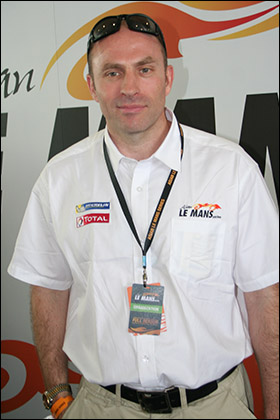
Before the race at Sepang, I spoke with Mark about the series, and how it has gone.
“I would say that the most important thing this year was that we established ourselves and got started,” he says. “Certainly we’ve had challenges: motor racing generally, but endurance racing specifically, is an unknown quantity across Asia, so to get teams to make the step up to a higher level has been a challenge. Sometimes our grid has been a little bit smaller than we’d have hoped for, but in terms of the overall achievement of sticking a flag in the ground and saying ’we are here’, I think it’s been a success.”
The ACO has been trying to get a foothold on the Asian continent for some years, and the successes of the American and European Le Mans Series have no doubt inspired efforts on the continent of Asia. But it hasn’t been an easy ride thus far. Thomas takes up the story: “I wasn’t involved in the previous attempts to get it going (the Asian Le Mans Series), but I know that there have been previous attempts, and it is important not to give up – we had to go forward, even if it meant that the grids were smaller than we wanted, For me, that’s the achievement itself: we are sitting here today we’ve had four races during 2013, and it looks quite nice.”
So what of the prospects for the future? At the time of our discussion, the calendar for 2014 had been announced, as had the inclusion of CN spec cars. How does Mark Thomas feel about the prospects?
“I am probably more optimistic now than I have ever been,” he declares. “As we’ve come through the year, we’ve broken through the perception barrier, people understand that we are here and that we are serious and we’re going to be around in the future. All the teams that have supported us this year and our partners: they’re all coming back next year; we have that solid foundation. The prospect list for new teams coming in at the moment is beyond my expectation. There’s obviously the prospect of taking those and making sure they’re on the grid (in 2014), but if I see where we were last year compared to this year, it’s day and night, in terms of the interest we getting the feelings we’re getting from teams and other partners.”
So what, I wondered, does that mean in terms of grid numbers? Mark is understandably reluctant to be drawn into making specific commitments. “We have four LMP2 teams who are already committed and we have another one or two on the fence. But if I have four, which is double what I have at the moment, then I shall be a very happy man. With the new CN category, we can attract a few more; so we envisage our prototype grid growing quite considerably from this year to next year. My priority is now to push this, making sure that the prototype grid is more credible. Although we love GT cars, if we are to maintain the credibility of the spirit of Le Mans racing, we need to help the prototype grid.”

A key element of the ACO’s push into Asia is utilising people who have experience of Asia, and this is one area in which Mark Thomas is well-experienced. Pan-Asian sport is not as well-embedded into the local culture as pan-European sport is though. Thomas recognises the challenge: “With the exception of the Asian Football Association, there’s no real pan-Asian competition or series in any sport,” he admits. “Although badminton is huge in Asia, there is no Asian tour, for example. What we have is a pan-Asian communications package and we go to individual countries so that our partners and sponsors and teams can enjoy activating themselves in each country.”
The problem is to make a business model that is sustainable. Traditionally, motor sport is difficult because teams have to get finance from drivers, and the promoters need to get commitment from teams before they can organise races. Again, Thomas understands the nature of the problem. “It is all very hand-to-mouth, that’s the trouble,” he says. “So although motor sport is at the core of it, we have to create a communication platform that can then be sold to sponsors, and that’s when you can come up with a more sustainable business model. If your revenues from any business model are coming from one structure, you’re always at risk in case it goes away. So we have to look at a much more rounded, revenue-high business structure. I’ve spent a lot of this year building up our TV distribution, our social media, our new media platforms, so we’re already leaps and bounds ahead of any other series in Asia, and I would also say maybe our European brothers as well.”
One thing in its favour is that the Asian economies are generally showing more growth than those in Europe. Sponsorship opportunities in Europe are few and contracting, whereas there are lots of Asian companies wanting to expand their brand exposure. “A big area for me is to bring together the management and technical expertise of some of the European teams with the Asian teams that have some money,” says Mark. “We see that with Craft Racing, working with Murphy Prototypes: there are three or four Murphy guys embedded in the team there and it is the sort of model that is attractive to both sides. There is no way that Craft Racing could do that on their own, and Murphy have a spare car, so why not work it, and make a bit of money out of it?”
Several things become clear: the first being the absolute commitment that the ACO has to make inroads into Asia; partners Michelin and Total want to be visible in the Far East marketplace. Second, and related, is that this is a long-term project. Even if, after three years, further success has not been achieved, then the intention will be to make changes to overcome the obstacles, not to give up. Part of the formula is that the desire for success is driven by a passion for Endurance racing and, in PR-speak, the “Le Mans brand”.
Speaking of the long-term, Thomas already has ideas of where that might take the series. “At the moment, our footprint is eastern Asia, (the 2014 calendar has races in Japan, China, South Korea and Malaysia), but maybe in the future we might consider a race in India, the middle east or one of the Oceanic countries. At the moment though, I’m pretty busy with the area I’ve got right now!”
And what about the length of races? In the European Le Mans Series, race lengths have been set at four hours for 2014, whereas the Asian races will remain at three hours. “Three hours is the really the minimum of what you can define as an Endurance race,” he says. “But we can’t run before we can walk: some of the teams here are still learning how to get through a three hour race. But our races will definitely get longer.”
Mark Thomas may be a businessman, but his passion for the sport is thinly veiled: “I would love to have an iconic endurance race in Asia,” he says with a smile. “Our version of Daytona or Petit Le Mans. Over the next couple of years we are going to introduce one or two races that go to six hours, and then beyond that to go to an iconic event that could become a brand, and that means having a 12 or a 24-hour race.
It may have been a difficult 2013 for everyone involved in the Asian Le Mans Series, but one cannot ignore the dedication, passion and will that is being shown to make it succeed. Napolean famously once said: “China is a sleeping giant. Let her sleep, for when she wakes, she will move the world.” One wonders if, in endurance racing, the sleeping giant may be about to stir…
Paul Truswell