It is almost time. The regulation talk can almost be put to rest as it is time for the Rolex 24 at Daytona, of which this is the 52nd anniversary running of the race.
The race has gone through time changes over the years , back in 1962, it kicked off as a 3 hour race, which was won by Dan Gurney in a Lotus 19b (see below), entered by Frank Arcerio. The track, which opened in 1959, became the new home for NASCAR and eventually a home for international sportscar racing.
The event stayed as a 3 hour event for 1963 and then moved to a 12 hour event for 1964-1965 before moving to a 24 hour format with the 1966 edition. Other than the 1972 edition, which was a 6 hour race, Daytona has hosted a 24 hour race ever since (except for 1974 when the OPEC oil embargo caused the event to be canceled).
But it wasn’t just time changes that the event has been through – it has also gone through phases. The initial phase which lasted through 1972 saw the event catering to an international audience. It was in this era that Ferrari, Ford and eventually Porsche reigned. But as we’re constantly reminded through history, sportscar racing is cyclical. 1972 was a downturn, and it affected this event greatly, based in large part to the fuel crisis that the world suffered through at the time. So 1973 saw the race start to turn its back on the international arena and instead focus on the North American market.
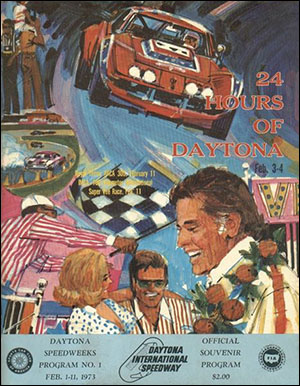 In 1975, the race became sanctioned by IMSA (founded by Bill France) as it was no longer deemed necessary to simply rely on the FIA to hold the race, even if it was still a part of the FIA World Championship of Makes. As the years went on, IMSA matured, the FIA relationship decreased in importance and the race itself became firmly entrenched into the North American series and calendar. As IMSA grew in stature so did the 24 hours of Daytona.
The race still was important to the world, but it became increasingly North American-centric. Through the mid to late 70’s, as the various incarnations of the Porsche 911 became the to car to have, it was pretty easy for European based teams to race at Daytona. But as IMSA and the FIA went their separate ways over the Group C/GTP regulations it didn’t seem to matter. The event continued to grow in stature, even if for awhile it required IMSA spec cars to be eligible to compete.
When Group C and GTP eventually died, North America continued to go their separate way. Their new class WSC struggled at first (See the 1995 programme below for evidence of that!) – there were some that thought WSC was short for Weird Sports Car – but the appearance of the Ferrari 333sp pretty much saved the day.
 Both IMSA and by relationship, Daytona became the home of Ferrari v. Riley battles. The world appeared to be looking towards GT based competition, but seeing some success out of North America with the WSC concept, started to look at prototypes too. That led to what we now have as the LMP categories.
The original WSC regulations looked at cost containment as a way of controlling competition – they relied on production based engines (of which the Ferrari was rather outside of those regs, but accepted anyway…) as well as very tight regulations. As often happens in racing, good intentions go awry. While initially it was hoped that there may be some common ground on regulations around the world, that didn’t happen. NASCAR, meaning Daytona revived the USRRC, while IMSA sanctioned first PSCR then the ALMS. USRRC became the Grand Am and as time went along, the two series drifted further apart, with the introduction of the Daytona Prototype regulations effectively ending any commonality between the regulations at least in the prototype category.
It was in 2003 that the DP/GT regulations came into play, with affordable racing being the key ingredient to the recipe. That was well intended, but unfortunately the recipe also included cars that were – kindly put – not the most attractive to grace a racetrack. Despite the efforts of NASCAR and Grand Am, the series never really caught on with the general public, while for a spell the ALMS seemed to catch the imagination of a part of the general public. The word of the series was spread by those competing, namely Audi, Porsche and Chevrolet and it made for some compelling racing.
But as we’ve seen before not all things last and eventually it became clear that nobody was making any inroads as far as fan interest. Which places us squarely where we are right now – the initial race of the Tudor United SportsCar Championship.
By all indications, the fans are excited to see the unified series compete for the first time, as tickets are selling quite well. The initial backlash concerning the unification appears to have been swept aside for now and there appears to be a genuine interest in this race.
While the regulations, are as expected a work in progress, much progress has been made in short order. It is unfortunate for the likes of Scott Elkins that the Daytona track offers its own unique set of requirements, which has made the balance of performance a difficult task. But based upon the last test, it appears as if the balance is close for the Prototype class. As expected, the DP spec cars are typically over a second faster than the rest of the class, but ultimately that is a difficult read as cars at the test were running at different configurations in order to determine what the ultimate balance for the race should be.

This has been an extremely difficult task to pull together, but it appears as if we may be close to what can be viewed as a workable balance for the race.
As far as results – that’s tough. Expect the normal DP runners to be right there. Thus far, Action Express, Spirit of Daytona and Wayne Taylor Racing have been impressive as expected with their Corvettes. The Ford powered Rileys for Ganassi and Shank have shown pace, but they’ve also shown new car, or make that new engine, blues. The Rolex 24 might be a development race for the Blue Oval gang.

As far as P2 and the Delta Wing entries – it’s a crap shoot. None of them have experience racing their cars at Daytona, which poses unique challenges all its own, thanks to the banking. Expect a winner to come from the DP ranks, but it wouldn’t be a surprise to see a P2 show on the overall podium.

What will be interesting to see from this class is what the attrition will be. How will the increased HP and speed of the DP cars affect their reliability and how will the P2 cars withstand the physical abuse of traffic and the banking? In many ways, this could be the most interesting aspect of the race.
While PC is truly the only spec class racing in this series, they may be the best example of what an older-school prototype – one from the mid-2000’s might have looked like on the banking. Unhindered with the fugly fin, they maybe the best looking of the prototypes running in this series.
While the Prototype classes have taken the headlines thus far, it will likely be the GT classes that steal the show. Both GTLM and GTD are loaded with everything – cars, drivers, teams… most anything you would want for a fantastic race. Expect an ebb and flow during the season as each of the car types visit track that may favour their own unique characteristics. As far as Daytona, can you ever exclude a Porsche from being a favourite? Likely not in GTLM, but when you’ve got strong competition from both Corvette and Viper factory efforts as well as strong Risi Ferrari effort, you’ve got an intriguing battle. Thus far, the BMW’s have been a bit off the pace at Daytona, but we’ll see what happens come race time…

As far as GTD favourites? This one is wide open. Porsche, Audi, Ferrari, Viper, BMW and Aston Martin. Impressive indeed.
One other thing worth mentioning – the actual rules of the racing. Most significant are the pit stop rules, which will follow what we’ve seen in Grand Am competition in the past. Fuel and tires are allowed to be changed simultaneously, although teams will only be allowed air guns for changing tires. This too will be a change in strategy for the ALMS based teams, one which they must adjust to.
No matter what, the BS stops on January 25th, when the TUSCC era begins, appropriately enough at Daytona.
Gary Horrocks