Marshall Pruett has been taking the opportunity whilst out shooting to keep a close eye on the very different grid for the 2014 12 Hours of Sebring:
Watching all three of Thursday’s practice sessions from trackside vantage points gave me the chance to observe various handling traits. Of the 60 or more cars that turned laps, the wildest one to watch was the #02 Chip Ganassi Racing with Felix Sabates Riley-Ford EcoBoost DP. With Scott Dixon onboard, the car was something to behold through Turn 1 during the first practice session as the Kiwi kept his foot planted on corner exit as the rear of the twin-turbo V6-powered Riley bounced and rocked over the bumps and pavement seams.
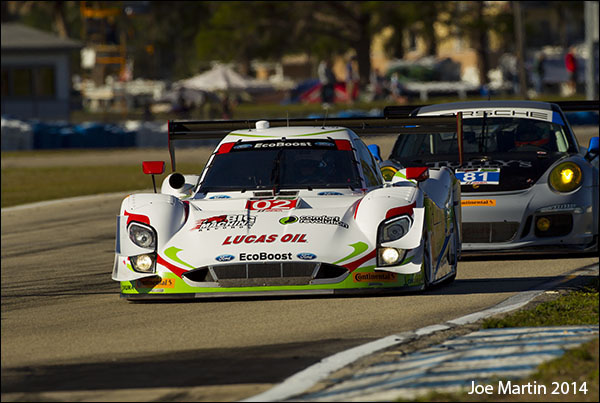
Compared to the other Prototypes, the right rear of the #02 had a life of its own as it compressed and rebounded quickly throughout the cornering phase but, and this is the important part, it was completely controllable and extremely fast.
Leap forward to night practice, and the same bouncing, carving handling trait allowed Dixon and his teammates to carry ridiculous speed into and though turns 3, 4 and 5. Dixon’s entry to Turn 3 was downright silly as he was able to throw the car into the corner and as he tracked out past the apex—the point where all of the extra speed would likely result in a big moment of oversteer—but the rear of the car held lap after lap.
It led to one conclusion: With so many cars and so much traffic to deal with, the #02 could have the right setup for the 12-hour race. Blindingly fast when they have clear track, soft and supple when they have to dodge meandering drivers—it’s pretty much everything a driver could ask for at Sebring.
“There’s more of a wider spread in this thing. You can get it sideways more, it can have more understeer, and it’s not on a knife edge. That’s really good, and it’s a lot different than an IndyCar which is very precise and will bite you if it moves around anything like the DP. Whenever you get into a car like this, there’s always more movement, everything happens a bit slower, and it’s a lot of fun to control.”
Dixon drove Acura’s ARX-02a P1 car at Sebring in 2009, generating cornering speeds that were so incredible it seemed almost cartoonish, and compared the difference between Acura’s aero marvel and the new high-downforce DPs
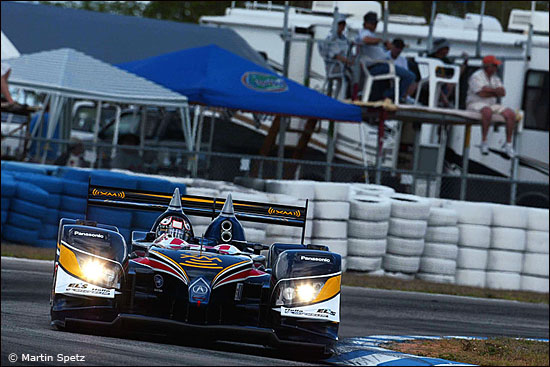
“The simple answer is when I drove the P1 car, it must have had double the downforce, it was a lot lighter and similar power,” he explained. “In the P1 car, you were flat through Turn 1. In the DP, we’re shifting down two gears from sixth to fourth… The DP moves around a lot more and has a smaller tire than we had then, which makes the DP more arms and elbows to drive…it’s a lot of work, but I love it.”
The three-time IndyCar Series champion hopes the #02’s handling will continue to make dodging traffic and easier task for his team than others during Saturday’s race.
“Racing here is very different to Daytona where you’ve got a lot of straights, a lot of 90- and 180-degree corners, long braking zones, it’s well lit, and passing is easy,” he added. “Here, it’s a lot different. There’s stuff everywhere. There’s guys on the right side of the track turning into a right-hand corner… Most of the time you hope the guy in front of you knows where he’s going, but you end up most of the time driving defensively because you have no idea what’s going to happen in front of you. And then you get into those halfway moments where you think they left the door open but they didn’t and you’re diving out of the way or trying to stop in time so you don’t get hit. It’s kind of mad out there, especially at night.”