Front and mid-engined vehicles, risk-taking machines, and numerous winners, champions, and icons of Honda's Super GT history!
While Nissan and Toyota were active in GT500 since the very first season of the Super GT Series in 1994, their rivals at Honda did not get involved with a full-fledged factory effort until 1997. But when they came on the scene, they immediately set out to innovate and dominate in the premier class of Super GT, formerly the All-Japan GT Championship (JGTC).
As of the conclusion of the 2020 Super GT season, Honda GT500 cars have won 58 races, five GT500 Drivers’ Championships, and six GT500 Teams’ Championships.
While the mid-engined NSX supercar has achieved much of Honda’s success in GT500, they’ve also found success in front-engined cars as well, including this past season, when Honda captured the GT500 Championship with the front-engined 2020 NSX-GT that was built in full compliance to the unified Class One technical regulations.
This gallery is another year-by-year history of Honda’s involvement in GT500, highlighting the most successful and memorable machines to represent the manufacturer.
Many of the photos seen are from Honda Motor Company’s media archive, captured from 2003 to 2020. Preceding photos appear courtesy of Suzuka Circuit, Fuji Speedway, and Dome Racing Ltd. – as well as an additional photo from veteran independent photographer “Hiro-kun”, whose works can be found throughout their Twitter profile, @kun71094249.
1996 Advan BP Honda NSX GT2: Honda’s first GT500 appearance came courtesy of ’95 Le Mans GT2 winners Team Kunimitsu, who brought their winning NSX GT2 to the JGTC – but with a horsepower deficit and no factory backing, their Le Mans winning drivers Kunimitsu Takahashi and Keiichi Tsuchiya only manage three top-10 finishes.
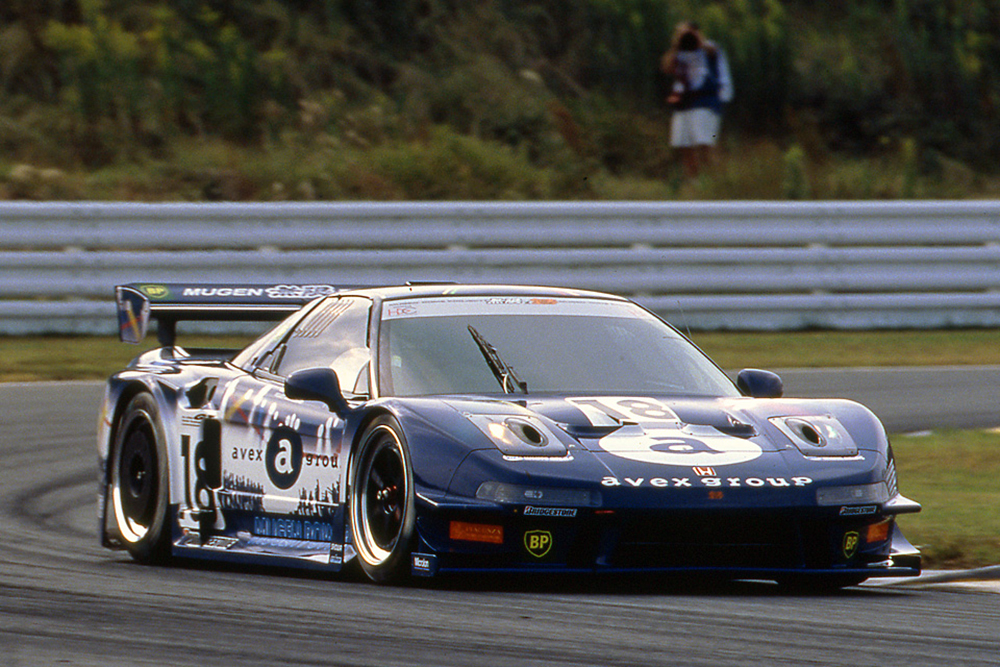
1997 Avex Dome/Mugen Honda NSX-GT: Honda’s first purpose-built GT500 machine was introduced at the Golden Week race at Fuji Speedway – this model, operated by Dome Racing and Mugen, scored Honda’s first GT500 pole position at Miné Circuit in the penultimate championship race of the season.
1998 Mobil 1 Honda NSX-GT: Fielded by F1 hero Satoru Nakajima, the Mobil 1 NSX of Koji Yamanishi and his Dutch co-driver takes Honda’s first GT500 race win at the summer race at Fuji Speedway – the Mobil 1 NSX finishes runner-up in the GT500 Championship, and Honda ends the season with four straight championship race victories (plus an All-Star race win at TI Circuit Aida).
1999 Raybrig Honda NSX-GT: One of the earliest iterations of the legendary Raybrig NSX, prepared by Team Kunimitsu in conjunction with Mooncraft Engineering – Kunimitsu Takahashi and Akira Iida scored a memorable win in the 1999 Golden Week race at Fuji, Honda’s sixth in a row in GT500 – and Kunimitsu’s last win as a driver, at age 59!
2000 Castrol Mugen Honda NSX-GT: Honda brought new tech to the 2000-spec NSX-GT including a new gearbox design derived from Formula Nippon – the end result is four victories and Honda’s first GT500 Drivers’ and Teams’ Championships, won by the Castrol Mugen NSX of Ryo Michigami – who didn’t win a race but racked up four podiums alongside Osamu Nakako and Hidetoshi Mitsusada.
2001 ARTA Honda NSX-GT: Autobacs Racing Team Aguri (ARTA) joined Honda in 2000, with Aguri Suzuki and Keiichi Tsuchiya winning together at the summer race in Fuji – a year later, Tsuchiya and new co-driver Katsutomo Kaneishi finished runner-up in the GT500 Drivers’ Championship and won the penultimate round at Suzuka Circuit.
2002 Mobil 1 Honda NSX-GT: The NSX received a facelift in 2002, the restyled car won five races this season, and also won the Teams’ Championship courtesy of Mugen/Dome – but the Mobil 1 NSX, now driven by young Tsugio Matsuda and Ralph Firman, just misses out on the drivers’ title by a single point despite winning three times this season.
2003 Takata Dome Honda NSX-GT: 2003’s vehicle regulation overhaul allows Honda to mount the 3.5L C32B engine longitudinally for better balance and cooling – but Honda struggles with aero balance for most of the season. They still manage two wins, including one for the Takata Dome NSX of Ryo Michigami and Sébastien Philippe in the last JGTC race held at the “old” Fuji Speedway.
2004 Epson PIAA Honda NSX-GT: Honda brings back a turbocharged version of the smaller C30A engine for 2004, but reliability issues plague the Honda fleet for most of the season – still, the Epson NSX of Tsugio Matsuda and German sophomore Andre Lotterer salvages some pride for Honda, winning at Motegi, as well as the second leg of the All-Star Race at California Speedway in the US.
2005 ARTA Honda NSX-GT: Honda continues to tinker with their GT500 efforts – they introduce the NSX-R GT as a road-going homologation special to allow more aero development, and at the third round in Malaysia, they revert back to the naturally-aspirated C32B engine. After this change, the ARTA NSX of Daisuke Ito and Ralph Firman takes three pole positions, wins at Autopolis, and goes on to finish 2nd in the GT500 Drivers’ Championship.
2006 Raybrig Honda NSX-GT: Team Kunimitsu entered a new technical partnership with M-TEC (Mugen) in 2005 – and in 2006, Sébastien Philippe and Shinya Hosokawa took Team Kunimitsu’s second of back-to-back wins at Twin Ring Motegi – Philippe and Hosokawa finish 2nd in the GT500 Drivers’ Championship.
2007 ARTA Honda NSX-GT: Quite simply, 2007 was the year of the NSX – Honda finished 1-2-3-4 in the GT500 standings, led by the ARTA NSX of Ito and Firman – their year started off with Ito breaking the 1’50 barrier at Suzuka in time trials, then the duo won at Okayama, Sugo, then Autopolis – to become the first team to clinch the GT500 Drivers’ and Teams’ Championships before the final race of the season.
2008 Takata Dome NSX-GT: Honda receives a 50kg weight handicap after their success in 2007, resulting in a drop of form – Ryo Michigami and Takashi Kogure score Honda’s only win at Sportsland Sugo in the Takata Dome NSX.
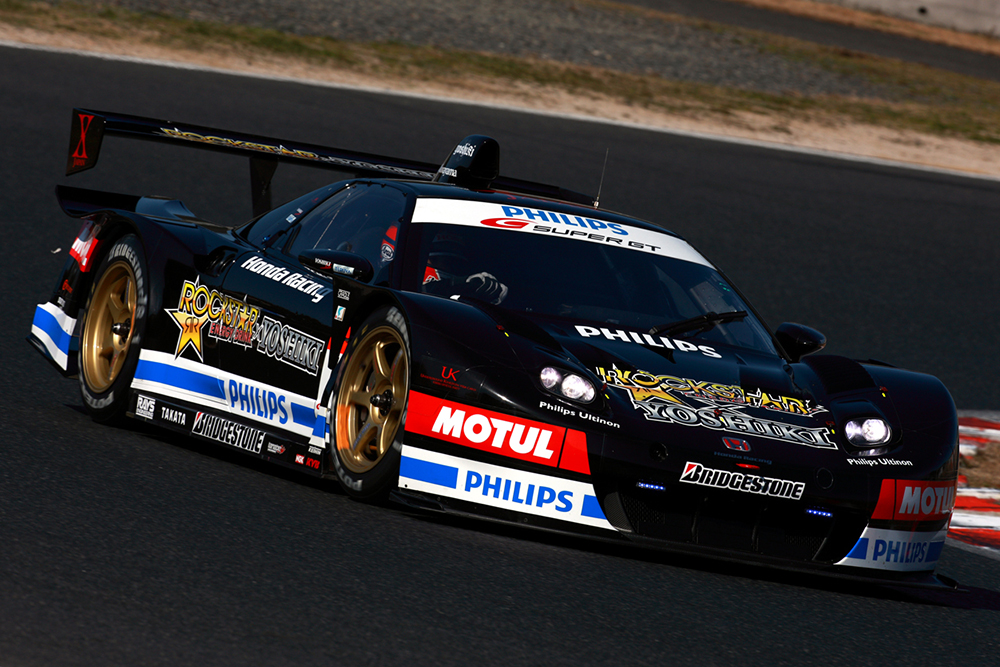
2009 Rockstar Dome Honda NSX-GT: The first-generation NSX-GT ends its swansong season with victories in two of its final three races in GT500. This year, the Dome-entered NSX of Michigami/Kogure gets new sponsorship as Japanese rock legend and avid racing fan Yoshiki Hasegawa partners with an American energy drink company.
2010 Weider Honda HSV-010 GT: Honda’s first front-engined, carbon-fibre monocoque GT500 car is based on a scrapped concept for a “new NSX” – and the sound of Honda’s new HR10EG engine is unmistakable! Takashi Kogure and Loïc Duval take the HSV-010’s maiden win at Okayama, then finish the season with six straight points finishes to clinch the GT500 Drivers’ and Teams’ Championships with Weider Honda Racing (Dome).
2011 Keihin Honda HSV-010 GT: Real Racing debuted in GT500 in 2007, in 2008 they gained auto parts constructor Keihin as a title sponsor, and in 2010 they won their first race at Sugo in the closest finish in series history. Veteran Toshihiro Kaneishi and young Koudai Tsukakoshi ended 2011 4th in the standings with 3 podiums.
2012 Raybrig Honda HSV-010 GT: Team Kunimitsu’s fortunes picked up at the start of 2010 when they formed a young, thrilling lineup of Takuya Izawa and Naoki Yamamoto. In 2012, the Raybrig HSV-010 scored back-to-back 2nd place finishes to open the season, and they finish 5th in the GT500 Drivers’ Championship, best of all Honda teams.
2013 ARTA Honda HSV-010 GT: The HSV years weren’t kind to ARTA, but in a wild 2013 race at Sportsland Sugo, Ralph Firman and Kosuke Matsuura led an ARTA double victory in the final season for the naturally-aspirated HSV-010.
2014 Weider Modulo Honda NSX Concept-GT: The pre-production, second-generation NSX Concept-GT debuts in 2014 with its two-litre turbo-four HR414E mounted behind the cockpit and mated to a hybrid powertrain. Honda’s only win comes in torrential rain at the summer race at Fuji, with the Weider NSX of Naoki Yamamoto and Frédéric Makowiecki leading a Honda 1-2.
2015 Raybrig Honda NSX Concept-GT: Even with a slight weight break, the hybrid-powertrain NSX Concept-GT still causes some headaches at the Honda camp – but they still salvage a win, at Sugo, with Yamamoto & Izawa finally taking their first win as a tandem at Team Kunimitsu.
2016 Modulo Drago Honda NSX Concept-GT: Ryo Michigami’s Drago Modulo team raced for just two seasons, including 2016, where they took pole position at the Suzuka 1000km and finished 2nd in the debut race for teenage prodigy Tadasuke Makino – but these are among the very few highlights of Honda’s first winless season since joining Super GT, as the removal of the hybrid powertrain exposed drivability issues and a lack of horsepower from the internal combustion engine.
2017 Epson Honda NSX-GT: Honda makes a breakthrough during 2017 with the HR417-E powerplant, introducing F1-style pre-chamber ignition technology to GT500 which means a more powerful and efficient car. In the first year for the production-derived 2nd-gen NSX-GT, Honda finally gets back in the win column – highlighted by Nakajima Racing’s stunning upset at the final Super GT-sanctioned Suzuka 1000km.
2018 Raybrig Honda NSX-GT: At long last the Class One NSX reaches maturity, taking four wins and six poles. Jenson Button’s full-time debut in the Raybrig NSX alongside Naoki Yamamoto grabs all the pre-season headlines and draws new viewers to Super GT. Yamamoto and Button win at Sugo, and then clinch the GT500 Drivers’ and Teams’ Championships at Motegi – a long-awaited first set of titles for Team Kunimitsu after 25 seasons.
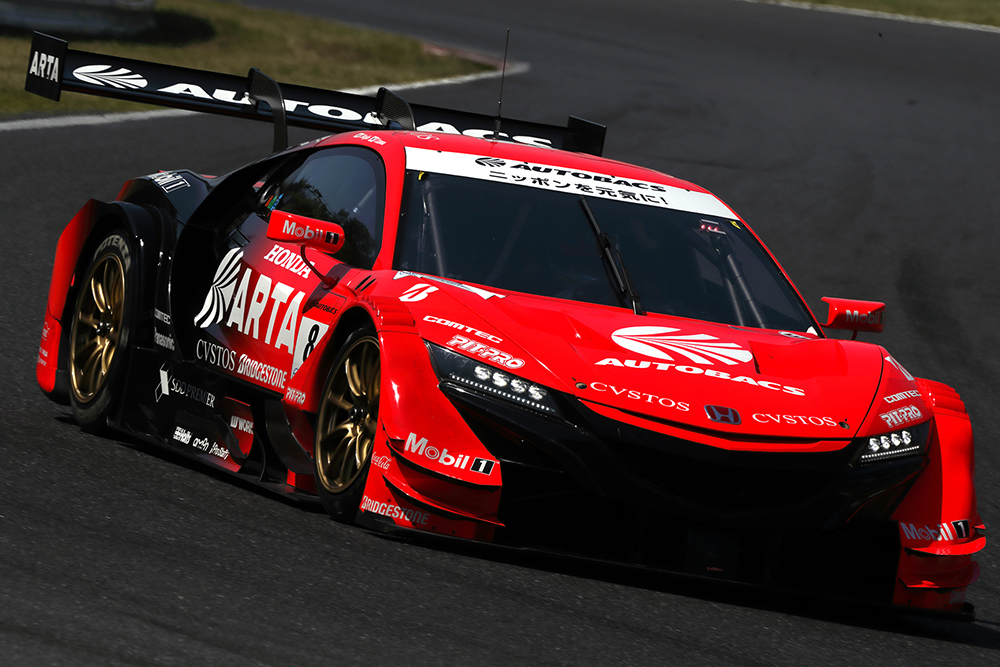
2019 ARTA Honda NSX-GT: New rules for 2020 will ensure this is the last mid-engined GT500 car for some time – Honda regresses somewhat in 2019, taking just a single win in a rain-shortened race at Okayama for the ARTA NSX of Tomoki Nojiri and Takuya Izawa.
2020 Raybrig Honda NSX-GT: The front-engined 2020 NSX-GT begins a new era for Honda in spectacular fashion, with four victories, and a memorable championship for Team Kunimitsu – in Raybrig’s final season as their title sponsor – as Naoki Yamamoto and Tadasuke Makino ride consistent results all the way to a dramatic, title-clinching victory in the season finale at Fuji.