This interview took place in a highly unusual place, Race Control at Spa Francorchamps during the final track session for the FIA WEC Prologue pre-season test.
And the timing was no accident, it was undertaken as a celebration of the 20th anniversary as an FIA Race Director of current Le Mans 24 Hours, FIA WEC, ELMS and Asian LMS Race Director Eduardo Freitas.
Let’s start with just how did you get to become an FIA Race Director?
“Well, first of all, welcome to Race Control welcome to my world.

“Here you can see and understand what we see and how we see it, and what kind of details we have to monitor during the race.
“Many people might say that Race Control are sitting comfortably in a nice room with air conditioning, and that we are watching TV the whole day. In reality, this is what we watch, this is what we have. Sometimes it’s not enough to be able to be 110% fair – let’s put it like that!
“This” was a veritable wall of CCTV and live TV feed monitors, some purposed with policing areas of concern for track limits, but most giving a variety of views of every inch of the 7 km circuit.
Added to that were a desk full of live, and playback data and video feeds.
“The main data in front of me is timing – I can go to car analysis on screen too. Then on this side, we have positioning, we can go into details of the track. I can select the car I want to follow or we also have the live TV feed which is not the case today. We don’t hear what is happening on TV. We see what they’re broadcasting we don’t hear the commentators.”
I’m looking at what I think is something like 50 visual inputs for you to monitor, including multiple displays on the four screens on your desk?

“Yes, which are permanently monitored by the setup, which is in race control. We have fewer people for a test day but even in race conditions today it will be less than the normal due to COVID restrictions.
“Each person is responsible for surveilling a certain amount of monitors, which are mainly the small ones on this wall.
“The big monitors are those that we can programme with optional views. For example, the one on the bottom right is the exit of T9 so that the teams can understand where their cars are exceeding track limits there, which will be monitoring for this weekend. And then the top one is focussed on the top of Raidillon which is always a challenging place. That’s been a busy screen this weekend!”

So to get to be in the big chair, before you became an FIA Race Director clearly, you were, and are, a fan of motorsport?
“It’s like this. I used to be a mechanic when I was a teenager. I love two-stroke engines. I still do. And one day a friend of mine said how about a karting engine myself?
“I said no, it’s four wheels. It’s no fun. two wheels is nice. Anyway, let’s go and see! Saying no before you taste is a bad idea!
“And what captured me immediately was the fact that the pinion was at the end of the crankshaft, no clutch, no gearbox nothing in between. I said “Wow! This should be fun.”
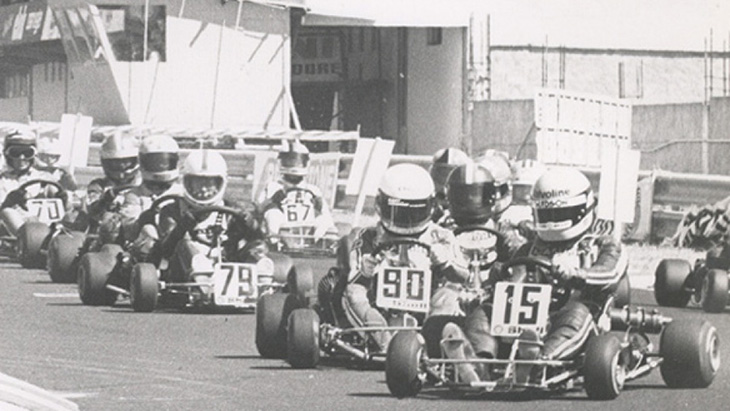
“That’s how I came in. In September 1979 I went to see the world kart championships (pic above) which was won by Peter Koene, he just beat Ayrton Senna, Kathy Muller was in the race too.
“I went there to buy a chassis, a Zip Shadow 77 from Martin Hines. I saw the whole world championships sitting on the grandstand where you could see the inner part of the karting track, I was right on top of a marshals post and on the Sunday I said to myself, I’m sure it’s much more fun down there than here in the grandstand.
“And on the Monday, I think that was the 24 September 1979, my first job was to dismantle parts of the karting track because it used part of the car track.
“The main straight and T1 were all built with concrete blocks, like the curbs on the main street. That’s when I got hit by the virus seriously!
“So during the week at night I was repairing the carts, at weekends, I would be a karting mechanic.
“If it was a motorcycle race I would be a marshal. That’s how it started. I did everything you can do on the track. From trainee all the way to Post Chief, sector Chief, Chief Track Marshal then Deputy Clerk of the Course and then Clerk of the Course.
“And in 2000 and 2001 we had FIA GT GT (at Estoril) and in February 2002, Jurgen Barth called me and told me there was a vacancy to be Race Director for the ETCC and FIA GT Championship. It was for one year but I thought, better one year than nothing, why not give it a try.
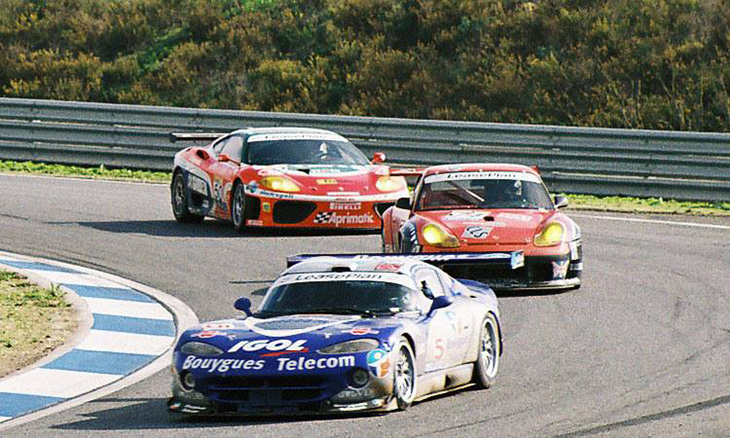
“And so I kicked off, I think, on Sunday 22nd April 2002, in Magny Cours, with FIA GT and ETCC (pic above). And then we had the support races we had Formula Renault, Renault Clios, so it was, it was difficult at the time. I had one notebook, and 20 screens in front of me, one telephone to call timing to put messages on the screen. And that was it!”
With all that you’ve got at your disposal. In so many ways, it’s better, but in some ways is it worse?
“You tend to see less racing the higher you go in the chain.
“I normally see the races at home. So we record them at home. That’s where I see the races. I choose a (free) weekend and then go through all of the sessions as if it was a live race weekend. Because here in Race Control you are focused on specific moments or issues – there is a trouble there so that’s where you focus – now let’s see the behaviour of the cars on this section/ that section of the track. Let’s do a few laps following the same car. Then there is a driver change. Let’s do a few laps, this driver is new. Let’s follow him for a few laps and understand his lines, how does he deal traffic and all that? So in the reality – the racing itself, you don’t see it that much.
“So if I want to see the racing its at home on TV, but pre-recorded, that’s the only way to see them.”
We know what you do on a weekend because we see you more or less every weekend. But what does an FIA official, an official operating your level do with the time outside of race weekends. I know for instance, you do some of the track inspection?
“I do track inspections. I like to grab my grandson and go incognito to see karting races. That’s good fun. I like to see other people’s races – there are some championships which I like to follow when I have time.
“Normally, it always involves four wheels. I was a big fan of fishing but something had to go! Fishing was taken out of the equation.
“One of the things which gives me the biggest pleasure is between October and May is being able to go to the beach and walk the dog and play with the dog.
I think all of us dog owners will appreciate that one! On occasion, though. You do go back on a Marshal’s post? (seen below ‘on post’ at the Le Mans Classic with friend and fellow Race Director Rui Marques)

“If I have a free weekend, and there is a race which interests me, yes, definitely. I go out, pick up the flags again. No radio, no computer, no screens, no headset, just me, a flag. and the drivers on track, enjoy the cars, the noise of the tyres, the smell of the rubber, the smell of the exhaust.”
And the camaraderie of the Marshals?
“That stays – once a marshal always a marshal, it’s for life. It’s hits you and it stays with you. Understanding the troubles they have, the visibility issues, the movement issues with each time more fences and obstacles for safety.
“I do understand that we put the debris fences to make it safer for them and then they move to the beginning of the fence! I do understand all those things.
“The scope is to try and find solutions and ideas on ways to communicate with the marshals so that they get the idea on how to reduce their margin of exposure.”
Let’s talk a little bit about your journey through as a Race Director over two decades. starting there with FIA GT, you continued with that for many years alongside European Touring Cars – They were a huge part of your story?
“And Touring Cars are still a huge passion for me. Touring Car races are short. You need to be swift and as get into the higher level of cars the races are longer, you have more time to decide.
“At the time I was officiating, a touring car race would last between 22 to 25 minutes.
“The conditions to watch replays were quite difficult and to make reports was quite difficult.
“Nowadays, it’s much easier to watch a replay, you get all the angles you need to be able to make the judgments. But in endurance racing you have time to decide, when you’re doing a touring car race, it’s always on the edge of the knife, you have to be much more creative. The margin of risk of taking a wrong decision is large!”
I guess the simple question to ask is a very unfair question – Which do you prefer Sprint races or the longer races that you have become well known for?
“You cannot compare a red line with a white line. It’s two different things. It’s like comparing Greek with Latin. It’s a different philosophy, a different mentality. Even the mindset of the driver is different.
“So that in a touring car race, if you lose three tenths on current BOP, if you lose three tenths at the start of the race, your race is more or less done.
“In endurance races, you always have the chance of the odd safety car, there might be a pit stop, which doesn’t go well for your opponent. Then it all happens in one go. It’s much quicker. I enjoy them both a lot. I enjoy them really a lot. And if I see a good touring car race on TV, yes, then dinner will wait. But it’s two different ways of doing motorsport. And I do respect them both equally.”
Fans would not thank me for coming in here and not asking the question – when we see up on the screens – “Team Manager of car number whatever – immediately to ace Control” – what happens here?
“Anything is possible!
“Sometimes I need to talk with the team manager to understand what has happened. I don’t like to call in the manager up and say “Listen, you’ve got a drive through because he did this.”
“First, I want to understand why this happened. So basically, it’s giving him to right to a defence, before I make a report to the stewards, and then the penalty will arrive. And sometimes when you talk to the manager, the team manager, sometimes gets surprised “He did that!!”
“So this is an open game. They know exactly what conditions we work within, what we have, what information we have. And I think it’s fair to tell them – listen, I have this problem, which is caused by your driver – help me get out of it. How? How did this happen? Why did he do this? Is there anything wrong with the car?
“And sometimes you see things on the TVs, which in reality are not so much a drivers fault, because he was struggling, he had a wishbone which broke and he’s trying to bring the car back to the pits or something like that. So let’s give him the opportunity to explain his point of view and what just happened.
It’s a transactional conversation?
“It’s like this, we work in a team. It’s not only us in Race Control that are the team, our way of working is to team up with the teams and the drivers. And if we all work together, I think at the end of the day, it’s better for all parties involved.”
There’s two main aspects- there is a rule book and it’s quite an extensive rulebook which everybody taking part in a race is responsible for understanding. But your job more than anything else has got one word that underpins it. And that’s Safety?
“The rule book is quite complex, some of the rules can take several times of reading to be able to understand what the legislator wants to achieve with it. But the main target and the first thing you always have to see is Safety.

“With safety, you cannot be soft, you cannot say, “Okay, let it go”. You have to be very careful. No matter what we do. It’s human beings inside the cars. The cars are expensive, I don’t care! For me, the target is to make sure that on Sunday, everyone goes home – and that’s a good weekend for me.
“If I lose seven hours afterwards discussing regulations and articles this I don’t mind as long as they all get home.”
One of the modern-day staples it seems of racing are the two little words Track Limits. Tell me a little bit about your philosophy on that subject?
“A track is conceived in a way. We put in guardrails, we put in asphalt run-offs and grass, and gravel, we have tyre barriers with inserts and conveyor belts, we have the high-speed barriers.
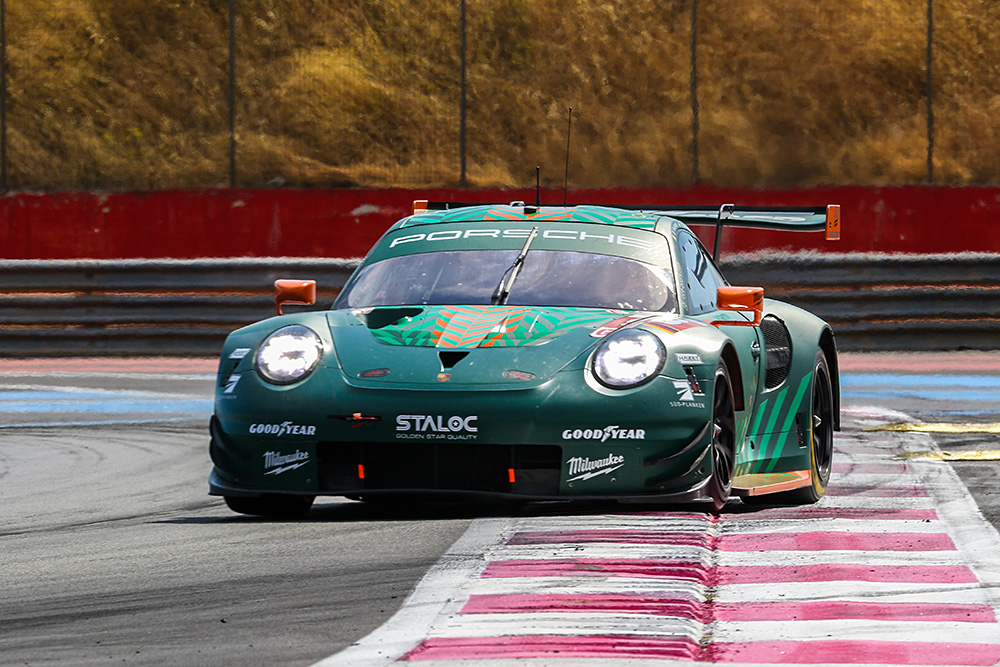
“All of that is calculated according to the race line and the speeds which are foreseen for that area of the circuit. And if we allow it to be driven beyond what is calculated, at the end of the day, we are allowing the drivers in a certain way to expose themselves to unnecessary risk.
“So there is the sporting part of it, which is a driver may achieve a lap in qualifying, which is done beyond track limits, which technically can be deemed as illegal, whether we saw it or not.
“And then there is the other part, which for me is the most important one, which is the fact that by abusing track limits, you may be doing your race line for which you may be putting yourself (or others) at risk if something goes wrong at that stage. That’s how I see it and that’s why I’m so stiff in my answers on what concerns track limits.
“It is because tracks are built in a certain way for a certain racing line and for a certain kind of impacts. If we go beyond that, then we need to eventually rethink how a barrier has to be built.
“Safety is of paramount importance here. The rulebook comes in second, let’s put it like that. Our priority is ensuring that when we say “Green flag pit line is open”, that it is safe for the drivers to go out.”
I hesitate to ask the next question, because I know you a little and I do know that you do care a great deal about the people in the sport. What have been the worst moments in the last 20 years?
“Well, unfortunately, some weekends, we don’t all go home. And that’s bad. That always leaves you with a feeling of what could I have done? What should have I known before this happened? It’s always complicated because it leaves you with a sour taste which lasts, I tell you, it lasts a very long time.
I get the impression that in some ways, you take on some of the responsibility for that.
“It’s like this. They know that if I say it’s green, you can go, it’s safe. All of a sudden, it’s not safe. Something went wrong there. It’s not something which I’ve foreseen or whoever calculated the circuit had foreseen. But it’s something which leaves us with a bad taste, even if it’s an accident between two cars where someone gets injured. You always feel “what could I have done to avoid this from happening?”, it’s complex.”
Those serious incidents happen, mercifully, quite infrequently now but I do sense that there has been a shift amongst people observing the sport between understanding an accident and attributing blame for an accident. It’s the former that seems to be far more important here?
“The blame is something which is not at all my target. Don’t forget, it’s human beings inside the car, they run at very high speeds with very sophisticated equipment.
Many of these cars are literally laboratories. So the amount of things which unfortunately can go wrong are quite big. Some of them are inexperienced, some of them are testing new things.
“So, at the end of the day, we try to understand and the FIA does a tremendous amount of work in the backstage which is not seen. Which is trying to understand how it happened and why it happened. And what can we do to minimise the consequences if this happens tomorrow again.
“That’s the target – improving on equipment, improving on the way we look at things. It’s a huge work which is done by a bunch of people who are highly dedicated to it in Geneva.
“They go through an accident, and they totally disassemble the accident to understand how the consequence can be improved. Those people are not known publically. It’s backstage work, which is tremendous. It takes hours, sometimes months of going through numbers, graphics and simulations. But thank God, the numbers which we have today are nothing compared to what we had in the 50s, or the 60s.”
“The day, the day I feel that I cannot bring anything else into it, that I’m not motivated to try to push further on this principle, that idea, or this equipment to be in place, then I think it’s about time I leave the church, and somebody else comes in with new ideas.”
I hope very much that that’s a while away yet!
We’ve talked about the bad days. What about the good days?
“Well, I’ve got friends all over the world which is amazing. I’ve got followers at home, which is amazing.
“Because this life, you live a lot from your suitcase. My ‘house’ is very often a 23 kg suitcase, because it’s always hopping from one side of the world to the other.
“The good part is I’ve got excellent connections all over the world. I know people with the same passion I share. I’ve known people which are happy each time we arrive and they start emailing months before, “Is there anything you would like to try this time, anything you want to do, any place you’d like to visit?”
“And it’s amazing how the motorsport community moves and how the motorsport community when it gets together, it’s always a party, even if it is sometimes at the end of the day, you’re around the circuit and the marshals are somewhere having a gathering. Let’s go then and say hi to them and thank them for their efforts.
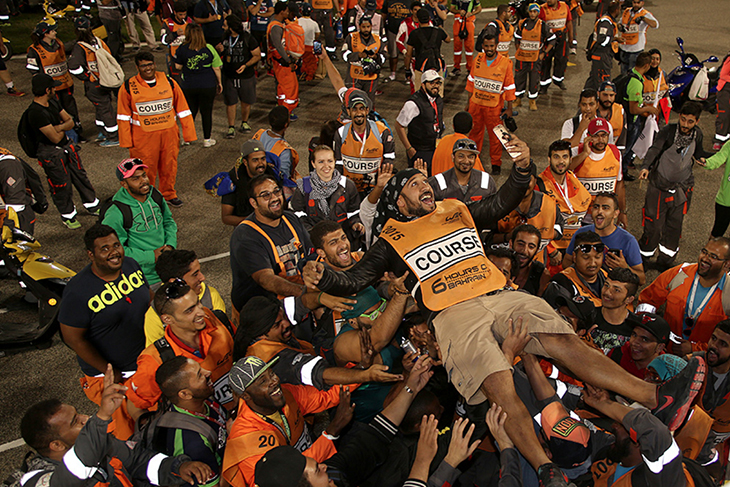
“That doesn’t have a price let’s put it like that. Unfortunately, times now don’t allow it much due to COVID and due to the amount of work which we have.
“But I do have excellent friendships all around the world because of this work that I do. And that’s something which has no price. It’s fantastic.
The final question is this. Was it a surprise to you that in this day and age where we are in a multi screen, multi channel world, and that your voice is now heard on the TV broadcast that you’ve become something of a personality?
“If you’ll allow me this indiulgence, I don’t I don’t really like my voice. I remember buying a telephone message machine for home and my wife said “no way you record the message yourself!”
“I recorded the message and I said “Oh my god!! So I was looking for the right music to put in so you couldn’t hear the voice and I still find it odd when I hear myself be it on TV here or there.
“It’s a fact that it’s a known voice. And I can’t get away from it. The amount of people who asked me to record sentences to put on their mobile phones are beyond what you could imagine.”
I won’t ask what those messages were!
“No, it’s all clean and straight don’t worry! But it’s something normal I think. Normally nobody likes hearing their own voice. I don’t know if it’s if it’s an instinct of defence. But I know that each time I talk during the race, it’s normally because something has happened. So I have to break the fun of the race by announcing something which is not pleasant this or that. But yes, it’s a fact that my voice is “known”.”
I’ll say this much in closing – Thank you very much indeed Eduardo Freitas for 20 years of fantastic service as a race director and also for your good humour and your time in explaining to those of us whose jobs it is to explain the ins and outs of what happens in the background, spending your time to help us to get it right, and to enhance the understanding of our audiences.
“I started out in a modern world where communication is the key. I think it’s important that all the people which are in the boat know exactly what the other people in the boat do.
“Potatoes don’t appear here peeled because they just appear here. And it’s interesting to know how they got on board and how they were kept and prepared and all the work which is done behind the potatoes which you have with your hamburger at night.
“And I think motorsport is such a complex machine, that there is so much going on in the backstage to prepare a six hour race, that we don’t really know exactly how the setup is done, the amount of people involved from the TV crews from the mechanics in the pit lane, the people at the door controlling the passes and the armbands to know if you’re okay to be somewhere, and those right now that are working hard on the COVID controls.
“All that it’s a huge machine which many times are just unnoticed. It only works if everything is in place, if everyone is motivated and doing what they should properly.
I’ll let you get back to business. Happily, we’ve not had a single Yellow Flag in the tower during this interview. I’m sure that’s the commentator’s curse that will then descend upon us as soon as I turn my back…
“We have a Portuguese saying that the harvest isn’t over until we wash the baskets. It’s been my pleasure!”