The Nordschleife and the Nurburgring Grand Prix circuit will receive a total of two and a half kilometres of new track surface this winter.
The work started in earnest last week with an asphalt milling machine starting to remove the tarmac of the Döttinger Höhe.

The resurfacing will continue down the long Nordschleife straight through the Antoniusbuche, Tiergarten and Hohenrain chicane to the Grand Prix circuit. Here, the Hyundai N curve before the start-finish line, as well as the connecting sections between the two circuits will be resurfaced.
Work will continue until February 2022.
“The asphalt work on our race tracks is one of the most emotional parts of my job,” explains project manager Alexander Schnobel. “We work here on behalf of the 95-year history of our racetrack. Preserving the characteristics of the track is always a top priority during the construction work. At the same time, we are producing a modern standard that meets today’s demands on our tracks.” Schnobel has been responsible for construction planning and infrastructure at the Nürburgring for 20 years.
On average, one kilometre of asphalt is renewed every year on the Nordschleife and Grand Prix circuit. With a total length of around 25 kilometres, the quality of the newly laid asphalt must therefore withstand the highest stresses for around 15 to 20 years before it is renewed again.
“Our race tracks are busy every day from mid-March to mid-November. In addition to the approximately 50 major events, these include driving training sessions, tourist drives or industry test drives,” explains Alexander Schnobel.
Furthermore, the project manager explains that the construction work on the race tracks is done differently.
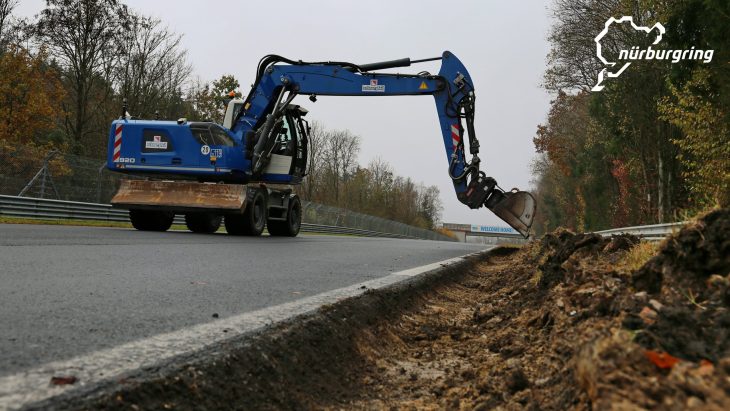
On the Nordschleife, the layers under the asphalt of the track, which was opened in 1927, are also being renewed. The area is therefore excavated to a depth of more than one metre and then completely rebuilt. On the modern Grand Prix circuit though , which was raced on for the first time in 1984, it is usually sufficient to first mill off the upper two asphalt layers and then renew them.
Specially developed asphalt mixtures also ensure that the respective grip level remains consistent on the respective tracks even with the newly paved surface. This should give the drivers a reliable driving experience without too many differences on a lap of 25 kilometres.
The Nürburgring is investing a total of about 2.5 million euros in the construction project.