


It’s hard to believe that the Benley Speed 8’s famous win at the Le Mans 24 Hours was two decades ago. So much has changed since Tom Kristensen, Dindo Capello and Guy Smith steered the British marque to its third overall victory.
For Guy Smith, 2023 running of the Le Mans 24 Hours this June is not only significant because it marks 20 years since his breakthrough win, but also because he will drive the Speed 8 again at the Circuit de la Sarthe as part of the centenary celebrations.
Smith was the last driver to drive the car at the circuit, as he was in for the finish in 2003, so getting back behind the wheel of what is one of the most iconic cars of the race’s 100 years of history will be an emotional experience.
Ahead of the occasion, DSC sat down with Guy for a lengthy discussion about all things Bentley Speed 8. We’re sure you will agree that it makes for an entertaining and revealing tale…
Let’s start from the beginning. What was your route into the Bentley programme like?
“It launched my career in many ways. I’d done Formula 3 and then gone over to America to race in Indy Lights in 1998, 1998. I went over there because Castroneves, Damatta and Kannan had gone over there and were winning so I wanted to take a look.

“I did a deal with Stefan Johansen’s team to drive for him in Indy Lights. A couple of years later he set up a sportscar team with a Reynard Judd. We kept in contact. I was trying to get to IndyCar. A couple of things nearly happened, but it didn’t work out. So I reached a point where it was either pack it all up and start making caravans or go to do Le Mans.
“Stefan asked me if I wanted to be a co-driver at Le Mans, and I hadn’t even considered it. I hadn’t followed it and I wasn’t a sportscar nut. So basically I started with him in the ALMS and Le Mans that year. I actually won Rookie of The Year. And it was managed by John Wickham, who I knew from Formula 3 days and got on well with.
“He could see that I was young and quick and that it was make or break. We didn’t get many good results but they believed in me and unbeknown to me, by the end of 2000 he’d started to work on the Bentley programme, and kept it quiet.
“When he revealed what he was doing he explained that Bentley wanted to go back and that they’d signed (James) Weaver, (Andy) Wallace and (Butch) Leitzinger. They’d inherited Stephane Ortelli from Audi, he was part of it too, and Martin Brundle. They were looking for a young Brit to add to the drivers, so I got invited to test and met the Bentley hierarchy.
“The worst thing about that experience is that I’d lost a bet with some of my mechanics and I had bleach-blonde hair. So I met all the Bentley execs looking like Billy Idol. But long story short I got the job, though they insisted that I lose the hair!
“Really without John’s input, I wouldn’t have been a part of it.”
What was that first Le Mans like with Bentley in 2001?
“I drove with Martin Brundle and Stephane Ortelli and we were fast but didn’t finish. It rained so much that the activator for the gear shifter stopped working. What we found was that in testing the rear brakes were getting too hot so we kept adding ducts to cool them.
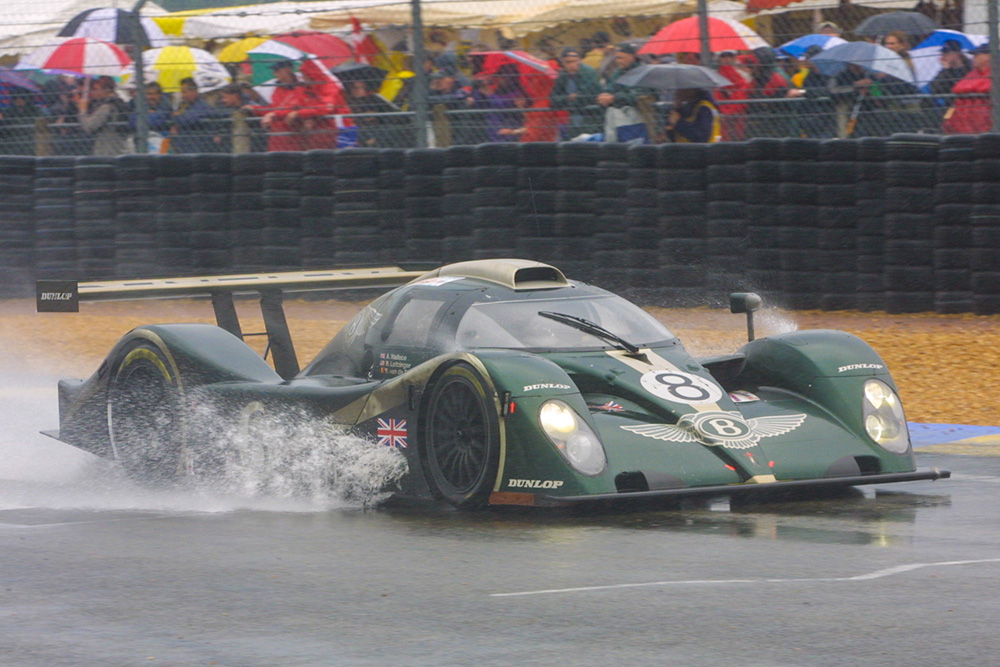
“Then when it rained, all the water was coming in through these ducts and the car stopped shifting. Martin struggled to find gears, then I got in and the car wasn’t shifting, it was fully steamed up, and I think we were second or third. I got stuck in sixth gear and as we came to Arnage, I tried to get round in sixth, it stalled and I couldn’t get it started again.
“Where Andy Wallace was more clever, is that he had the same thing and just straight-lined the corner in sixth, kept it going and made it back to the pits for a fix.
“It was a big eye-opener. I hadn’t done much in sportscars and was suddenly at the sharp end. But they were pleased with my performance and they signed me for two more years. They knew the current car wasn’t capable of winning an endurance race, so they decided quickly to design a new car. They scaled back to one car and started building the 2003 car.
I hadn’t done much in sportscars and was suddenly at the sharp end.
“As part of the deal, they gave me all the testing but put me on standby for 2002. I just tested and tested then at the end of 2002 they signed Tom and Dindo, which was amazing, they were dominating. So they put me in their car and put Blundell, Herbert and Brundle in the other car.
“That experience was exactly what I needed. I needed a multi-year programme that allowed me to get loads of mileage. They also had me test with Tom and Dindo, so I had a good comparison. I needed to know if I could work at their level.”
The development curve the car went on with only a handful of races is ridiculous!
“The programme was just Sebring and Le Mans. Which is remarkable. We did lots of 30-hour tests which were great, but not much racing. We had RTN running one car, then the Joest guys on the #7. And it wasn’t a good decision, it created two factions. I thought World War III was going to break out at Sebring.
“It was us and them. I was in the German car, but it felt like Britain vs Germany. It was quite fractious. The car was competitive though, it showed real pace but the team wasn’t working. It was actually Ralf Juttner who got everyone together after the race and forced us to work together, he was instrumental in making it all happen.
“To get a team together for two races. It wasn’t easy. But at Le Mans, it worked seamlessly. We all knew the car was capable, so eventually everyone worked together.
So how much of the previous-gen car’s DNA was in the 2003 model?
“Literally nothing! They were completely different animals. Pete Elleray designed the car. The first car was just really raw, even driving it around the paddock was hard work. In low-speed corners it was brutal. It had no drivability. It was physical, it was hard on the tyres.
“On cold tyres, I remember at Snetterton it would pull left and right coming out of the pits. It wasn’t an easy thing to drive. It could do a lap time but it wasn’t an endurance car.
“But we learnt a lot of lessons, and the 2003 car was a different beast.”
Was it a pleasure to drive? How physical was it?
“It was easy. The mapping was good. It was smooth. Everything about it was nice. That’s the difference between a car that wins and a car that doesn’t.

“Even when I get in the car now, it doesn’t feel like an old car. It still drives smoothly.
“It looks like it would be tough to steer, but it really isn’t. It’s like the Bentley GT3 car, looks are deceiving. It looks big but it’s not actually a big car. It’s just low.
“Crucially we went to Michelin from Dunlop. Dunlop did a good job, but everyone was on Michelins, we switched and it was a big step forward in terms of performance. I did a back-to-back, and even around Snetterton, it gained us a couple of seconds a lap.
“At the time the R8 was the benchmark, it was easy to drive. And the Bentley was like an evolution of that. It was like the R8 taken to the next level.”
The car was in a category of its own that year at Le Mans, LMGTP. Was there a lot of chatter about balancing the car with the other LMP900s at the time? Was it a fair fight looking back?
“No chatter at all. Performance balancing really wasn’t a thing. The first time I remember anyone mentioning it at all was when Blancpain GT started!”
It feels like all of a sudden we walked into the paddock and BoP was all anyone wanted to talk about. It wasn’t a topic of discussion in the same way it is now was it?
“There are a lot of things discussed today that weren’t an issue five or six years ago. We never had any discussions, there wasn’t complaining, it wasn’t even on our minds.”

What was a factory programme environment like back then? You mentioned a bit of infighting early on. But how did it turn out? What was the media attention like? Was it a buzz for you as driver?
“It was good. The good thing about Bentley was that it took a unique approach to racing. The car was different, the drivers were great. We did it differently. We served cucumber sandwiches at Sebring, champagne, and things like that. It was so much fun.
“Tom had lots of wins at that point too, he was on a roll, and there was a lot of hype around that. It was very calm though. As a young driver in that environment, it was so valuable.
“I don’t remember feeling any pressure, and that was down to the team having confidence in me, and me being confident that the team was up to it.
I learned from Tom how to live and breathe a programme
“I learned so much from it, I learned from Tom how to live and breathe a programme. He was different. He understood the importance of teamwork more than anyone I’d worked with to that point.”
In the current era of the FIA WEC, it seems alien for a car to win Le Mans having only raced at Sebring beforehand. Those days seem so far gone…
“There wasn’t the depth there is now, that’s part of it. But the car just ran trouble-free in 2003, in testing and the races.”
At the time did you realise that this was going to be a significant programme, not just in sportscar racing history, but motorsport history too?

“I think so. I’m still reading books now about the Bentley Boys, the history is fascinating. For Bentley, it was all about history. We knew it would be big, and with the people involved, we knew it was there to win. They were doing whatever it took.
“There aren’t many teams that realise early on that they have a car that isn’t good enough and start again. Early on in 2001, we knew we couldn’t win, so instead of walking away, they took the gamble to get a brand new car just for one year. It was bold, it was brave, but that’s what it took.”
And then it went away… When you crossed the line at Le Mans to take the win did you know that was it? Was there ever a discussion about coming back in 2004 to defend the Le Mans win?
“It was always a three-year programme. It was used to give Bentley its own identity. Bentley wasn’t making money after being taken over. And by achieving a 1-2, it doesn’t get any better, so they quit while they were ahead and focused on building cars and making money.

“It was a shame because the car was good enough to keep winning. I’m sure it could have come back the following year and won again. The winning car only did one race, and it won.
“Overall, looking back I knew was great to have that win on my CV. I knew I still had to work, I couldn’t just stop, but it was good. It changed my mindset. I knew I didn’t want to go back to Le Mans the next year unless I could win.
“My story with Bentley didn’t end there though, as you know. I got the call to ask if I wanted to be part of the GT programme.”
And you will of course be present at Le Mans for the centenary celebrations and will get a chance to drive the Speed 8 again at the circuit. You must be so excited by this chance.
“It’s weird to think that I was the last person to drive it there. I crossed the line.

“Bentley asked me if I’ll drive it. And of course, the answer was ‘yes’. It will be nice to get back in and drive it again.
“The car has been prepped for it. It hasn’t been altered much, but it has been prepped by Progressive Motorsport.
“I don’t know how fast I will drive. Every time I get in I’m thinking about how much the car is worth. I almost don’t want to know. I’d be happy to go for it a bit but within reason!”
2000 image courtesy of Jean-Michel Bosslet


