Mitsunori Takaboshi and Atsushi Miyake made a strong statement this past Saturday as they dominated the SUPER GT Fuji GT 3 Hours Race aboard the #3 Niterra Motul Nissan Z.
This edition of SUPER GT’s annual Golden Week classic at Fuji Speedway celebrated the 30th anniversary of the series’ first championship event in 1994. Under beautiful sunny skies on a warm spring day, a crowd of almost 54,000 spectators (88,400 in total across Friday and Saturday) gathered to see SUPER GT’s first timed endurance race.
Koudai Tsukakoshi started on pole position in his #17 Astemo Honda Civic Type R-GT, sharing the front row with Takaboshi at his side. But it took just one corner for Takaboshi to out-brake Tsukakoshi and overtake the leading Honda around the outside of TGR Corner.

By the end of the first lap, Takaboshi already led the GT500 field by over a second, from Tsukakoshi, and the #23 Motul Autech Z of Katsumasa Chiyo in third. Their progress was only interrupted by a brief Full Course Yellow on Lap 17, when the #11 Gainer TanaX Nissan Fairlady Z (Ryuichiro Tomita/Keishi Ishikawa) broke down just 25 minutes into its first race.
The GTA-GT300 spec Z went to the garage several times throughout the day and completed just 32 laps. But the car showed bursts of genuinely strong pace in the short time that it ran after starting from the pit lane.
Once the FCY was withdrawn, Takaboshi built a four-second lead, while Chiyo set up Tsukakoshi around the outside of TGR Corner to get second place up the inside of Coca-Cola Corner. Now it was a NISMO 1-2 after just 35 minutes of racing.
Just before the end of the first hour, the first pit window opened up via the #16 ARTA Mugen Civic of Ren Sato, which had worked its way into the top ten. Takaboshi was comfortable to run a long first stint, and he pitted on lap 40 for fuel and tyres. Takaboshi not only held the lead of the race throughout, but his lead had grown to ten seconds!
But there was a change for second place. The #17 Astemo Civic of Tsukakoshi came in for its first stop on lap 34, four laps before the #23 Motul Z came in for its first stop. Tsukakoshi stayed on for a double stint, and with his tyres already up to temperature, he was able to run down and swoop past the #23 Motul Z – now driven by Ronnie Quintarelli – to get ahead.

Takaboshi’s lead only continued to grow as he put the hammer down in his mid-race stint. At half-distance, the Niterra Z’s lead grew to 17 seconds over Tsukakoshi. Tomoki Nojiri in the #8 ARTA Mugen Civic then worked GT300 traffic to his advantage to overtake Quintarelli for third place, all while Takaboshi’s lead grew even further, out to 25 seconds.
With the two-hour mark approaching, Takaboshi brought the #3 Niterra Motul Z into the pits for its final stop, and Atsushi Miyake would be trusted to take the car home to the chequered flag. This would be the only time that the #3 Nissan conceded the lead of the race at any stage, and after the final cycle of pit stops was completed, Miyake would come out with a 35-second lead.
Behind them, Chiyo had gotten back aboard the #23 Motul Z, and was able to undercut the #8 ARTA Civic of Nobuharu Matsushita to regain second place. The #17 Astemo Civic, now driven by Kakunoshin Ohta, had a slow final pit stop that dropped Ohta to fourth, just behind Chiyo and Matsushita.
Chiyo began to pull out a gap from the two Hondas, who were embroiled in a tough battle for third in the last half-hour of the race. Matsushita and Ohta raced side-by-side for nearly half a lap during their fight, but with 20 minutes to go, a mistake from Ohta appeared to give the battle to Matsushita when the #17 Astemo Civic locked up in the braking zone to Advan Corner.
But with less than ten minutes remaining, it all crumbled to dust for ARTA. Matsushita pulled off to the pits and retired the orange #8 ARTA Civic with a terminal gearbox issue. This happened just 20 minutes after the black #16 car of Sato and Hiroki Otsu retired with a power steering failure.

All Miyake had to do was manage his resources and drive a mistake-free final stint to seal the win for the NISMO NDDP team, and he did exactly that. Takaboshi and Miyake completed 117 laps in three hours of racing. Together, they won by 13.738 seconds, and led 113 out of the 117 laps they completed.
This was Takaboshi’s fourth career GT500 victory, his second straight win at Fuji Speedway – and a very sweet win for him, coming two years to the date of his frightening accident during the 2022 Fuji 450km Golden Week race. “Since we knew that the Astemo Civic was fast, I wanted to pass it at an early stage in the race, so I was aiming to pass it in the first turn,” Takaboshi recalled of the start.

“I was able to pass it as I had planned, and I thought things would go well after that. At times it was difficult to hold the pace in the race, but I knew it was even harder for our rivals. So, I thought we could win if I kept it up, and after that, I left it up to Miyake-san.”
As for Miyake, he won in just his second race as a GT500 driver – the first driver to do so since James Rossiter won the 2013 Fuji 500km in just his second start with TOM’S! It was vindication for the young man who found himself out of a drive when Max Racing folded after the August race at Fuji, and looked to be heading to WEC’s new LMGT3 class until he signed with Nissan instead.
“Before I knew it, we had a large margin,” said Miyake. “So I concentrated on keeping calm and not making any mistakes like hitting any GT300 cars or missing a Yellow Flag on display and getting a penalty. Because of the lead that Takaboshi-san gave us in the early stages, I was able to run with confidence and assurance.
“I never thought that I would be able to get a win in my second race after moving up to the GT500 class, so I really feel great.”

This was also the first NISMO victory since Bridgestone became the team’s tyre supplier – and a NISMO 1-2 with the #23 Motul Z of Chiyo and Quintarelli finishing in second place.
With that second-place run, Quintarelli became only the fourth driver in GT500 history to score 1,000 career points – joining his former co-driver Tsugio Matsuda, Satoshi Motoyama, and Yuji Tachikawa.

ARTA’s misfortune was Astemo Real Racing’s reprieve, as the #17 Honda of Tsukakoshi and Ohta salvaged third place for their efforts.

It was a fine turn-around after a first-lap DNF in Okayama for the new Real Racing pair, but they only held onto that podium place by a second and a half over the #36 au TOM’S Toyota GR Supra of Sho Tsuboi and Kenta Yamashita.
TGR Team au TOM’S and Tsuboi had the chance to win their fourth race in a row together, which would have been a new outright SUPER GT record. An 11th-place starting spot and a +46kg Success Weight burden were too much to overcome to get the win.

But in the end, Tsuboi and Yamashita were the class of the Toyota fleet, fighting their way up from 11th to sixth after the first hour, then up to fifth in the second hour, before moving up into fourth place after the #8 ARTA Civic’s retirement and closing in on a podium until the very end. This in contrast to its sister car, the #37 Deloitte TOM’S GR Supra (Ukyo Sasahara/Giuliano Alesi), which languished in 11th after a drive-through penalty for a pit work violation.
That fourth-place finish ensured that Tsuboi and Yamashita would leave Fuji with the lead in the GT500 Drivers’ Championship standings with 31 points. Takaboshi and Miyake now trail by four points, with Chiyo and Quintarelli in third, trailing by nine points.
Rounding out the top five was the #38 KeePer Cerumo GR Supra (Hiroaki Ishiura/Toshiki Oyu) which came back from fifth on the grid, to finish ahead of the sixth-placed #12 Marelli Impul Z (Kazuki Hiramine/Bertrand Baguette). The #100 Stanley Civic (Naoki Yamamoto) finished seventh, and the #14 Eneos X Prime GR Supra (Kazuya Oshima/Nirei Fukuzumi) recovered from a pit-lane start – the consequence of choosing to change tyres between qualifying and the race – to finish eighth, even without the help of a full Safety Car.
The points finishers were rounded out by the #39 Denso Kobelco SARD GR Supra (Yuhi Sekiguchi/Yuichi Nakayama) and the #19 WedsSport Advan GR Supra (Yuji Kunimoto/Sena Sakaguchi). The Yokohama-clad WedsSport GR Supra prevented a top-ten sweep from Bridgestone teams.
Over the start-finish line, the #64 Modulo Civic (Takuya Izawa/Riki Okusa) suffered an explosive left-rear puncture on its way to finishing 12th, but Okusa was uninjured after the puncture tore apart the rear of the car.

In this celebration of 30 years of SUPER GT’s history, it was only fitting that another of the series’ ever-present teams – JLOC – won in GT300. The #88 JLOC Lamborghini Huracán GT3 EVO2 of Takashi Kogure and Yuya Motojima dominantly won the class from pole position.
Motojima started the race aboard the #88 JLOC Huracán and jumped out to an early lead ahead of the #4 Goodsmile Hatsune Miku Mercedes-AMG GT3 of Tatsuya Kataoka in second. Championship leader Hibiki Taira moved up to third in the #2 muta Racing Toyota GR86.

The blistering pace of the leading Lamborghini was unmatchable, as Motojima pulled around half a second per lap over the field, stretching his lead out to 15 seconds by the end of his first stint.
JLOC pitted its lead car after 33 laps, taking fuel and four fresh Yokohama tyres. Meanwhile, a couple of GTA-GT300 cars ran long first stints and cycled out to the lead – the #2 muta GR86 of Taira, and the #52 Saitama Green Brave GR Supra of Seita Nonaka. Both drivers ran over 70 minutes before pitting in and changing drivers to Yuui Tsutsumi and Hiroki Yoshida respectively.
Motojima then regained the race lead, now up by 20 seconds over the #31 apr Lexus LC 500h of Kazuto Kotaka, which had pitted just 30 minutes into the race for fuel only and was able to gain track position from 13th on the grid with this strategy.
The slippery LC 500h was able to hold off the Hatsune Miku AMG for second place right up until it had to make its second stop with around 75 minutes left. Here, apr changed all four tyres, though rookie Jin Nakamura lost significant track position due to a slow stop. He was jumped by the #52 Green Brave GR Supra of Yoshida which took fuel only on its second stop, and the #4 Hatsune Miku AMG, now driven by Nobuteru Taniguchi, which had a quicker four-tyre, full-service stop.
With 65 minutes left, Motojima made his final pit stop and handed the cockpit over to Kogure for the final stint. Once all GT300 cars made their final stops, Kogure maintained a 15-second lead over Yoshida in second place, with Taniguchi in third.
Late in the race, the #65 LEON Pyramid Mercedes-AMG GT3 (Naoya Gamou/Takuro Shinohara/Haruki Kurosawa) went off course and retreated to the garage with a brake problem, which cost them five laps and a shot at the podium. The #61 Subaru BRZ R&D Sport (Takuto Iguchi/Hideki Yamauchi), which was in the points, had to take a late splash of fuel to get to the end – then ran out of fuel again on the last lap.

None of that bothered the veteran Kogure on the way to the chequered flag for JLOC. The #88 JLOC Huracán completed 108 laps and won the class by 17.7 seconds, for Kogure and Motojima’s second win with JLOC in the last three races – following their win in the 2023 finale at Mobility Resort Motegi.
“This was great. Everything was perfect from the machine to the tyres and the team strategy,” said Motojima. “My stint was long, but no matter how hard I pushed, the tyres performed well for us, so I was able to really enjoy the race. I am so very grateful for the new parts that team manager (Isao) Noritake brought us for this race, and the team members that worked all night to mount them on the car.”

Kogure, who first came to Fuji Speedway as a Honda GT500 driver in 2003, had never won at the Speedway until now. “I am really happy,” he said. “First of all I want to thank everyone on the team and to thank Motojima-san for running the first half of the race at such a fast pace. After not being able to win for a long time, we finally won in the last race of last year’s season, and to now get this win makes me feel that we now have good momentum. I really want to thank our team manager Noritake and the team for this.”
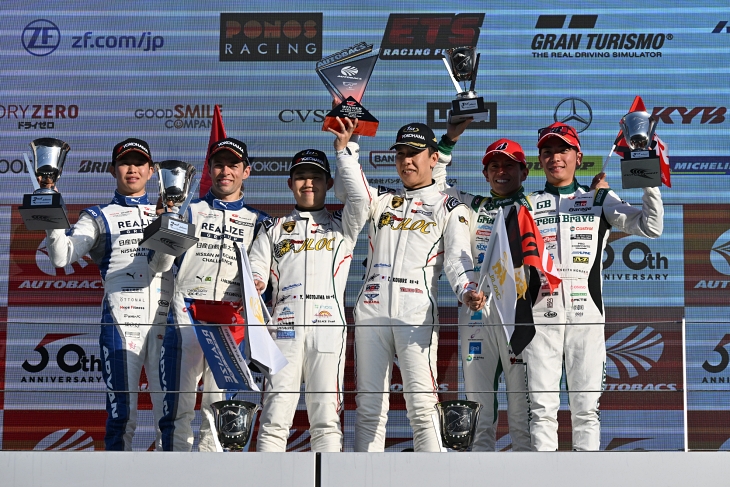
Meanwhile, the battle for second place had an unexpected new entrant as João Paulo de Oliveira charged from fourth place in the #56 Realize/Nissan Mechanic Challenge GT-R. Oliveira caught and passed Taniguchi for third place, then with fresher tyres, began chasing down Yoshida.
Yoshida fought as hard as he could on his ageing Bridgestones, but Oliveira wouldn’t be denied. With 15 minutes left, just a lap after the two touched wheels into Dunlop Corner, Oliveira thrust up the inside of Turn 13 and muscled his way through into second place.

Oliveira and Daiki Sasaki, who finished outside the points at Okayama, took advantage of the Nissan GT-R NISMO GT3’s BoP buff and executed a well-driven race to finish in second place. This was Sasaki’s first official GT300 podium – the only other time he’d stood on the podium in this class was in his very first SUPER GT appearance at the 2012 Suzuka 1000km, but he didn’t drive during the race itself, so he didn’t get points or credit.

Yoshida would salvage third place for himself and Seita Nonaka, who also got his first official GT300 podium in just his third appearance with Saitama Green Brave (at Autopolis, Nonaka did not drive in the race that Yoshida and Kohta Kawaai went on to win).
Yokohama teams finished 1-2-4 with the #4 Hatsune Miku AMG of Taniguchi and Kataoka finishing fourth to match its car number, as the last car scored on the lead lap.
The #31 apr LC500h of Kotaka, Nakamura, and Yuki Nemoto (who did not run) fought back to finish fifth, just six-tenths of a second ahead of the #2 muta GR86 of Tsutsumi and Taira, which began suffering from power steering problems in the middle of the race and could only finish sixth.
In seventh place was the #18 UPGarage Honda NSX GT3 (Takashi Kobayashi/Syun Koide/Yusuke Mitsui※) which gained three places towards the end of the race, followed by the #87 Metalive S Lamborghini GT3 (Kosuke Matsuura/Natsu Sakaguchi) in eighth.
Two good stories came at the end of the points-paying places, where the #45 PONOS Racing Ferrari 296 GT3 (Kei Cozzolino/Lilou Wadoux) finished in ninth place.
This made Wadoux the first woman to score points in a SUPER GT race since Cyndie Allemann did it in her first appearance at Okayama in 2012, more than a dozen years ago – and the pace shown by the team suggests it will not be her last points finish either.
In tenth, HELM Motorsports’ #62 Nissan GT-R (Kohei Hirate/Yuya Hiraki/Reiji Hiraki) clawed its way into the points in just the team’s second race in the series, 3.7 seconds ahead of the #7 Studie BMW M4 GT3 (Seiji Ara/Niklas Krütten/Bruno Spengler).
Tsutsumi and Taira lead the GT300 Drivers’ Championship after two races, but by just one point over Kogure and Motojima, eight points over Yoshida and Nonaka, and nine points over Gamou and Shinohara.
Two weeks before the 24 Hours of Le Mans, the SUPER GT Series returns for its second three-hour endurance race of the season, the Suzuka GT 3 Hours Race on 2 June.
Images © GTA