

What’s the first image that comes to mind when you think of a BMW race car? For most, it’s the sight of a white BMW sedan with the blue, red, and violet “M” tricolour carving its way around the Nürburgring Nordschleife.
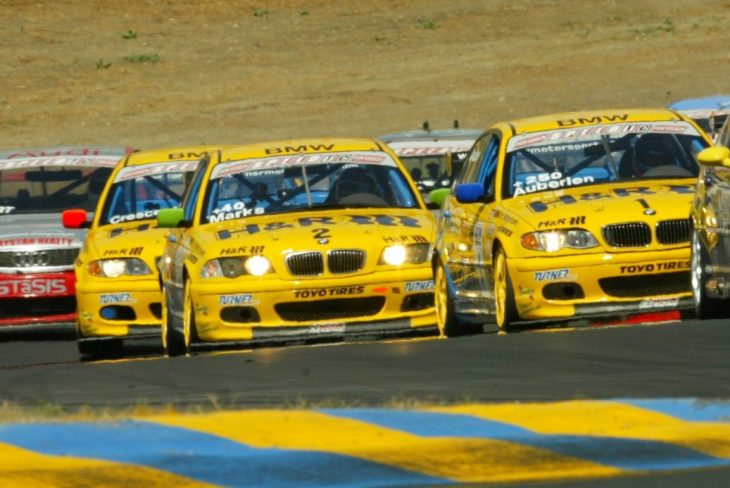
If that’s the first image, then what follows? Perhaps it’s a bright blue and yellow BMW dropping through the corkscrew at Laguna Seca or climbing the high banks of Daytona, run by a man with an insatiable appetite for tacos and trophies – and enough stories of time in American racing to fill an epic novel.
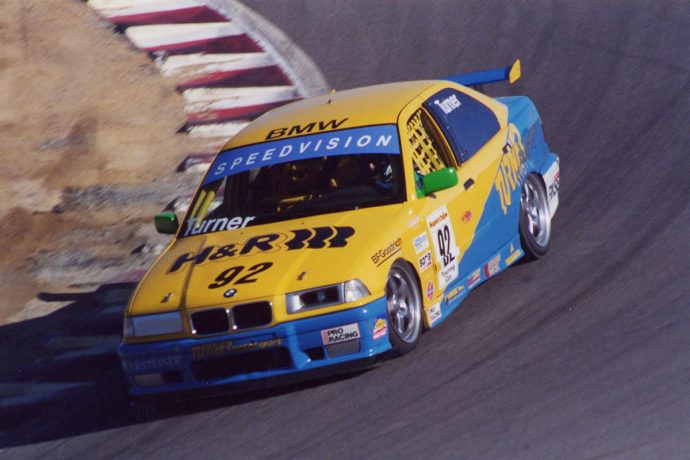
And when you think of that bright blue and yellow BMW, Turner Motorsport comes to mind. This weekend, Turner Motorsport will start its 557th race at WeatherTech Raceway Laguna Seca and, in doing so, will become the BMW M customer team with the most races anywhere in the world.
For team founder, owner, and namesake Will Turner, it’s still a lot to take in. “This one snuck up on us for sure,” Turner said of the impending milestone race.
It all began on 16 May 1998 – almost 26 years to the day of race #557 – when Turner entered his first pro race in the SCCA Pro Racing World Challenge at Heartland Park Raceway in Topeka, Kansas.
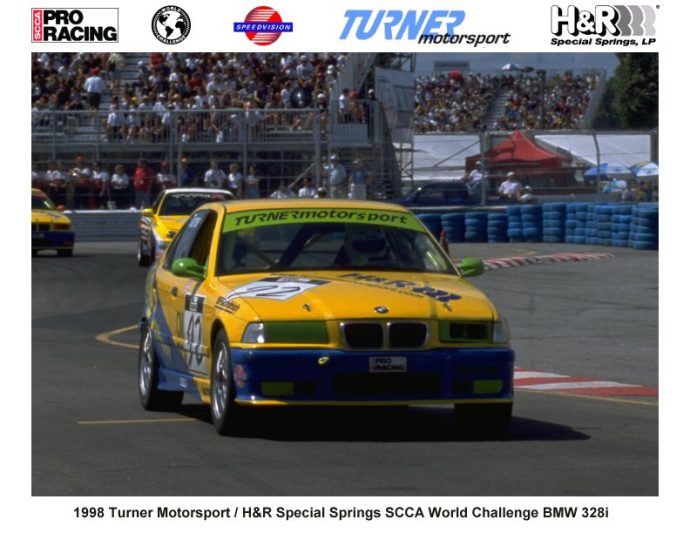
“Back in ’98, I remember when we built the cars to do our first pro start, I didn’t know if it was going to be a ‘one-race wonder’ or if I’d have the resources and/or the drive to do another one. It wasn’t my original plan to race professionally for 26 years. It was a hobby turned, ‘Why don’t I try this, see if I can make a go at it?’
Turner certainly had no ambitions at the outset of his racing journey to build a team that would have a presence in almost every corner of North American sports car racing, and could one day run more races with BMW than even the legendary Schnitzer Motorsport. In truth, he chose a BMW 325i as his first car simply because it was rear-wheel drive and had near 50/50 weight distribution.
The signature yellow and blue colours? He just wanted something more interesting than plain white or red. Then he stumbled on some recent British Touring Car Championship tapes, saw the yellow and blue Williams-run Renault Lagunas – and took inspiration from that, keeping that look throughout most of these 26 years.
“We’re still known as the yellow and blue BMWs all over the world. And it wasn’t my original plan to do that. I just kind of stumbled into it, and rode it out to 2024.”
Turner’s priority in those early days was keeping his upstart team afloat, taking out loans on university-supplied credit cards to fund that first season on a shoestring budget. “We really did start out very humbly,” he recalls.
“Building our cars in the shop with minimum resources. I would get my hands dirty, I would need band-aids for scraping my knuckles on stuff. Ordering pizzas in for all-nighters trying to get the cars ready. Sleeping five guys in a hotel room – somebody’s in the bathtub, somebody’s in the closet. That stuff really happened!
“Everybody jamming into a rental car. We did what we needed to do to go racing. I had people on my team that would be volunteers that really had no business in racing. We’ve gone through that part too.”
There was no big transporter lorry in Turner colours to carry the cars to every race in those days. “It was a beat-up Chevy Dually with mismatched tyres towing a wobbly old transporter. It was definitely a scene back then. But we had fun with it. And every year, we added a little more upgrades. Starting with getting people hotel rooms with only two or three to a room, instead of everybody in one room!
“Parallel to all this racing stuff I’m trying to sell BMW parts through the parts company to pay for this racing. That wasn’t necessarily profitable back then, either. It was side by side – I’m trying to grow a parts business, and trying to grow the race team. Fortunately, the better the race team did, the better the parts company did – and vice versa.”
But he and the rest of his team survived that first year – and in fact, not long after that first race in Topeka, Turner developed the passion to turn his hobby into something much bigger.
“Prior to 1998, I’d been club racing. When you’re club racing, you never really know if you’re talented, or you have a good car – or the person that beat you is talented or has a better car,” says Turner. “There’s a little bit of uncertainty when you’re going up through the ranks of amateur racing.

“I think once we entered the pro ranks in World Challenge, the competitiveness of the sport kind of got me. And not only did I just want to race, but I actually wanted to do better. I wanted to strive as a team and strive as a driver. And for me, I was both. I was building my cars, I was running my team – and I was driving.
“When I got that little taste of the competitiveness, I wanted to A) be a better driver, B) wanted to build a better car, and C) I wanted to run a better team. So that was the drive, all three of those things. Obviously, a better car makes me look like a better driver – if I’m a better driver, it makes me look like I can build a better car. And if we have a little bit of luck and success, it makes makes the team look good.
“As soon as maybe mid-season in ’98, I kind of caught the bug and said, ‘You know, I want to do this, I want to win – and this is going to make me happy!'”

From that first season, Turner and his team remained a fixture in what became known as Speed(vision) World Challenge. Then it expanded to the Grand-Am Cup, the precursor to today’s IMSA Michelin Pilot Challenge. In 2010, Turner Motorsport made its first Daytona 24 Hours start, beginning the team’s continuing presence in the highest levels of American sportscar racing – Grand-Am, then IMSA WeatherTech.
Along the way, there’s been great memories for him. “I had my first win in West Michigan in a professional race (in 1999). Didn’t think I had a chance of winning, and the planets aligned, everything came together – that was big.
“Certainly, winning your first championship is a big one.” Turner hired Bill Auberlen to drive one of his E46 touring cars in 2003, and Auberlen proceeded to win back-to-back Speed World Challenge Touring Car titles – Turner’s first two out of nine championships across IMSA and World Challenge (now SRO America). That was the start of a 20-year association between Turner Motorsport and Auberlen.
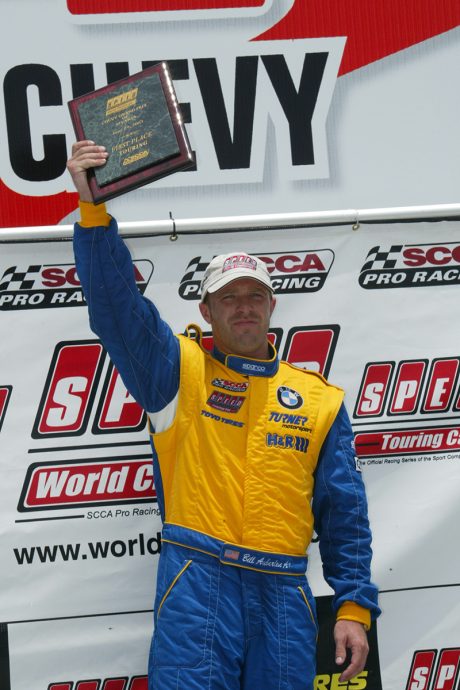
“He (Bill) was a big fish in a small pond then. But when you move him into a into a big pond, he’s still a big fish moving forward. Bill was most memorable,” says Turner, who laments not being able to provide his longest-tenured driver a chance to race for him in 2024. “Not having a place for Bill was tough.”
And when you look through the list of drivers that Turner Motorsport has had over the years – either as full-timers or as one-race wonders, you see that the team’s fingerprints are in both top classes of prototype sportscar racing today. Jesse Krohn, Maxime Martin, and Augusto Farfus are now part of the BMW M Hybrid V8 programme on either side of IMSA or WEC.
Reigning Daytona 24H champion Dane Cameron flies the flag for a different German marque these days – but not before racing with Turner ten years ago, right after the Grand-Am/ALMS merger. “We raced against Dane Cameron, and he was always on my radar. A guy like that, who jumped into the Turner program and just drove – meaning, he would just show up, and he would just drive and he would do great at it…he was a different type of personality than some of the other drivers that I had, a true jump-in-and-go driver.”
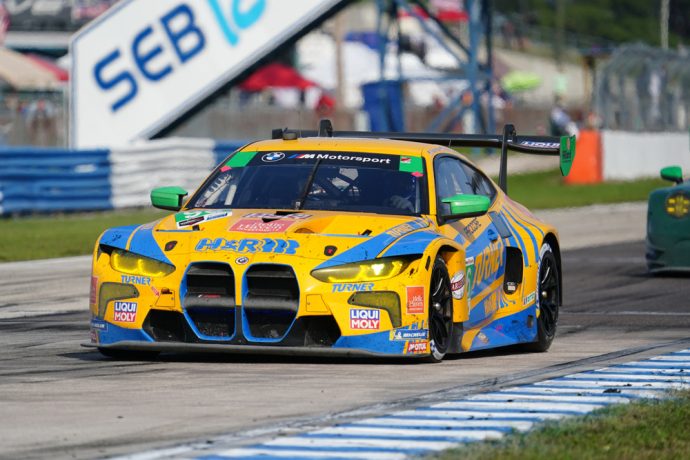
In 2024, Turner’s premier programme in IMSA is led by former club racer turned BMW works driver Robby Foley, the ace of the team alongside second-year team-mate Patrick Gallagher, who’s followed a similar path from the club level to IMSA’s rich semi-pro GTD class. They’re the ones carrying the number 557 in this weekend’s Motul Course de Monterey, driving the yellow and blue BMW M4 GT3.
Turner is proud of the roll of honour, of the great names that have driven for him before, and continue to race for him today. “I’ve learned over the years from working with a bunch of different drivers, that if you’re a if you’re a driver that’s on the Turner program, you didn’t get there by accident. It worked out because you were qualified to be part of our program. I have confidence in my drivers when they first get in the door. I realise my job is to give them the equipment and the crew so that they can be their best.
“I think some teams put a lot of pressure on their drivers, some manufacturers put a lot of pressure on their drivers. And fortunately, I don’t have to do that. Drivers do the best they can. And hopefully, the team can make them superstars.”
Today, Turner Motorsport operates in three different IMSA race series (WeatherTech Sportscar Championship, Michelin Pilot Challenge, and VP Racing Fuels Challenge) and two different SRO America series (GT World Challenge America and GT America), running M4 GT3s and GT4s – homologated race cars that Turner has purchased through BMW, the biggest change that he has seen in his 26 years of professional racing as a driver and owner.
“I’ve gone through building my own race cars, and then all of a sudden having the homologation race car era hit us. As recent as 2012 and 13, if your car wasn’t fast enough, you could make changes to it. You had all these different ways of making your car better,” he says. “And then – bang, all of a sudden, 2014 on, we have the homologation cars. And you can’t even use a lugnut that doesn’t have a part number on it from your manufacturer!
“You can’t make the car better by modifying it. So you look towards your drivers, and you look towards the strategy. And you optimize your engineers to get the setup just a little bit better than the next guy’s setup.
“I think the game has changed to a way more detail-oriented sport. Not only do your drivers need to be at the top of their game, but your crew, your pitstops, your organisation, and even your travel & logistics person need to be on top of their game. It makes it more exciting in a way, and less exciting in a way.”
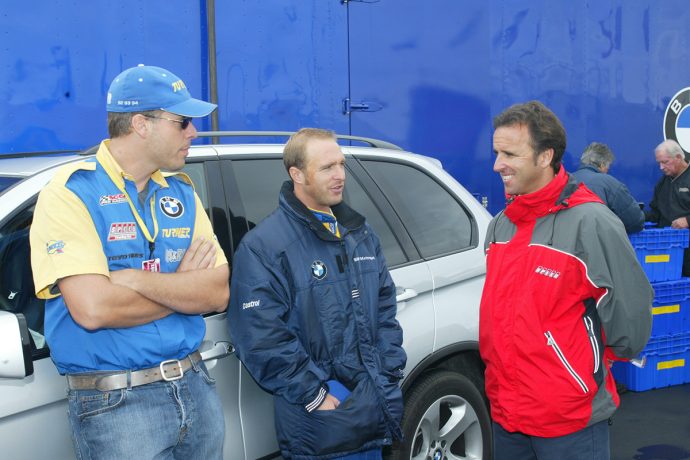
Whether it’s the track record of success or the fun-loving, snarky social media presence – or both – Turner has cultivated a genuine fan-friendly presence in the otherwise painfully serious and rigid world of sports car racing. Don’t get it twisted: Turner still takes the preparation and the business side of the sport seriously. But what’s the point in stressing out about what you can’t control, in a sport that already subjects the people in it to long nights and long periods spent away from home?
And now that the torch has been passed from Schnitzer to Turner Motorsport, Turner wants to continue to build his team’s unique legacy and to continue to be a part of this sport, for the sake of the people who work for the team and support its endeavours. “I think one thing that’s important, that has been a goal of mine, is the continuity of what we’ve been doing all these years,” he professes.
“It’s not just for me, I have a lot of my crew and a lot of my employees that have been working for me for a lot of years. And they support their family with racing. And I know it sounds kind of cheesy, but one of my goals is to make sure my guys and girls have jobs for the next year. And that’s always difficult in sportscar racing.
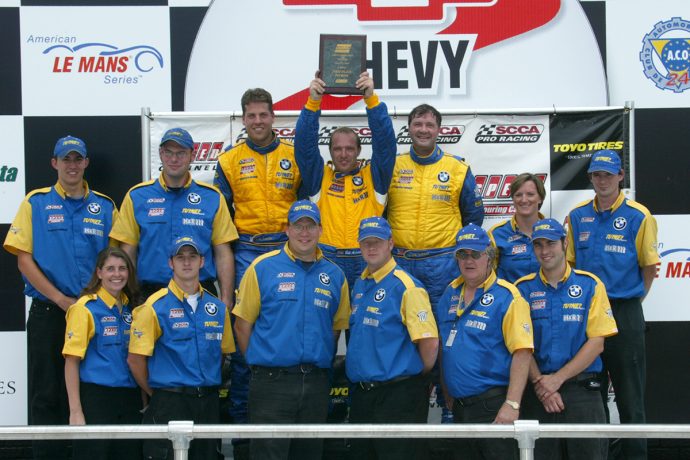
“Teams come and go, make a big splash, and then leave. The teams that have a solid core, there aren’t a lot of them. And it’s important to me to keep this thing going and make sure that the people that have worked so hard, and are as passionate about the sport as I am, have jobs moving forward.”
There’s not much left that Turner Motorsport hasn’t done with BMW in North American racing. Except win the sport’s two biggest races, particularly Daytona, the race where it all began for Turner at this apex of GT racing – but the race that, despite the team’s incredible track record, they’ve yet to win in 15 attempts.
“People have asked me before, ‘Would you rather win Daytona or win the championship?’ If you haven’t won a championship, maybe you want to win a championship – if you’ve won a championship, maybe you trade that in for Daytona,” as Turner explains.
“I want to keep doing this. I want to keep winning. The ‘big one’ for me is Daytona now. We haven’t come close – I’d like to say we’ve come close, but we haven’t come close! Not coming close to winning Daytona has prioritized it even more on my bucket list.

“The competition in IMSA has gotten so much more competitive. It’s so much more difficult to win a race right now. That drive makes me want to try to win races even more.
“There’s a carrot – and the further the carrot gets away, the more I want to chase it!”


