

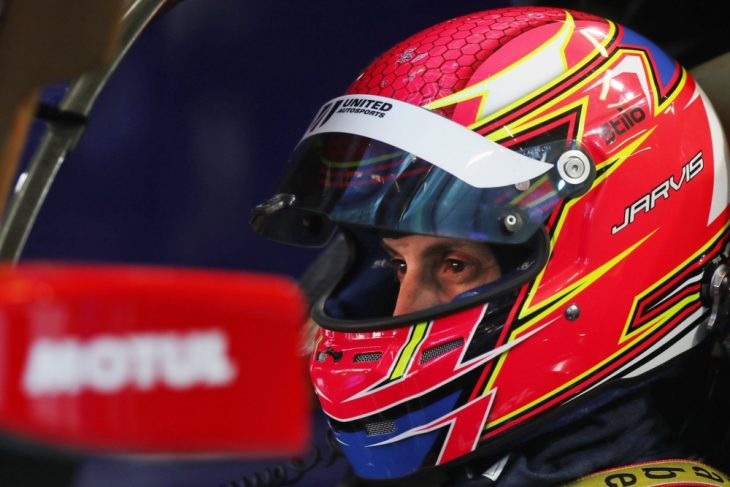
In the LMP2 paddock at this year’s 24 Hours of Le Mans, few drivers have more experience than 12-time Le Mans participant Oliver Jarvis. This year, the Cambridgeshire native is in the seat of the #22 United Autosports ORECA 07 and is hoping to add a second class win to his CV.
With the return of LMP2 to the FIA WEC just for Le Mans, Jarvis offered his insight on what it was like to part of this year’s class, which is made up entirely of guest entries entirely focused on winning the race, as there are no championship points on offer this time.
For starters, of the big talking points this year in the paddock is the performance level for the P2 cars, which are running to an identical spec to 2023. In practice for teams and drivers coming into the race from the ELMS paddock it’s taken some adjusting, as the ORECAs here are running with less power to ensure there is a clear gap in lap time between the P2 cars and the Hypercars.
“The Hypercars produce a lot of their speed in the straight,” he explained to DSC. “If you look [at the sector times], I think we were the fourth or fifth fastest car through the Porsche Curves – and that’s out of the whole grid.
“We’re talking hundreds of a second between us and the quickest Hypercar. We were quicker than the majority through the Porsche curves. As the tyres degrade, I think [the LMP2’s] will be quicker there.
“With no tyre warmers the Hypercar out laps still look very difficult. if we get caught with them on an outlap, it will be a huge time loss for us.”
This is one of the finer details in a complex LMP2 picture which sees the eighth edition of this spec of car participating at the 24 Hours. United Autosports has remained a front-runner throughout the current era, winning races and fighting for titles consistently in the ELMS and WEC (prior to the introduction of the current two-class structure).
In recent years the competition around United has strengthened in LMP2, but this hasn’t affected the team’s goals or level of expectation.
“If you’re looking at it, the calibre of teams and the calibre of drivers, it’s really hard to pick clear favourites,” Jarvis said.
“The standard has gone up, everybody’s had the cars a little longer, everybody continues to improve and develop. But I think we still have one of the best cars out there.”
Nevertheless, it was a struggle to squeeze into Hyperpole. Not at all helped by a self-admitted mistake on what would have been his fastest lap.
“Qualifying was more difficult than it needed to be!” laughs Jarvis. “I had a lap – it was easily good enough – but I had a small oversteer moment at Tertre Rouge. I thought I’d gotten away with it.
“From there, you’re just trying to find a gap, and you’re constantly on the back foot, under pressure. Sometimes, you have to back off, then the tyres aren’t in the temperature window. You’re at the mercy of people coming out of pit lane, Hypercars behind you, GT3’s in front.
“We literally did the lap on the last lap and snuck in.”
Of more concern to Jarvis is just what the 24 hours has in store.

“Even if you did give us the best car, and the best drivers, you can’t control other factors,” he explains. “Other drivers on track, safety cars, weather…
“24 Hour racing, and multiclass racing, is so unique in that really, anything can happen.
“I really think this is going to be a race of attrition, especially with the weather. I can’t emphasise enough, at four in the morning, in the dark, in the rain, in multiclass racing, it’s so easy to make that mistake, and end your race.”
The forecast has been at the forefront of everyone’s mind as we approach the weekend. So far, all track running has been done in dry conditions. But, that isn’t expected to continue through to the end of the race.
“It’s so hard to know at this stage what direction to take with the car. That’s the discussion we’re going to be having tomorrow or Saturday morning,” said Jarvis.
“Do you go for a car that’s good with the potential of rain coming? Or do you just go out with the car that you’ve run all week, and then just hope it works in the wet?
“I would prefer a dry race because I know we’re strong enough to go with it.”
Also at the forefront of Jarvis’s mind is the fact that he’s sharing the #22 United Autosports car with two rookies (Nolan Siegel and Bijoy Garg) for the first time in his career. But, in the modern day, that’s not as much of a disadvantage as it might seem.
“Nowadays it’s very different – they arrive, they’ve done simulator sessions, they’ve done pretty much 80% of the work before they get here,” he explained.
“Yes, it takes them 5, 10, 20 laps, but then they’re on the pace. That’s a big difference from 15 or 20 years ago. Back then, it took longer to learn the track just because they didn’t have the things available to learn the track, like simulators.
“We call them rookies – rookies to this race – but they already have huge amounts of experience. Nolan [Siegel]’s coming across from IndyCar, and we’ve seen the job he’s done there.
“Bijoy [Garg]’s running in the US and internationally, and he knows the car extremely well, so for him it was just learning the track.
“United in general has created a great environment for pro’s to race and rookies to come and develop.
“When I’m here I’m always trying to pass on some of my experience (to younger drivers) in a very short period of time, and it’s something I find rewarding.”
Featured image courtesy of United


