Good things come to those that wait. That was definitely the case last season for AIM Autosport and with the recent announcement that Bill Sweedler is now not returning to the team, the team hopes to find themselves eventually be in a similar situation.
In 2014, the team went from losing out on a package they thought was a done deal, only to later find them leading the TUSCC GTD class throughout most of the season, as well as dominantly winning the Tequila Patron North American Endurance Championship. This put the team, as well as team co-owner Ian Willis on what appears to be a perpetual roller-coaster ride.
Heading into the 2014, the Toronto Canada based team that had captured the GT class Grand Am Championship in 2012 was expecting to field a single car full season effort in this initial season of the TUDOR Sportscar Championship. Unfortunately that initial promise went away rather quickly.
“Initially we had an agreement that Emil Assentato and Jeff Segal would be returning with us once again”, stated Ian Willis. “Unfortunately that all fell apart and we were forced to start from ground zero to make something happen. The budget just went up too much for Emil to be able to commit again. When Emil had to back out, Jeff had to look for a ride and ended up at Level 5”. All of this occurred after the team had submitted a season long entry.
“Thankfully IMSA understood our situation and worked with us. Even though the full season entry was limited by the series, they understood where we were and worked with us and our $102,000 full season entry. They knew we were working on something and that we’d be there one way or another.”
“As we were still sorting things, Level 5 sent out some feelers, looking for some assistance for the race at Daytona. As a team, we didn’t have anything settled quite yet, so we opted to work with them. In the end, it ended up as a blessing for us. First off, it was interesting to see how other teams work, but eventually it gave us the opportunity to compete for the season, we just didn’t know it at the time.”

For those that don’t remember, the GTD finish at Daytona was a controversial one. The Level 5 Ferrari fought hard with the Flying Lizard Audi. During the fight, series officials thought they saw the Ferrari make contact with the Audi. The race ended with IMSA officials deciding to give the Level 5 Ferrari a post-race penalty for contact, something which the video clearly showed did not happen. That ruling led to a social media outcry, which eventually saw the Level 5/AIM effort rewarded with the class victory, although well after the proceedings were over. “It was well after the race was over that I found out the reversal of the ruling. By that time I was back at the hotel, exhausted and I just couldn’t muster the energy to go back to the make-up podium celebration for us. My emotions were still pretty raw then too.”
”It was after Daytona that we started to hear some things about Level 5 not returning. They were keeping a rather low profile and I eventually heard from Townsend Bell that they were out. I contacted Level 5 team manager David Stone, who said Scott Tucker simply didn’t want to continue any longer.”
“So we entered Sebring with what was car 556, numbered as 555 in order to keep the team points and then reverted to our 2012 championship winning Ferrari for our next race at Laguna.” From there the team completed the 2014 schedule and established a great relationship with drivers Bill Sweedler and Townsend Bell. The team led the TUDOR Championship for most of the season, but fell victim to a questionable BOP that stifled their challenge late in the season.
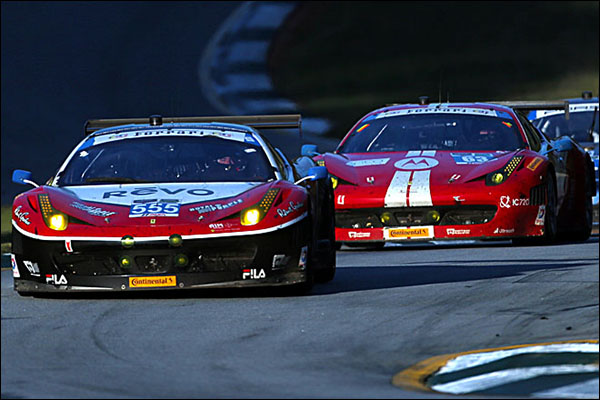
While they fell short in the season long chase, the team was able to celebrate the fact that they won yet another championship. It was at Petit Le Mans that they finally clinched the inaugural Tequila Patron North American Endurance Cup, a championship within the main TUDOR series comprising of the long races of Daytona, Sebring, Watkins Glen and Petit Le Mans. AIM won both the team and driver titles, as well as being an important piece of bringing the manufacturers championship to Ferrari.
“It’s awesome to be able to be the first winner of anything, certainly the Patron Cup in the inaugural year of the TUDOR Championship. We started the seasons without a program. I engineered the Level 5 car at Daytona with Townsend and Bill driving. When Level 5 pulled out it made for us to step in and fill a gap to complete the season and compete for the Cup. So a little bit of this win belongs to Level 5 as well. Our crew picked up the ball and ran with it. To win this championship is awesome.”
Unfortunately the team wasn’t really able to celebrate the championship they had earned. While Ian had indicated in the post-race that he so looked forward to partaking in some of the championship sponsors products, the series had other things in mind. “I got back to the truck, only to be greeted by the news that series officials had stepped in and said they needed the engine out of the Ferrari. Dyno testing was scheduled and the series wanted the engines right away. The crew, already tired and worn out from the build up for the race as well as the race itself then faced the task of removing the engine from the race car. It was after 3:00 am before we got away from the track. That was rough.”
After the fact, this move was appreciated more by Ian, especially with the imminent wind tunnel testing that is due to take place in Charlotte. It is here that the series will attempt further learn the aerodynamic tendencies of all of the cars. “I appreciate the series taking the cars to the tunnel to establish the downforce and drag baselines of the various cars. I just wish they had done this earlier in the season. If they had, we still may have had the chance to fight for the season championship instead of being pushed back due to the late season BOP.”
As a company, AIM is co-owned by three partners, Ian, his brother Keith and also Andrew Bordin. Racing is all that AIM Autosports does. That is their entire focus. It was back in 1995 that the team formed, kicking off with efforts in the open wheeled ranks. The initial push for the team was to get Andrew Bordin established as a racer and within 5 years get him into Champ Cars. The team was successful in getting that done, as Andrew did test an Indy Car, only to be forced to retire from the sport due to an injury sustained in an accident.
Their effort started off in the Esso Protec Canadian Formula Ford Championship, with a car that Ian and his brother Keith had built. That car, named the Aero2 (below) propelled Andrew to the series championship as a rookie and is still being raced.

Ian’s nephew Craig has used the Aero2 to great success where he won the B class championship with the car in 2013 and actually finished 3rd overall in the championship in 2014 in what is a 25 year old car, still utilizing the old Ford Kent pushrod motor.
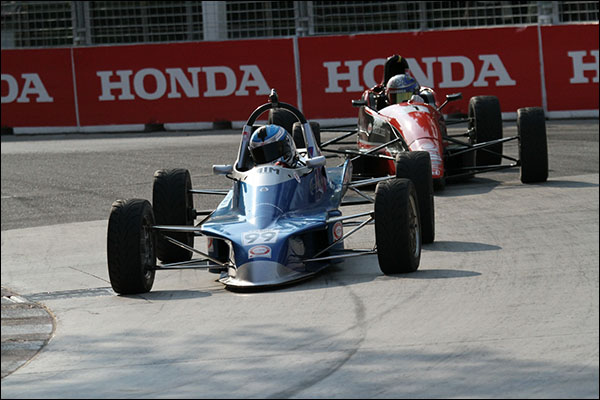
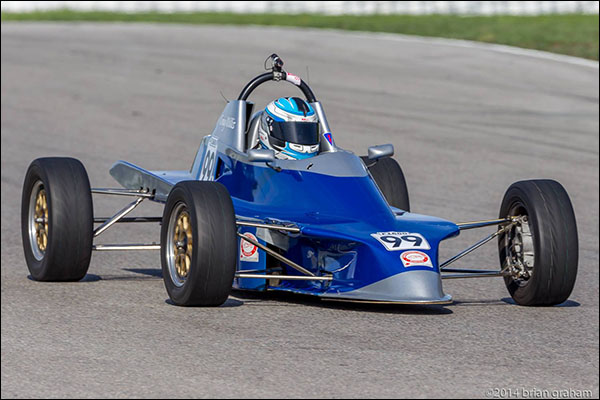
Throughout the racing career of the two chassis, they have completed a 78% record of finishing on the podium from 1995 to 2013. Not bad at all for a vintage eligible car competing in such a competitive class.
While forming the team, they based their strategy upon the Stewart Staircase of Talent that Jackie and his son Paul had so successfully established earlier on. By utilizing the Staircase, the team kept their cars when Andrew moved on to the next level, thus ensuring that there would be a car available for the next somebody to step into.
One of the keys to the success of AIM is indeed the crew. Ian is truly proud of his crew and what they have been able to accomplish. Because of that, when times have been tough, things have been found that will keep the crew employed. And there were some dry times, times when Ian was forced to work with other teams in order to bring in money. One of those instances was a stint that Ian served with Michael Shank, back when Shank was racing in Formula Atlantic. “But through it all, it has been worth it. I have absolute confidence in the team members. Their loyalty to us is apparent and we do everything we can do to repay that to them. Through the rough times, we’ve still managed to go without any lay-offs and we have no plans to so at all.”
The list of AIM alumni and their championships is impressive, including Andrew Ranger, James Hinchcliffe, Mark Wilkins, Brian Frisselle, John Edwards, as well as the 2012 Grand Am GT Champions, Jeff Segal and Emil Assentato and now Bill Sweedler and Townsend Bell.
As opportunities in open wheeled racing dried up, AIM too made changes, opting to head into sportscars. “I look back kindly at the Daytona Prototype era for us as a team. It came about because the open wheel racing scene was sort of falling apart. It was at the suggestion of Mark Wilkins’s Dad Greg that we looked into sportscars. He encouraged us to look into the Grand Am, specifically the Daytona Prototypes.
Eventually we bought a Riley with a TRD/Lexus motor from Ganassi and debuted the car at the July race at Daytona in 2006. That car, chassis 001 served us well and continued philosophy of using taking care of our product, something that we still do to this day. The crew is really good at keeping on top of things. We don’t cut corners, but we don’t go crazy on budget things either. We are very good at maximizing cost items and tracking mileage.”
“What I appreciated about the concept of the Daytona Prototypes was that it allowed a team like us to compete against the likes of Penske and Ganassi and beat them. It really was a good and solid concept for the teams, it was a formula that was cost effective and provided a solid foundation for competition. Unfortunately it wasn’t a hit with the fans of the sport and never drew the fans in.” While competing in the class full time from 2007 to 2010, AIM was a giant killer, as they earned 2 wins, as well as 3 pole positions.
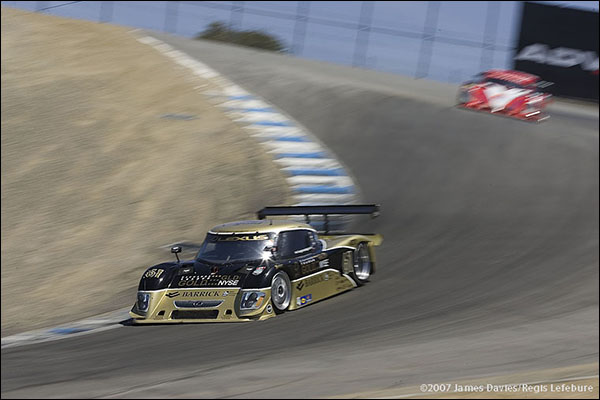
After their DP effort dried up, the team moved down to the GT class, winning the class championship with Jeff Segal and Emil Assentato in 2012 (below) and then in 2013 they combined with Remo Ferri to run again in the GT class. “Andrew, Keith and I had known Remo for quite some time. It was natural for us to work together, our facilities were located quite close together. Unfortunately it only lasted a year. We had some success, but not what we’d hoped. It was hard to run both programs, much more difficult that I’d imagined. But in hind sight, it was more successful than maybe we thought. I learned some from the experience and we helped bring Remo up to speed and establish his successful Pirelli World Challenge Program.”
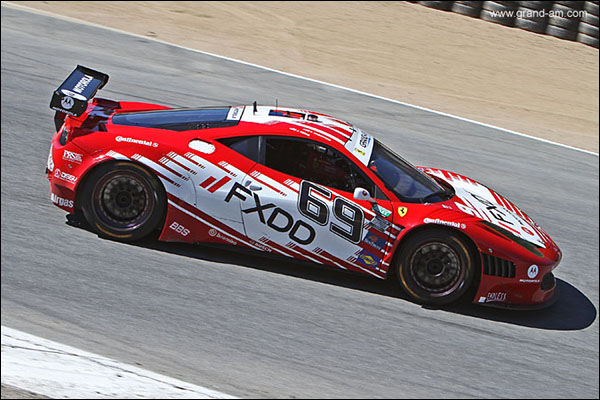
As far as running a Ferrari racing program, Ian couldn’t be happier. “From the perspective of a privateer team, I couldn’t be happier. I’m blown away with the reliability of the Ferrari product. In the old days they may have had a reputation for issues in the road cars, but no more. The engines we use are scheduled for 10,000 K before rebuilds and we had one go 15,000 before we sent it back for rebuild. It came back and is in the car now. The car itself has 40,000 K on it now and it is still going strong.”
Being a 2011 Ferrari, built to GTD spec, it can be converted to full GT3 spec and that is one of the options for the can next season. But that is something for the off season that still needs to be sorted. Right now, Ian feels that the cost to compete in the full season GTD championship is a bit expensive for the typical privateer. “As of now, the cost for the full season is quite high. For many privateers, the NAEC championship is a much better proposition.
It is much more in line cost wise, but the series is working to improve that. As the series becomes stronger, it will become more attractive to sponsors, which will bring the out of pocket cost to compete for a privateer down. As it stands now, I expect to see the full season entry count to be lower than what we saw this last season, but I do expect the NAEC races to be fully subscribed, mostly because of the prestige events that are featured. As far as the Pirelli World Challenge, I see it as a better value proposition right now, simply because of the sprint format. But with that series separating the GT and GTS classes into separate races, that series will be changing. It will miss some of the spectacle that traffic provides in multi class racing. One class may not be enough, but at least it is easier to follow than the current 4-class format that we have in TUSCC.”
In the meantime, Ian and the crew at AIM is hard at work, once again sorting possibilities for the upcoming season. For many, the ups and downs would be very difficult to deal with, but according to Ian, “in this business, it is something that you just get used to.”
Gary Horrocks