

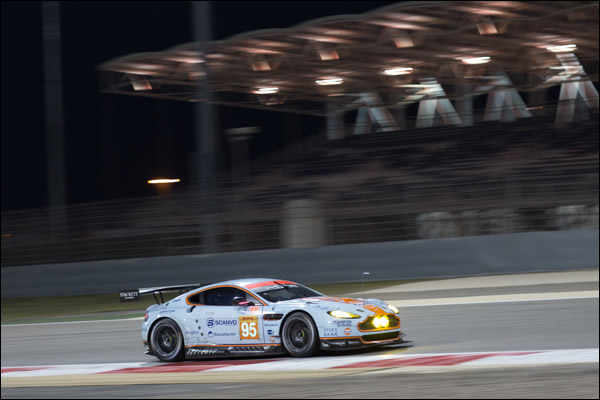
I often concentrate in these articles on the battles for overall honours, and that, inevitably, means that I end up talking exclusively about the LMP1 class. In a departure from that tradition, and in no small part because, as expected, Toyota dominated that race, I intend to look in some detail at the race for the GTE Pro class during the Six Hours of Bahrain.
In a nutshell, it boiled down to a race between two cars: the no. 51 AF Corse Ferrari 458 Italia of Gianmaria Bruni and Toni Vilander; and the no. 97 Aston Martin Vantage V8 of Darren Turner and Stefan Mücke. Although the Danish-crewed Am-class Aston Martin was involved in the battle early in the race, it was never really going to be a long term factor in the GTE Pro class fight.
From previous experience, the AF Corse team knew that their Ferrari could comfortably complete the race on five pit stops. A race pace of 2m 00s per lap would probably not be possible, but if it were, and if each pit stop could be achieved in 1m 15s, then, provided the team had a perfect race, a distance of 177 laps might be achievable. Compared to the 175 laps that Bruni and Vilander had completed to win the class in 2013, Amato Ferrari probably reckoned that would be sufficient this year.
The Ferrari’s range on a tank of fuel at Bahrain was 30 laps, which would take around an hour to complete, and hence meant that pit stops for re-fuelling would have to be within a couple of minutes of the top of every hour, if the ‘ideal’ strategy was to be achieved.

Before the race, there was much talk of tyre degradation, but it was unclear how badly it would affect things, and what tactics would be used in the race to overcome it. Some were suggesting that tyre performance would ‘fall off a cliff’ before a GTE car would get through a tank of fuel – others smelled bags of sand at play.
Before the Six Hours of Shanghai, the Astons had received a slight increase in weight (10kg) and this added to the British team’s worries on the highly abrasive Sakhir track. Even if they could manage 30 laps on a tank of fuel, which seemed unlikely, would the tyres last that long while still providing adequate lap times?
The answers would only become clear during the race itself: the longest stint completed by the Aston during free practice was seven laps, so that the nine it did in qualifying had already taken a toll on the tyres. The Ferrari had also done nine qualifying laps, so the first stint would be particularly critical, and more than likely, would be the shortest stint of the race.
After a little over half an hour of the race had elapsed, what could have been a pivotal decision was taken in Race Control. Full Course Yellow, to retrieve a bollard from turns 6/7. The regulation required everyone to slow down to 60km/h, giving an opportunity for some serious fuel-saving, but also the chance to call at the pits for those who thought it was a good idea. But was it?
In the LMP1 class, Toyota thought so, and brought both its cars in: Audi and Porsche each brought one car in and left the other one out. At the moment when the yellow flags were shown, Darren Turner in his Aston was behind the no. 95 GTE Am car of Nikki Thiim, the two of them both within a second of Bruni in the Ferrari, almost exactly half way round the lap. A full 90 seconds would elapse before either car reached the pit lane entrance; plenty of time for decisions to be made about pitting or not.
My suspicion is that Astons adopted a ‘copycat’ position: whatever the Ferrari did, it would do. Both teams (rightly) expected the neutralisation to be short, and that racing would be underway again in short order. As they came past the pits, they all stayed out; although just behind, both Manthey Porsches dived for the pit lane to rid themselves of their ageing Michelins, Patrick Pilet’s now being 27 laps old, including formation lap and qualifying. Mid-way round the next lap, the green flag was shown; but by then both Manthey Porsches had changed tyres, refuelled and were back on track.
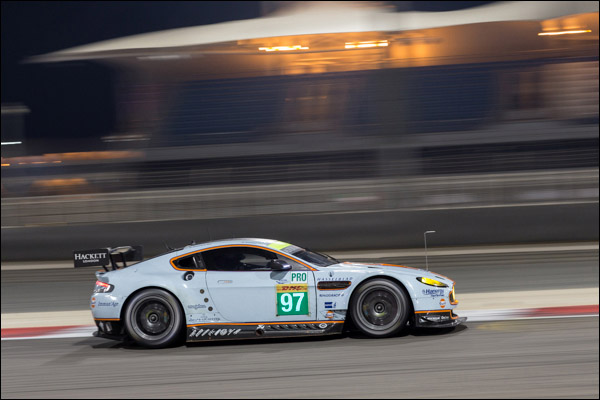
The reason that this is significant is that it allows us to simulate precisely what would have happened if Turner had also chosen to pit. But I will come back to that. For the moment, Darren was more concerned about getting past Thiim, which he managed on lap 19. The tyres on the Aston were going off though, and after three laps on which he wasn’t able to better a time of 2m 02.4s, Turner came in to hand the V8 Vantage over to Stefan Mücke. With only 48 minutes of the race elapsed, it was quickly evident that five more stops would be required to get the Aston to the end of the six hours.
Meanwhile, Bruni stayed out for another three laps, bringing him (just) into his refuelling window for a five stop race, even though none of his laps since the Full Course Yellow had been under 2m 02.5s. Aston’s strategy seemed to be to short-fuel the car, do shorter stints, and avoid the dreaded ‘tyre drop-off’; Ferrari’s was to drive for an hour, deal with the tyre wear, refuel, and ‘stick with the plan’.
The table below shows the stint lengths and the average lap times achieved by the driver in each:
|
Stint
|
Driver
|
Laps
|
Average lap time
|
|
1
|
Bruni
|
26
|
2m 05.071s
|
|
2
|
Vilander
|
30
|
2m 02.271s
|
|
3
|
Bruni
|
30
|
2m 01.889s
|
|
4
|
Vilander
|
30
|
2m 01.963s
|
|
5
|
Bruni
|
30
|
2m 03.382s
|
|
6
|
Vilander
|
27
|
2m 02.839s
|
|
Stint
|
Driver
|
Laps
|
Average lap time
|
|
1
|
Turner
|
23
|
2m 05.236s
|
|
2
|
Mücke
|
28
|
2m 01.670s
|
|
3
|
Turner
|
27
|
2m 01.676s
|
|
4
|
Mücke
|
26
|
2m 01.189s
|
|
5
|
Turner
|
24
|
2m 03.545s
|
|
6
|
Mücke
|
22
|
2m 01.262s
|
|
7
|
Turner
|
23
|
2m 02.313s
|
Note that the first and the fifth stints are slower, due to the brief Full Course Yellow periods that occurred during those stints, and while the procedure undoubtedly works to briefly neutralise the race, note also that it is only those stints in which the Ferrari is quicker than the Aston. Methinks perhaps 60km/h is quicker for some than for others…
That can of worms aside though, there is no doubt that the Aston Martin was quicker than the Ferrari in green conditions. The fact that the gap at the end of the race was just 1.8s, despite the Aston spending 1m 26s longer in the pits than the Ferrari, is testament to that. Around 24 seconds of that pit time was taken to fix the failed rear wing structure on the Aston Martin, but the remainder of the time was accounted for as the Aston did one extra fuel/tyre stop as a result of the shorter stints shown above.
What the Aston Martin was not able to do though, was to get itself into a position from which it could overtake the Ferrari on the track. Even though, in a mercurial final stint, Darren Turner managed to gain 18s in just 42 minutes, Toni Vilander somehow didn’t look like he was going to just wave the Aston past.
At various points during the race itself, the Ferrari and the Aston would circulate nose-to-tail, but at no time did the Aston ever make an overtaking move that stuck. Turner and Mücke’s chase was valiant, but ultimately looked always to be in vain, although it did force Bruni and Vilander to extract the maximum from the Italian V8.
What if, I wondered after the race, Darren Turner would have come in for his first stop during that first Full Course Yellow? The stop would have been used to replace the rear tailgate, of course, but slightly less fuel would have had to be added, and, by my reckoning, the car would have spent 1m 32s in the pit lane. That would have brought it out just before the green flag waved, and on the assumption that the Ferrari would still have stopped at the end of its 26th lap, would have put Stefan Mücke ahead when Vilander rejoined having taken the Ferrari over from Bruni.
The problem for the Aston team would then have been to get the car to the finish – 158 laps – on just five further stops. It certainly would have been possible: four stints each of 26 laps, and two of 27 laps would have done it; but would the lap times have suffered as a result of the higher tyre degradation?
One can never be certain of these things of course, but let’s assume that the average lap times for the longer stints would have been 2m 01.4s (for a 26 lap stint) and 2m 01.8s (for a 27 lap stint). Further, remember that the remaining pit stops would also have been a little longer (as more fuel would have been required), so assume 1m 16s for a stop following a 26-lap stint, and 1m 18s for a stop following a 27-lap stint. Finally, don’t forget to add time to allow for the second Full Course Yellow period.
Put all the data into a bit of projection /simulation software, and you can establish that the Aston Martin would have made its final pit stop on lap 147, just one lap later than the Ferrari. Not only that, but the Aston would exit the pits eleven seconds ahead of the Ferrari, and instead of Turner having to chase down Toni Vilander, it would have been the Finn who would have been doing the chasing.
In conclusion, it seems to me that someone at Aston Martin should have called Darren Turner into the pits when the first Full Course Caution was given – it may have been a risk, and it may be that my calculations are flawed, but I reckon the decision to stay out cost Darren and Stefan the race.
And if John Gaw is reading this and agrees, then I am available any time he likes!
Paul Truswell
Aston Martin Racing Team Principal John Gaw responded very positively to Paul’s analysis above but added the following very interesting clarifications:
In reality what lost the race was running the WEC camera:
Point 1 – That particular tailgate was the one for the WEC camera Arial so without the camera the car would have had a different tailgate which may not have needed replacing
Point 2 – at the stop to change the tailgate it took 5/6s to remove/replace the Arial lead which is only on when you are running the camera!


