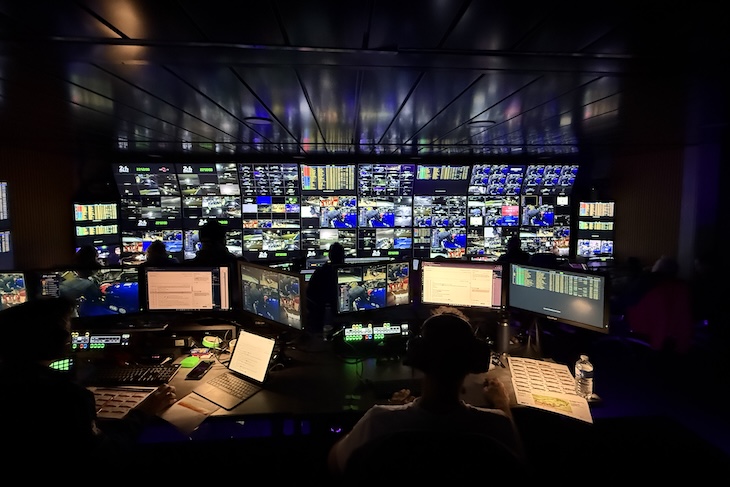
Almost all viewers of the 2026 24 Hours Of Le Mans will have experienced the pictures and the commentary that have defined this world-class event in the modern era – one new name for DSC, Czech journalist Tereza Černá, though, chose to dig a little deeper into what makes the whole thing tick – and she found some impressive answers to her questions!
For most FIA World Endurance Championship rounds, the television production follows a familiar template. The infrastructure moves from circuit to circuit, camera positions change, and the same crew adapts to a different venue.
Le Mans is a bit different.
The race lasts four times longer than a standard WEC event, but the television operation grows by considerably more than that. The increase isn’t simply about adding extra cameras or extending commentary shifts. Every department expands. The world feed requires more personnel, more infrastructure, more editing teams, more replay operators and more engineering support than any other event on the calendar.
Planning starts months before race week. Camera locations are surveyed, kilometres of fibre are installed around the Circuit de la Sarthe, onboard systems are allocated to teams, and broadcasters begin coordinating their own unilateral productions alongside the international feed.
By the time the first practice session begins on the Wednesday of Le Mans race week, a temporary television network has been built around the 13.6-kilometre circuit.
Building the world feed
The international signal is produced by AMP Visual TV on behalf of the Automobile Club de l’Ouest. While every broadcaster adds its own commentary and studio programming, the pictures seen around the world originate from the same production.
For the 2026 race, that production used 212 cameras. There were 54 cameras positioned around the circuit itself, supplemented by 4 dedicated pit lane cameras. A helicopter joined the operation during the race, alongside a drone, a cable camera above the circuit and several remote-operated cameras placed in locations where conventional camera positions were not practical.
The onboard programme has also continued to expand. Thirty-nine cars carried onboard systems, covering every Hypercar entry and the majority of the LMGT3 field, and 4 LMP2 cars. Each equipped Hypercar and LMGT3 carried 4 miniature cameras, LMP2 only 3, giving the director multiple viewpoints from inside the cockpit. Twenty-three cars still compete without onboard cameras, meaning trackside coverage remains essential for following the full field.

Not every camera presents the same technical challenge. One position, known internally as Camera 17, requires almost seven kilometres of fibre-optic cable simply to connect it back to the production compound. Across the circuit, every camera, microphone and communications system ultimately feeds into the outside broadcast facilities where the international signal is assembled.
The production team also has access to CCTV images around the circuit. These feeds are not used as broadcast cameras but provide valuable situational awareness when incidents occur away from the primary television coverage.
The duration of the race is only one factor. The scale of the production is largely dictated by the size of the circuit and the amount of infrastructure needed to cover it effectively.
Increasing the crew
The cameras are the most visible part of the operation, but they represent only a fraction of the personnel required to produce the broadcast. Behind every feed is a production team responsible for directing, replay, graphics, audio and transmission.
Around 70 people are directly involved in producing the live broadcast before camera operators are even counted. Directors, assistant directors, replay operators, graphics specialists, audio engineers, vision mixers and communications staff all contribute to the international feed.

Separate teams handle highlights editing, post-production and digital content throughout the event. Their work continues while the race is still in progress, producing edited packages for broadcasters, manufacturers, teams and social media platforms without affecting the live production.
The way endurance racing is consumed has also changed significantly over the past decade.
Producing a world feed is no longer enough. Television remains the priority, but broadcasters now expect live streaming outputs, digital clips, social media content and tailored material for rights holders almost immediately. The production has evolved accordingly, becoming a multi-platform operation rather than a traditional television broadcast.
The challenge is maintaining consistency across all of those outputs while the race itself continues uninterrupted.
Producing a 24-hour race
Le Mans introduces challenges that do not exist at any other WEC round.
Unlike a 6-hour race, no single production team can work continuously for the whole race. Commentary teams rotate throughout the event, combining experienced broadcasters with former racing drivers. The broadcasters maintain continuity and explain the broader narrative, while drivers provide technical context on traffic management, tyre strategy, fuel saving and other race-car driver know-how.
The same principle applies throughout production. Directors, replay operators, graphics teams and engineers work in shifts to maintain concentration during the overnight hours. Unlike many sports, there is no natural break in play. Editorial decisions continue every minute of the race.
Those decisions become increasingly complex as the event develops.
With Hypercar, LMP2 and LMGT3 racing simultaneously, multiple stories unfold at the same time. The production gallery constantly weighs the battle for the overall lead against class fights, recovery drives, pit stop strategy and incidents elsewhere on the circuit. Choosing what viewers see is often as challenging as capturing the images themselves.
There are even specific members of the production team who are responsible solely for driver radios. As team communications are monitored in real time, they decide which conversations add editorial value to the broadcast and whether those messages should also appear as on-screen transcripts. This is now done with the help of an AI system that records and transcribes every radio transmission, allowing the human at the screen to determine relevance, accuracy and suitability for transmission.
Branding also plays an important role. Camera selection affects sponsor visibility, manufacturer exposure and the commercial commitments attached to the international broadcast. Editorial decisions remain independent, but every angle has implications beyond simply showing the race.
A global production
The audience explains why Le Mans demands such an extensive operation. Though not with an official number, the following of the French endurance classic is expected to be 3-5 times larger than a standard WEC race.
Looking at the 2025 figures, that edition generated more than 49 hours of live programming, distributed to broadcasters in more than 190 countries. A total of 532 television rights holders, production companies and broadcast personnel were accredited to the event.
In France alone, cumulative television audiences reached 10.7 million across the race weekend, with 1.5 million viewers watching the finish live. Away from traditional television, the event generated 394 million digital impressions and 153 million video views.
Those figures help explain why Le Mans has become a showcase for broadcast technology. Every year the production grows, whether through additional onboard cameras, expanded digital distribution or new ways of presenting data to viewers.
By the time the chequered flag falls on Sunday afternoon, the television operation has been running almost continuously for days. The world feed has combined more than 200 cameras, dozens of production and presentation roles and multiple teams working in shifts to deliver uninterrupted coverage of one of motorsport’s most demanding events. For viewers, it’s still a single broadcast. Behind it is one of the largest production operations in racing.