Completing this short series of catch-ups with Brazilian Prototype builders Sigma P1 is an updated trot through the technical package that underpins their latest G5-EVO and the story of some of the choices made by the team.
It’s a long way from the earlier Sigmas seen in the high-performance – but extremely high cost – Brazilian Endurance Series.
That’s not to say that the G5 EVO lacks punch – it doesn’t, but it does feature advances in pretty much every area that matters to a privately run racer – Safety, serviceability and, of course, cost!
Overall
The purchase cost of the car was reduced by more than a third compared to earlier offerings from Sigma P1, this despite the inclusion of a brand new interior, new headlights, electric air-conditioning, advanced electronics and a host of safety upgrades.
Purchase and operating costs are lower than GT4 cars with performance currently capped (see below) and broadly GT3 levels.
Current price is $185k USD, complete and ready to race.
Powertrain
The new powertrain makes a huge contribution to the reduced cost and is effectively a third of the price of previous Sigma P1 machines.
The cars are currently limited to 58% throttle to keep the car at GT3 pace for the Sport Prototipo Cup.
Engine:
The G5 EVO now incorporates, for the first time, an in-house designed and developed Sigma P1-branded engine. The normally aspirated 6.2 litre V8 unit is based on the GM LT2 Chevrolet Small Block Corvette C8 baseline engine.

The engine, though, now features port injection for reduced complexity and ease of maintenance;
The spec includes:

- Forged pistons and connecting rods, “off-the-shelf” GM Performance heads;
- Sigma-designed dry sump pan + Brazilian Indutech 4-stage oil pump;
- Sigma-designed flat front engine plate with integrated coolant and oil lines;
- Integrated triple chamber coaxial oil-air separator and 9 litre stainless-steel oil reservoir bolted directly to the oil pump assembly, o-ring sealed;
- Oil circuit simplification effort allowed reduction of metal-braided oil hoses from 12 to only 2 per car (to and from the oil radiator);
- Sigma designed, jig-welded stainless steel exhaust headers: CNC laser-cut and engraved straight sections and standard 90° and 45° curves; cost reduced to 30% of previous custom handcrafted exhaust headers;
- Cadillac DPi-inspired positioning of the ignition coils, beside the engine block: spark plug cables are super short, are less exposed to convective heat from the exhaust, and can easily be accessed through a big hatch under the car.
- Engine BOM cost went from $37k USD (600+ HP Katech Engineering or Audace Tech engines) to c. $24k USD (530 HP unrestricted, 450 HP with race map);
- Sigma P1 expects to run the engine for a whole season before rebuilds, over 60 hours;

Since the new transmission (see below) is longer than the previous XTRAC unit, much work went into keeping the engine as short in total length as possible. From the bell housing face to the tip of the front damper pulley it is 630 mm long, including the front mounted oil reservoir.
The engine is also low in profile, only 115 mm from crankshaft centre to the lowest point of the dry sump pan, a very neat package.
Sigma P1 is considering the potential for selling these engines for other applications and third parties and has already had an enquiry from an unnamed LMP3 chassis manufacturer about it.
Transmission:
Sigma P1 have replaced their previous XTRAC unit with SADEV’s new SLR 90-20 transaxle – the same unit as used in the successful Nova prototype NP02.

The selection of the SADEV unit follows a long-time search for appropriate units – since 2018 Sigma P1 have been looking for a 600Nm+ transaxle with rear differential, with the only available solutions being transversal LMP2 transmissions, at costs that were not economic for the Sigma P1 market.
SADEV’s cast aluminium bell housing comes ready to fit the new engine;
The complete package, including input shaft, bell housing and gear position sensor, costs less than $20k USD (the standard XTRAC LMP3 gearbox costs c.$44k USD in the Brazilian market;
Sigma P1 has designed their own pneumatic gear change valve + actuator module that costs as little as $200 USD, using high-quality standard industrial parts. Internal data shows it can be replaced yearly (the alternative Megaline gear change actuator can cost up to $9k USD, with the yearly factory rebuild costing from $4.5k to $7k;
The longitudinal transmission + rear differential architecture allows for a big, voluminous riveted steel + aluminium rear crashbox.
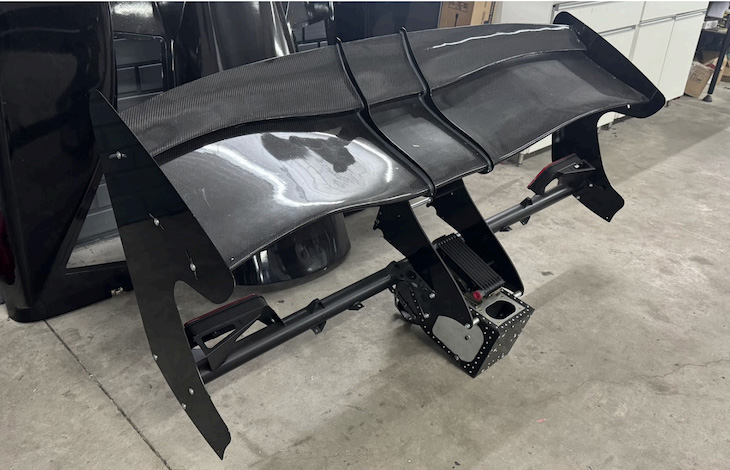
The rear crashbox has been designed to serve multiple functions: it’s a structural element and holds the rear wing support, acts as the rear lifting point for the external hydraulic jack, and it’s internally sealed, acting as a 4.5 L catch can for the engine and transmission fluids.
Electronics and Wiring:
- In another first for the Sigma P1 concern, the G5 EVO sees an entirely in-house designed electrical system;
- Wiring looms are co-designed and built by Cabello Motorsport, the leader in motorsports wiring in Brazil, who also supplies Stock Car Brasil and other series;
- The looms are modular and divided into 7 main subsections, facilitating quick repair/replacements;
- The car’s electric system is based around the new FuelTech FT700 Vehicle Control Unit;
- The unit features a brand new hardware and software architecture for the Brazilian electronics manufacturer.
- FuelTech is a world leader in drag racing applications, dominates the Latin American market and is growing fast in the USA;
- Fueltech’s circuit racing development is happening apace with a lot of input from Sigma P1.
- The Vehicle Control Unit (VCU) controls all engine and transmission functions;
- It also includes GPS track timing and video-logging;
- Power is distributed through a remote electric main kill switch and a 16 channel ECUMaster PMU-16 power distribution module.
- A 200A external charger to keep the air conditioning system running while the car is stopped in the pits. Sigma P1: We designed their own charger + external battery carts for this purpose.
Suspension:
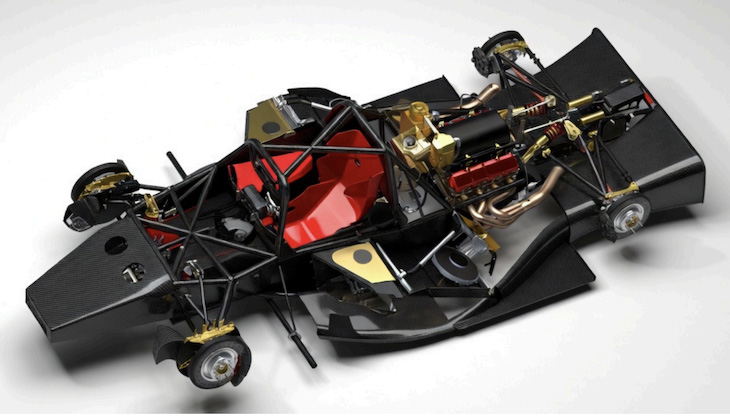
The G5 EVO retains most of the suspension components just as they were in the unlimited class car, although with much lower loads (half the peak downforce and less power).
For the G5 EVO, the 3rd element/bump stops have been removed to simplify setup and driver feel, while keeping front and rear
adjustable roll bars;
The front roll bar is cockpit-lever adjustable, allowing the driver to keep the car neutral as the rear tyres naturally wear out faster during the race;
Sigma P1 uses oversized Teflon-coated rod end bearings, which are a bit softer but extremely resistant to wear and hard kerb impacts. Most of them are expected to survive the whole life of the car.
In a neat development in-house for the rear suspension, Sigma P1 designed and developed a new set of CNC laser-cut and CNC bent pickup points. “These are not as easy as they sound, as they have to be carefully designed to break as ‘mechanical fuses’ in case of crashes, while never rupturing prematurely. We had to develop special tools directly with the supplier to be able to replicate the parts with high quality,” says Sigma P1’s Pedro Fetter.
As a result of this development, the complete set of rear suspension pickup points (10 parts) cost less than a single billet aluminium pickup point of Sigma P1’s previous design!
Sigma P1 has secured a Brazilian supplier for high-quality 2-way adjustable remote reservoir pressurised racing dampers, and is supplying them with Sigma P1 branding.
Driver Safety and Comfort:
The brand new interior incorporates a number of evolutions in driver comfort and safety:
The driver is completely surrounded by upholstered composite panels, from the seat and armrests, all the way to the pedals. The leg tunnel is compliant with FIA LMDh requirements;
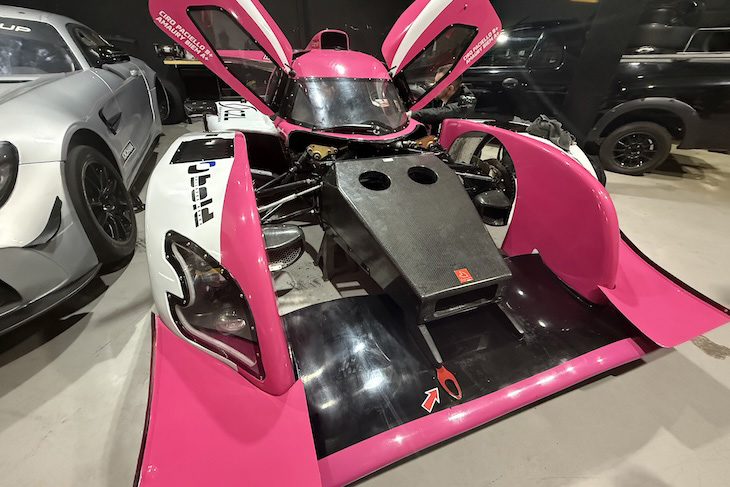
The new steering wheel uses a simple helical cable while containing all button connections within a billet main case.;
The system integrates three rear-view cameras in addition to the 2 standard convex side rear-view mirrors. One in the centre has the camera on the roof aiming rearwards, while the two side ones cover the mirror’s blind spots;

The central screen also acts as a front + rear video logger, offering a backup in case of main camera failure/drained battery/etc;
An automotive electric air conditioning system was installed behind the driver’s seat, requiring a tight packaging of the rest of the onboard auxiliary systems (air compressor and reservoir, battery, PMU, etc.). The system is rated at 20000 BTU/h and is capable of dropping cockpit temperatures by up to 10°C. The cooled air outlet blows directly through the seat back, or can be directed to the driver’s helmet;
A strong 5” electric fan also blows dry cold air to cool the electrically assisted steering column, the VCU and the windshield to avoid fogging.

In past Sigma P1 cars there were issues accommodating driver crews with significantly different heights. The prior solution was to adjust the steering wheel position and pedal box for the taller driver, and then make huge seat inserts for the shorter driver; this offered risks since the shorter driver was, at times, almost outside the seat, offering little side body and helmet support.
For the G5 EVO Sigma P1 have designed a new adjustable steering column (120 mm) and pedal box (150 mm). These allow both tall and short drivers to remain perfectly inside the sidewalls of the seat while allowing quick adjustability during pitstops;
The adjustable pedal box was a big part of the G5 EVO redesign. It uses redundant recirculating-sphere linear bearings and rails, twin oversized locking pins, and can withstand a driver braking with all his force while under crash-level deceleration’s.

With the safety cell in the form of a raised-nose prototype, there were subsequent serious space constraints for the pedal box.
Available third-party adjustable pedal boxes would not fit the super tight height limits. Most market solutions have the master cylinders under the driver’s feet, but in the case of the G5 EVO that would not work; those parts needed moving to the front, entering the front crash-box volume in the most forward position.
The final pedal box weighs in at just over 10 kg, thanks to the use of generative geometry on a TIG-welded steel main structure.
The car has a brand new FIA FT3 homologated autoclaved rubber fuel cell, manufactured by Serviço Aero Técnico (SAT) in Brazil.
A central 6-litre stainless steel catch tank houses the 2 scavenge pumps, 2 redundant pressure pumps, a pressure regulator, and a level sensor. This means pressurised fuel runs exclusively through a single metal braided line, from the top of the fuel cell to the engine, greatly reducing the chances for leaks or fuel spills in case of crashes.
The car also has an FIA homologated 2.25L LifeLine Electric fire suppression system, covering the cockpit, the fuel cell and the engine bay in foam with the press of a button.
Chassis:
The first Sigma P1 chassis design was created between 2015 and 2017 around overall LMP1 dimensions of the time, but using the most severe tube-frame prototype resistance requirements available.

The G5 EVO’s chassis is the result of continuous evolution of that safety structure, including the experience gathered from some very severe crashes.
The tube frame is 100% 4130 chrome-molybdenum alloy steel, CNC laser-cut, CNC bent and completely TIG-welded.
A single chassis is composed of 473 individual numbered parts, including 101 tube sections.
Only the 2 main roll hoops have bends. All the other tubes are triangulated.
The national homologation of the safety structure follows current FIA Group E requirements for tube frame special prototypes and formulae.
Sigma P1s report, detailing simulations, materials and manufacturing specifications, was approved by the local ASN, the CBA, with great margins.
The most severe crash for a Sigma P1 car ever happened last year in an unlimited P1-class G5: the driver lost control of the car at a curved braking point at over 230 km/h, lost some speed on the grass and crossing the track, and hit a single-line tire barrier, straight on, at 123 km/h.
Sigma P1’s engineering team estimates a peak deceleration between 70 and 90 G. The minimum number is from the GPS/Log recorded (the internal accelerometers went off-scale), and the higher number was estimated from the force theoretically required to rupture the bolts holding the engine attached to the bell housing.
The engine moved 1” forward from its berth.
The carbon-fibre front crashbox was completely destroyed, and a few tubes at the very front of the chassis deformed as intended.
The safety cell volume was kept intact, and the driver was able to leave the car on his own.
Later exams found a tiny fracture on his L4 vertebra, which did not require surgery. The driver was back to racing 2 months later and the car was rebuilt in the same period.
Car Build:
The new design was strongly focused on making the “car build” better.
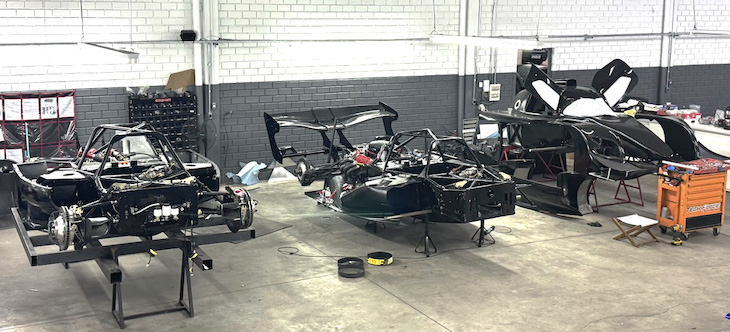
Build time went from over 1000 hours (classic P1 cars) down to 300 hours for the G5 EVO
Indeed, one car was built in exactly 10 business days, with no overtime for the mechanics.
Ease of manufacture, ease of assembly, ease of maintenance. The Sigma P1 engineering team was relocated for months right beside the first car being assembled, so mechanics could have easy access to indicate demands for quality, fit or finish of all the parts.
Some parts reached up to 7 design revisions before the very first car was delivered.
Sigma P1 has over 80 direct manufacturing suppliers, and has implemented its own quality control programmes in a number of them.
The 4th EVO unit (G5-10) was delivered directly at Interlagos with no prior shakedown near the factory (Sigma P1 manufacturing base is 1000 km south of Sao Paulo). The car completed a 3-day race event, including two 1-hour races at GT3 pace with no significant issues.