Audi’s long history of success at the Le Mans 24 Hours has seen different tweaks made to the Audi LMPs down the years to squeeze the best out of the available package.
The need to do so surrounds the very high average lap speed, in excess of 240 km/h at Le Mans compared to an average of c.180 km/h at Shanghai, 25 per cent slower on averge!
While the visual changes in Audi’s Le Mans spec cars in previous years were barely recognisable to the untrained eye, recent years have seen a progressively more radical path taken.
“The long tail was an effective distinguishing feature for the public,” says Jan Monchaux, Head of Aerodynamics at Audi Sport.
Together with his development team, Monchaux has developed a bodywork version specifically for the 24 Hours of Le Mans. This configuration finished flush with the rear wing and at the same time contained many more detailed solutions.

 The goal: significantly lower drag by omitting downforce, in order to be better equipped for higher speeds. Downforce is the force that aerodynamic components create. It presses the race car onto the ground and, as a result, permits higher cornering speeds.
When the version that creates less downforce runs for the first time this weekend, the differences to the sister specification, which generates higher downforce levels, are more apparent than ever before. A fundamentally different front fairing, modified sidepods, openings relocated on the inner surface of the rear fenders for venting the wheel arches, and the bodywork rear edge featuring an unusual rear wing support, characterise the newly developed race car.
“Because downforce at Le Mans is not as important as it is at other tracks, we developed other solutions and new body shapes,” says Monchaux. “In this way, we reduce the drag. All the turning vanes, wings and similar elements are no longer mounted so steeply in the airflow; the curvature of the wing profile is less.”
In addition to the bodywork surfaces, the technology beneath is also affected.
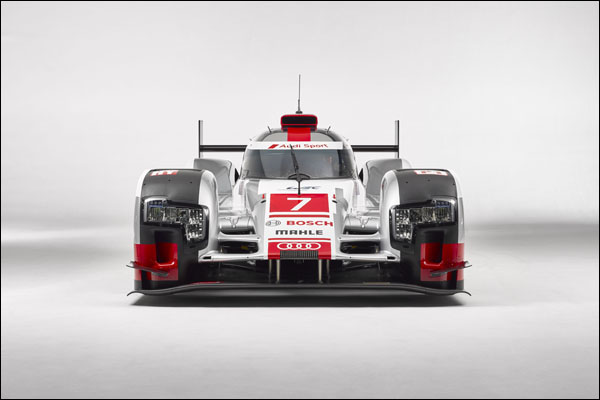
“The cooling system’s requirements are different. We were able to reevaluate and adapt the flow across the cooler, because at Le Mans less air mass flow is necessary due to the higher speeds,” he continues. New suspension solutions, which restrict the spring displacement on the car to a smaller range, provide additional help. In this way, the turbulent airflow under the race car is reduced.
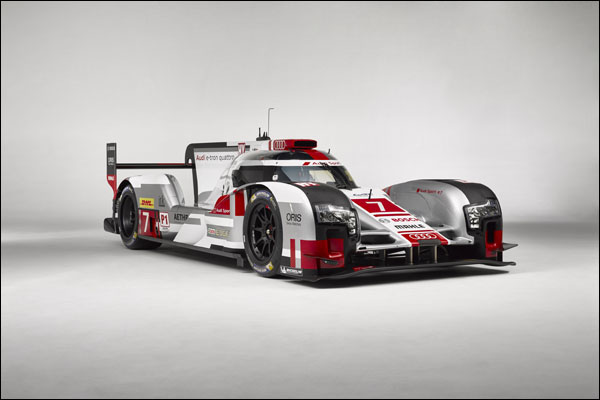
With the sum of all innovations, Audi further improves the efficiency of its hybrid sports car. “We expect to benefit from this and to be able to use these advantages on other race tracks.”