FIA
GT Championship - Proximus 24 Hours of Spa The 2006 Proximus 24 Hours concluded with one of the finest finishes to a 24 hour event - ever.
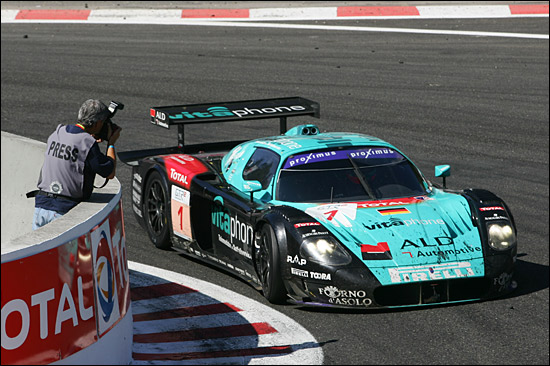
Behind these two, the Saleen had had too many minor interruptions to be right in contention, while the GLPK Corvette, which had harried the Phoenix Aston Martin and the Vitaphone Maserati throughout 18 or more hours, was in real trouble with its chronic oil loss. As Anthony Kumpen explained, at one point “Mike (Hezemans) was coming into the pits – and he didn’t want tyres or fuel – only oil! I think we used 100 litres of oil in the race.” So despite Kurt Mollekens suggesting, on Sunday morning, that the Corvette probably wouldn’t make it to the finish, it did indeed make it, to a praiseworthy third place. But delays and problems for the V8s meant that it was between the V12s for the overall and GT1 victory. Eric van de Poele and Andrea Piccini have helped to build up a full picture of what was taking place in the last two hours or so – although as the former admits, “when you’re in the car, you don’t have much idea of the whole pattern.” An example of that would be that even a couple of days after the race, Eric had no idea how much time he made up on the Phoenix Aston Martin, during his double stint on Sunday afternoon – so we can help him by including that detail further down the page. What problems had any of you had with the Maserati, before you got in for that double stint towards the end of the race, Eric? “Just two punctures, that was all. I had one in the night, and I think Andrea (Bertolini) had one too. The good thing about my one was that it happened almost at the end of a stint – but the bad thing was that it happened at La Source. When a race is as close as this, where every second counts, you look back and wonder if you should have tried to go faster on the way back to the pits – but would that have damaged the car if you had? “But other than the two punctures, that was it. Even at the end of the race, the Maserati was perfect, just perfect.” And the health of the two cars fighting for the lead was certainly one factor that helped decide the outcome. Andrea Piccini: “We had a small problem on the Aston Martin – we had a little understeer, and it wasn’t performing as well as it had at the beginning of the race. The Spyker had turned in on me at the downhill hairpin (Rivage) on Sunday morning, and after that the front was a bit ‘gone’: we were losing something like six-tenths of a second each lap, and we had more wear on the tyres. If the car had been like it was at the beginning of the race, I would have had a much better chance against Eric.” So at 13.00 on Sunday, three hours to go, we had Michael Bartels in the Maserati, Jean-Denis Deletraz in the Aston Martin – and they seemed sufficiently well-matched that we anticipated that only a problem for the DBR9 would see it lose first place, at 16.00, to the MC12 – because the Aston Martin had the advantage of pitting on the hour, whereas the Maserati had got onto a different schedule, and was pitting at approximately 20 minutes past the hour (after which it was half a lap or more behind the DBR9 - and therefore it would presumably still be at the end of the (last) hour). The official positions at 21 hours into the race were: 1 #1 Maserati MC12 21:01:32.822 But notice that the elapsed time is just past the hour: the Aston Martin had just pitted, and was effectively leading with three hours to go, assuming its fuel strategy would allow it to run the rest of the race on two more stops, at 14.00 and 15.00.
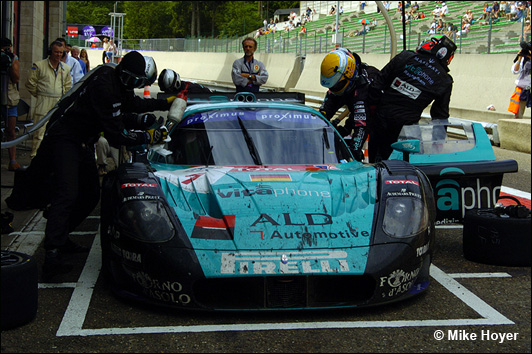
Michael Bartels pitted at 13.22, at which point, with Eric van de Poele taking over (above), Jean-Denis Deletraz led by 85 seconds on the road (all timings from our race notes, as MST’s figures for the second half of the race don’t seem to be available). It was this 85 second difference that was more significant than the gap at 21 hours and one and a half minutes – as explained above. But now we had the van de Poele effect – which was magnified once rain started falling. Andrea Piccini suggests that “I was up against the fastest driver in the Maserati – and they had three professionals in that car.” Eric van de Poele disputes the fact that he is normally the fastest man in the MC12, “because it’s not so easy to come into the team and join the regular drivers and be fast straight away. You want to be fast, but you cannot risk making any mistakes. But thanks to the Vitaphone team, I was able to test the car at Mugello, and then I had some laps at the Spa test day – and of course I raced the car (to the win) last year. But that chance to test before the race was very important.” Before the rain started to fall, van de Poele set a 2:18 lap, then consistently set 2:19s – while Deletraz set one high 2:21, but was generally lapping in the low 2:23s. “Jean-Denis is doing a great job in the car this year,” comments Andrea Piccini, “and Lemeret did a good job too.” But their rival, the Belgian Spa-specialist, looked unbeatable on this day, in these conditions, in that “perfect” Maserati, on his favourite race track. And that was before the rain began to fall.
We reckon that van de Poele got the gap down from 85 seconds to 56 in 12 laps – but surely the scrap would intensify with Piccini at the wheel? We didn’t know at the time that the DBR9 was carrying some slight damage. Deletraz pitted, on schedule, at just before 14.00, Piccini took over, on slicks, and the Belgian in #1 led by 62 seconds. “It’s always difficult for a new driver to be straight onto the pace in those conditions,” comments van de Poele. “I had the advantage over Piccini because I knew the track conditions. And Spa is my track.” The Belgian has such an intimate knowledge of Spa-Francorchamps that he knows exactly where to push really hard – over the kerbs for instance. In a quick comment immediately after the race, he pointed out that if they’re not too wet, some of the kerbs have more grip than the tarmac – and there he was, moving the Maserati right out to the full extent of some of the kerbs, while Piccini was typically staying right off them. The Maserati was visibly quicker than the Aston Martin. “Using some of the kerbs also gives you a smoother exit, without risks,” added van de Poele, “but obviously you need to know the track. It was lucky I was at the wheel (when it rained).” So there he was, using the limits of the tarmac and kerbs, the car moving around under him – but all the time looking very, very smooth – and very, very quick. And the gap between the cars grew – from 62 seconds just after 14.00 to 83 seconds just five laps later. This was when the rain was at its heaviest, and vdP’s advantage was probably at its greatest. But the Italian in #5 did bring the gap down on some laps after that, and when the Maserati pitted just before 14.30, the gap was 88 seconds. What we couldn’t have known at the time was that Eric van de Poele, aged 44, was about to commence another stint. “We had planned it that I would do a single stint, but Georgio (Ascanelli) came on the radio and asked me to do another one. That was a really good decision.” In fairness though, Piccini was down to a very good pace straight away – and it was the second shower of rain, the heavier one, that allowed the local man, with all that local knowledge, to open up the gap. “There is something else you need to now about driving in those conditions,” continues van de Poele. “It is very important to keep up the speed so you keep up the tyre temperatures – and then you keep the grip. If you still have the grip, you still have the speed. If you lose speed, you lose grip and you go much slower – and you can’t get the grip back. And so he pitted – and stayed in the car. Remember how van de Poele was 85 seconds behind when he started his double stint? Now, after a pit stop for each car, he was only 10 seconds behind. We believe some of the 78 second gain occurred at the stops, but it seems reasonable to assume, and using the lap times we jotted down, that the Belgian had actually gained something like 55 seconds on the track – in an hour. It seems rather crude to suggest that the race was all but won (with an hour and a half left) – but effectively it was. That ten second gap shrank to nothing within a handful of laps – despite Piccini getting the “PUSH” signal.
“We then decided to stay right behind the Aston Martin, to give him some pressure. We knew he had to take on a full load of fuel, and we didn’t need a full load.” Even when traffic allowed the Aston Martin to pull out a few lengths, that Vitaphone Maserati was right on its tail again within a corner or two. “I’m sure Piccini is quicker than me normally, but in those circumstances, ‘we had a good wind’,” offered van de Poele, ever the gentleman. But there were another couple of twists to come in this amazing final stage of the Spa 24 Hours. Piccini duly pitted at 15.00, handing over to Marcel Fassler – “I had driven for eight hours, pushing all the time,” said Piccini – and now the Maserati led by 1 minute and 52 seconds. “I was getting a cramp,” explains van de Poele, “and anyway Georgio Ascanelli wanted me to pit a little early, so we could take on less fuel.” We’re not sure about that comment – and anyway, wouldn’t it have made sense to leave the quick man at the wheel for as long as possible? As soon as he vacated the car, Eric van de Poele disappeared. Where were you?
“I decided to go straight to the medical centre, which was only 10 metres away from our pit. There were so many people around… so I sat there and had some frites! “The only problem for me was that I was moving a little in the belts. It was an advantage for us all to use the belts the same, but I was a little bit loose throughout the race – and it was quite tiring on my back.” Almost the last twist was that Michael Bartels stalled the Maserati as he tried to leave the pit apron – but he got it going the next time (below).
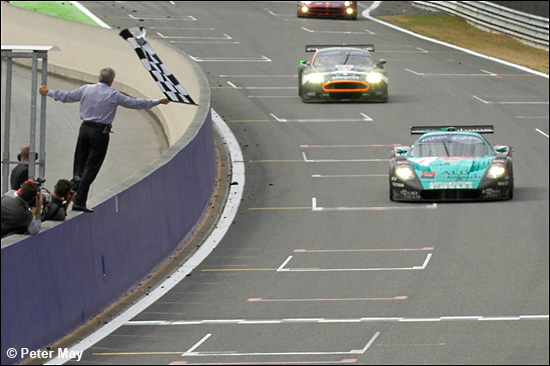
“It was quite tricky to get the car moving with the pit limiter on, so I used to switch it off to get the car moving, then switch it on again,” explains vdP. “I don’t know whether Michael did the same or not.” Bartels popped out of the pit lane before Fassler rushed down the pit straight, and next time by, the gap was six seconds. With half an hour to go, the gap was nine seconds – and assuming no mistakes, the Vitaphone team did have it sewn up. Presumably the Phoenix pit stop with a lap to go was to ensure that the DBR9 didn’t run dry on the last lap – or on the slow-down lap, and have no fuel for the scrutineers to test?
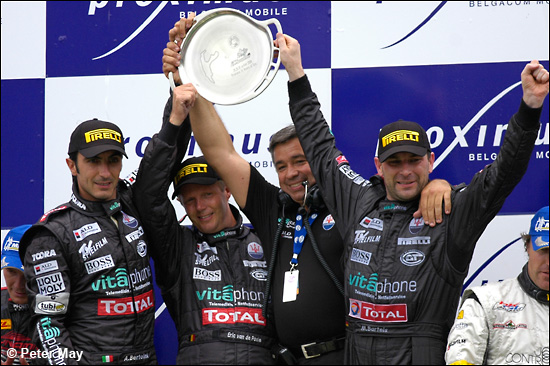
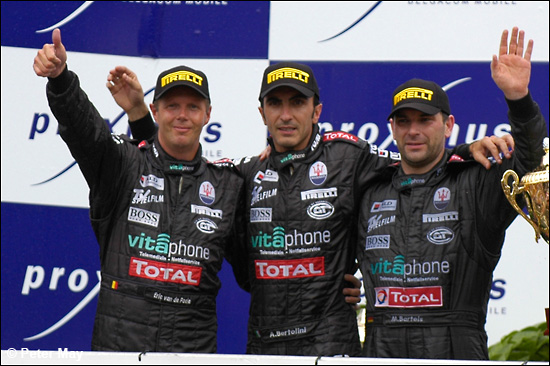
Eric van de Poele duly paid tribute to the whole Vitaphone team – “It was a fantastic effort, a fantastic team effort, to reach this goal. We didn’t have the fastest car on the track, but the team did a great job.”
He then explained that with Andrea Bertolini’s test driver role at Ferrari, the Italian had played a part in two wins this weekend – Ferrari having taken a 1-2 in the latest Grand Prix. Which led to a mention of Eric van de Poele’s next race, at the Grand Prix Masters at Silverstone. He’s loving that series, and even suggested that the reason why young drivers want to get to F1 is because “F1 is a step up to the Grand Prix Masters!” Spa on Sunday
afternoon reminded me of some of the great drives in the past at
this wonderful track (yes, it’s not quite the same now as
in the ‘70s) – by the likes of Rodriguez, Siffert and
Ickx, for example. Perhaps the similarity between then and now was
stronger because the Maserati is, in some ways, reminiscent of prototypes
from the past – certainly more so than the more road-car look
of the Aston Martin. Yes, I know you can buy an MC12 road car….
but it is almost a prototype, isn’t it? But even the MC12
needed someone in it who could produce a performance that was exceptional
last Sunday afternoon – and that man was Eric van de Poele.
I believe I’ve now seen 25 24 hour races, and this one ranks
right up there with Le Mans in 1988. If that was Jan Lammers' race,
this one was surely Eric van de Poele's.
|

 Until
Eric van de Poele got into the #1 Maserati at 13.22 on Sunday afternoon,
we’d had a very, very good 24 hours – especially where
it matters, at the head of the race. But until the Belgian took
over, for what turned out to be a double stint, it seemed to be
stalemate between the Vitaphone and Phoenix entries. I was sure
that Phoenix had the advantage, if only because of its pit stop
timing – on the hour. If the victory was going to go to Vitaphone
again, someone would have to produce something quite remarkable
out of the (his?) hat.





Contents Copyright © dailysportscar.com. All Rights Reserved. |