It’s been a whirlwind June here: suddenly Le Mans was all over, other racing beckoned – and it’s taken until July 1 to try and catch up, and pay due credit to the achievements of all those responsible for the double finish of the purple TVRs at Le Mans. We can do so
now, through the eyes of Bob Berridge, Lawrence Tomlinson and Nigel
Greensall, three of the six drivers. The driver line-ups were:
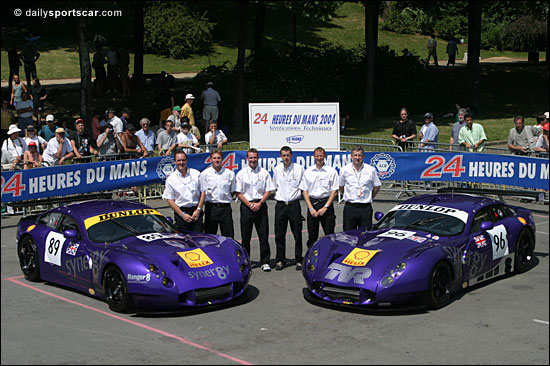
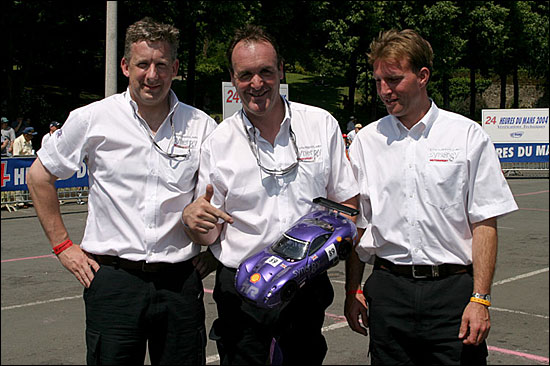
The two cars finished eighth and ninth in GT, 21st and 22nd overall, with 300 and 291 laps to their credit. The GT Class showed a much more competitive bunching of the cars this year than last: a similar performance then would have seen the #89 in a serious race for sixth in class. Here are Evans, Berridge and Stockton... with one they made earlier?
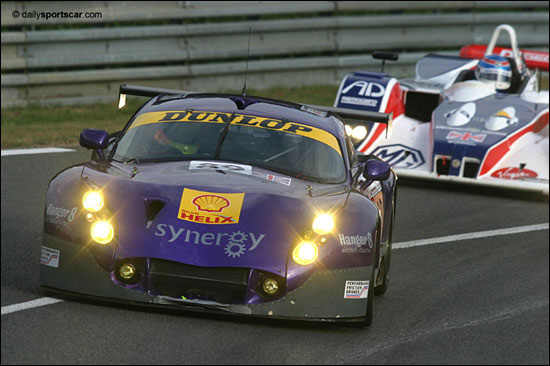
Bob Berridge’s description of the work that went on in the build-up to the race also puts the effort into perspective: “We did six months work on the cars in three months, and we started four months late.” Sebring had been something of a nightmare for the team, where “we barely ran for more than 45 minutes without a problem, it was the worst motor racing experience I’ve ever had,” says Berridge. But there was time, just time, to put things right. “For the Le Mans Test Day, we hired Les White, who was the number one mechanic on the second placed Bentley at Le Mans last year. That gave us a big step forward, and by Monza, we’d made another step forward. “Between Monza and Le Mans itself, we at last had the time to go through the cars absolutely as we wanted to, and that was the foundation for what we achieved.” The story of the TVRs at Le Mans in 2004 really began at the final race of the 2003 British GT Championship, after which the decision was taken to heavily revise the basic T400Rs. There were a number of issues that Berridge, car owner Gareth Evans and Hugh Chamberlain wanted to resolve, and collectively they’d taken a long hard look at the TVR product – and came up with many, very significant, changes. Hugh Chamberlain made up his mind about the diff. and rear suspension after taking a long, hard look at the basic set-up – lying on his back, on the workshop floor. Decisions taken then eventually resulted in the wider, more bullish appearance of the cars at Sebring, and Berridge pays due credit to Dave Lampitt and his SpecFab concern for all the engineering changes. “Dave Lampitt did a marvellous job, but because of the time scale, we’re still scratching the surface of what these cars can achieve. We went into Le Mans with the intention of bringing both cars home, so ultimate speed wasn’t the target, although we made some impressive gains compared with the performance of the same two, basic chassis in 2003. With two finishes at Le Mans behind us, now we can work on performance.” But the racing season being what it is, that won’t include demonstrating that performance at the second event of the LMES: dramas at Donington Park – the car’s first FIA GT race, where Stockton was attacked by a brakeless Viper – brought the inevitable decision to take a step back, and prepare thoroughly for Silverstone in August. “We spent a day in the wind tunnel after Monza,” continues Berridge, “and we also had an excellent test at Pembrey. At the Test Day at Le Mans, we recorded a best speed of 280 kph, not much more than they achieved in 2003, but by race week, we were up to 297 kph, and we knew (as we had done all along) that we were going in the right direction. “Our approach to the race was based on what Ian Khan and Michel Neugarten had achieved in 2003, when they finished third: they had lapped steadily in the 4:22s, as simple as that." Very smart, Messrs. Caine, Berridge and Stockton.
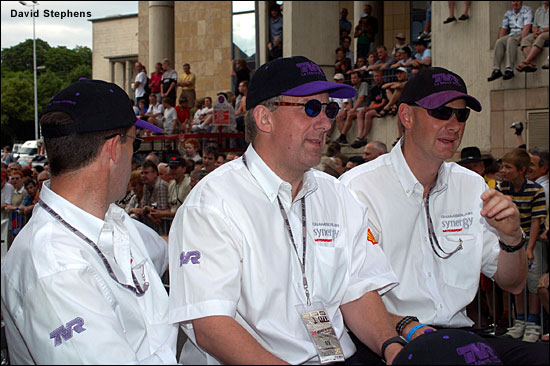
Greensall, Evans and Tomlinson at the Friday evening parade, above. “In qualifying, Chris (Stockton) set a 4:13.3, but on that lap, he lost time through the Porsche Curves. On the data it would have been a 4:11.7, so we were very happy. It was an amazing effort from him to get out and start that lap, crossing the line three seconds before the chequered flag came down to end the Thursday night session. He had to slow down on his qualifying because there were prototypes ahead of him, coming into the pits. “In 2003, the best the cars could achieve in qualifying was a 4;16.8. Chris set a 4:15 in the race this year, but he did that by accident – he didn’t mean to go that quickly. We were aiming for 4:18s to 4:20s throughout the race.” A significant problem for the #96 car in qualifying was a straight six (not a V8, as some seem to think) failure, on Thursday, a unit that was supposed to be the car’s race engine. That meant fitting #89’s qualifying engine into #96 for the race – and it was a fairly traumatic start, for #96 race starter Nigel Greensall. “Coming out of Arnage on the third lap, the engine just died on me. Fortunately it fired up again, then stopped again at the Porsche Curves. It fired up again, and I just about made it into the pitlane, but it could have been all over as soon as that.” The car was sent out with a replacement ECU, and that was the end of that problem, thankfully. The race plan was similar with the Greensall / Tomlinson / Evans car. Lawrence Tomlinson: “We weren’t interested in pressing the car at all over the 24 Hours. Nigel was under clear instructions not to go too quickly, simple as that.”
Apart from the ECU, what else went wrong, Nigel Greensall? “We had a little bit of a diff. problem, which Lawrence noticed, but he brought it in and that was tightened up. “The really significant one could have been the ‘bang’ I heard and felt from the rear suspension, going into the first right hander of the Porsche Curves – where McNish and Lehto went off. I thought I might be visiting the TVR campsite! I had more than a bit of a moment, but did better than the Audis… I made it round the corner. I cruised back to the pits, and we finished the race with the rear dampers from the orange RSR British GT car.”
Despite the engine from the sister car having run for six hours already, before it went into the #96 for the race, it ran absolutely trouble-free… as did the #89’s, throughout the race and on into the FIA event at Donington, by which time it was up to 31 hours “and still only giving out a little whisp of smoke on the overrun,” says Bob Berridge.
If you get a good ‘un from TVR, they do seem to run and run. The intended unit for the #96 had actually thrown its timing chain, rather than suffered any kind of internal failure. “At the end of the race, our car felt as strong as it did at the start,” concludes Greensall. He popped in his best lap of the race towards the end, a very impressive 4:13.461, this in a car that never seemed to quite match the other one on straight line speed. Stockton didn’t go for a quick lap in the other one remember, apart from that 4:15 ‘accidental one’. Greensall and Tomlinson, gentlemen that they are, insisted that Gareth Evans took the chequered flag in the ninth-placed car.
“Gareth was great company, very laid back, but he drove really well, particularly at night,” explains Tomlinson. “The problems we had in the race cost us about 27 laps in total, that first one with the ECU putting us about ten laps down.” In the other car, “we had a hole in the radiator, which lost us 39 minutes,” comments Bob Berridge, “and apart from that it was just a bolt shearing on the exhaust, which cost 12 minutes. “We’re still scratching the surface on these cars,” concludes Berridge. “We know we’ve got a pukka endurance car, but we’ve had to do most of our testing in the races. Now we’re looking for speed….” With the “six months work in three months” background to these heavily revised cars, doesn’t it make it even more remarkable that the teams brought both TVRs home at the end of the 72nd edition of the Le Mans 24 Hours? Well done Chamberlain-Synergy Motorsport.
|




Contents Copyright © dailysportscar.com. All Rights Reserved. |