In the wake of the announcement last weekend of the confirmed 2014 WEC programme for Rebellion Racing to campaign a pair of Oreca built chassis, dubbed the Rebellion R1, there was the opportunity to chat to the two men behind the new partnership
Bart, will there be any immediate impact on your 2013 programme as a result of what must be a substantially increased financial commitment?

“There will actually be very little impact on our running budget but there is clearly a major capital commitment involved in this programme. That will mean that our planned full season ALMS programme will now be reeled back in somewhat, we’ll still race at Austin, Road America and Petit Le Mans but will miss the remaining rounds. That’s a shame because we have loved racing in the USA but we have to put the new programme on a firm footing.”
You’ve chosen Oreca as your partner with the new R1, did you look at the other potential suppliers before making the decision?
“Of course, we looked at all of the available options but there are a number of reasons why we decided to go with Oreca, most importantly we looked not only at the quality of the design and the capability to build and develop the car, but the ability to support our efforts with effective logistics. Pretty clearly that would be more difficult for a start-up concern like Perrinn or geographically more difficult for Dome. We have a huge respect for the work being done by Dome but the time and distance involved on the supply front could easily have become a major issue in supporting a World Championship programme.
Bart, you’ve chosen to race with a revised version of your Toyota (TMG) customer V8, have you considered the potential to use a hybrid system alongside it?
“We looked at it carefully but when you examine the options (which have options for hybrid systems of varying power capacity) take into account the minimum weight without a hybrid and factor in the fuel allowance too there is really no advantage unless you are using the most powerful hybrid systems, and they are very, very expensive. A hybrid in the future is a possibility, but it isn’t part of our current plan.

“The most important factor though behind our decision. Not just on the powerplant but on the whole programme, is the new regulations, and it isn’t a case of what it says, but rather what it doesn’t say. The current regulations have determined that a 2% performance gap is acceptable between the factory cars and that for private teams like ours. That regulation has been omitted for the new regulations, and by definition it is now regarded as unacceptable to have such a gap in performance.
“The reality, of course, is that even without that rule the factories will have better resources, testing, training and development, that in itself gives them an advantage, and all of that is fair enough. What they shouldn’t have though is something that mandates a reassurance of that advantage.
“What it means is that if the factory boys trip up we could have a real opportunity to get amongst them by the end of a race.
“Remember Le Mans last year, each of the Audis had trouble, but they had enough in hand to still beat us, and to beat us comfortably, and that despite the fact that we had an pretty well perfect run!
“The other thing about the current regulations that, if I’m honest, rather annoys me, is that if the powers that be determine that an adjustment is needed then it will be enacted by asking us to speed up rather than to ask the factories to slow down. That sounds fine in theory but in practice it really is an expensive and time consuming issue, with a new restrictor the engines need to be remapped and to go on the dyno – In the middle of a logistically challenging World Championship that’s a big ask from a small team.
“I also think that beyond all of that the ACO have realised the importance of the involvement of private teams in LMP1 but let’s make no bones about this – We think what we have come up with is the right response and the right package, we’re sensible enough though to realise that depending on the way that things pan out whilst we could get this bang on the nail, we could, if we and the rulemakers aren’t entirely aligned, get it spectacularly wrong too!”
What can you tell us about the update for the engine?
“Not a lot at the moment, the current engine is derived from the Formula Nippon unit and we continue to have their lead engineers working with us. I believe the development work will be done in Japan with the engines built and supported by TMG in Cologne.”
And are there any decisions yet around other key components and partners?
“Not a lot to say at the moment – All options are open over this and everything is up for discussion – We have a lot of experience with alternative suppliers for components, and of course so do ORECA.
“Michelin are already very engaged and very positive about the programme.”
Is there a plan for the length of programme that you foresee with the new cars?
“It’s a fair question but I think you know that the answer will have to be fairly non-committal. We’re committing to 2014, and beyond that I can’t give you numbers, but we have a good record, and have had some great success, with squeezing our assets. The current Lolas that we run date back in some cases to 2008 and have served us very well but it’s pretty apparent that the Lola tub has been our Achilles Heel, built on the basis of the earlier open car and is compromised as a result. We hope that the new car will be much better in that respect, if we can get six years from the R1 then that will have been a very good investment!
“The new car will be exclusive to Rebellion and whilst there is nothing set in concrete we are not against the possibility that if other potential competitors were struggling to find a way in to LMP1then we would be prepared to look into the potential for commercial sales.
“We will be working very closely with ORECA on the design, and in particular the build, of the cars building on the model we established with Lola where we embedded our engineers in their process, we benefited hugely from that, right from the beginning.”
So how long have you been working together on the programme leading up to this point?
Hugues de Chaunac:
“I want to make one thing very clear to begin. This is NOT a customer programme, it is a partnership, that is very different in terms of the timeframes involved, and the method of working.
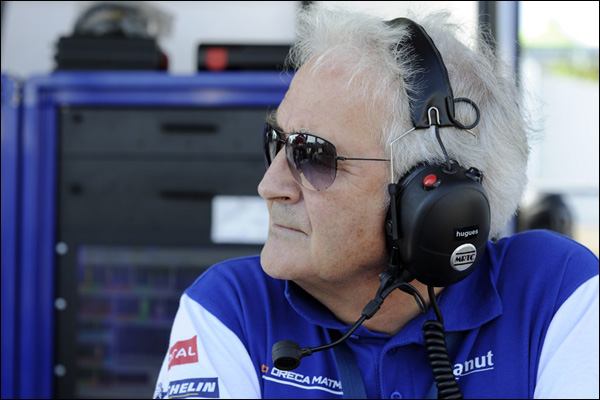
“Normally for a programme of this sort you would expect a 14-15 month timeframe leading up to a car being tested on track, our target for the new car is March 2014 for that but we did start work some time ago, at the beginning of 2013, realistically we are looking to compress parts of the programme from around 15 months to around 12 months.
“At the moment we are working on some of the general concepts for the car, including areas like the suspension, aero etc. At the beginning of July we have a big meeting planned with Bart and his team to really push forward.”
Hugues, this car is. If I’m correct, ORECA’s first ever ground up design at this kind of level, you had a previous design for an LMP1 coupe, how much of that work has been useful here and will the new programme have any effect on your relationship with the Toyota factory programme?
“You are absolutely right. It is certainly correct also to say that some of the work with the 02 (LMP1 Coupe concept) has helped us with the conceptual stages but there is a lot of work to do.
“There will be no effect on our partnership with Toyota, that stays under David Floury for the logistics and support of Toyota’s factory effort, an entirely different part of ORECA from the team that will design and build the Rebellion.
“That team will be under the direction of Christophe Guibal with Ian Smith from Rebellion working alongside. It’s a clean sheet design and will be a very intensive process.
“Christophe was responsible for the 01 LMP1 car and for the current 03 LMP2. He currently has a team of 8 designers working with him and we will grow that by 2-3 as the programme progresses.
“The car will be designed with CFD, not in a wind tunnel“
So what do you think the prospects for customer LMP1s are in general?
Bart Hayden:
“I don’t think we’ll see LMP1 privateers in large numbers. It’s a big financial commitment to buy these new cars and run them, we are very fortunate to have such forward thinking backers.
“I hope though that our coming forward with these plans will encourage others to take a look too. We have been talking to others that might be interested in the potential for LMP1 in the FIA WEC so lets see what emerges.
So what do you think is a realistic ambition in year one of the new cars?
Bart Hayden:
“Next year we want to challenge the manufacturers. For me, and I hope for you, that’s an enticing prospect. That’s another reason why we are not looking at hybrids for 2014, our major strength might well be reliability with a well proven powertrain as the factories get to grips with their new cars and with complex systems.
“It’s not lost on us either hat announcing this programme so early gives us the opportunity for a far more relevant and constructive dialogue with the ACO.
“Those discussions, and the whole of this programme, are predicated on one thought – We believe we can win, and we are aiming to do just that.
“The factories might have financial and timing advantages but they are not immune to problems, to wrong turns or for that matter to regulatory changes!
So do you think that in 2014 Rebellion could be in contention to win races, including here at Le Mans?
“Absolutely we do, and why not? Our objective is to do just that, and not just next year, but to come back and be in contention for 2, 3 or 4 years beyond that!”
GG