To this day the Mille Miglia is very much an event featuring on many a driver’s bucket list. One person who ticked it off this year is Derek Bell, an almost lifelong fan and advocate for Italy’s 1000 mile road race. The five-time Le Mans champion tackled it for the first time with Jaguar Heritage, partnered with enthusiast Adam Lindemann in a C-Type for the gruelling four-day marathon rally which ran from Brescia to Rome and back again.

Unlike much of his illustrious racing career, this one wasn’t about finishing first. Instead it was about the journey, the experience of driving an historic amongst 450 + other priceless classics on public roads at high speeds.
“It’s been something I’d wanted to do for a long time,” Bell told DSC. “I remember growing up and following my childhood hero Stirling Moss in the race on crystal radio, because back then it wasn’t really covered by the BBC or anything. I would stay up all night, turning it up just enough so only I could hear. That’s what got me going, I wanted the challenge. But at that time I didn’t know I was ever going to race.
“The thing with the Mille Miglia now, is even though it’s on your bucket list as a driver, there’s no real reason to do it. It isn’t the race it once was, it’s still got much of the craziness that made it special, but there’s a reason that not many professional racing drivers do it now. It’s not something you need to do, my wife asked me: ‘why are you doing this, driving around Italy at high speeds?’ and I almost had no answer.”
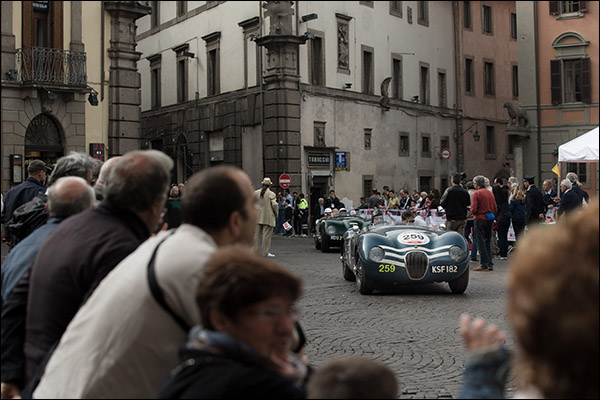
Despite undergoing such change in recent times, the event still plays host to one of the most incredible collections of classic cars that crucially, are driven in the ways which they were built for. Not only that, but it still holds true to the spirit of the Mille Miglia, in the sense that it sends it’s competitors through and past almost every key part of Italy. It’s that part of the allure which kept it on Bell’s radar.
“I didn’t think I’d be competing in the Mille Miglia with Jaguar, but I drove a D-Type at Goodwood, and after that I was asked if I’d like to join them for the Mille Miglia, I almost couldn’t say no. We all knew I wasn’t in it to win, I’d leave that to the locals who learn the route inside out and make it the highlight of the year. But I just love driving fast cars on interesting roads, so naturally I said ‘yes!’
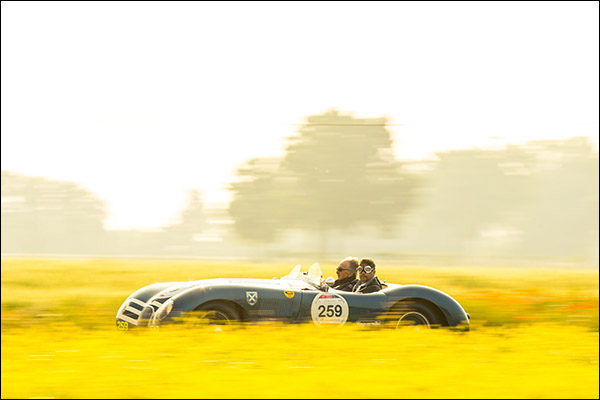
“The route is amazing, events like this must be treasured because of this,” he pointed out. “When we drove past Monza for instance it brought back many fond memories. We went past Enzo Ferrari’s old house, which I remember being invited to when he asked me to drive for Ferrari in Formula One.
“You knew if you’d been asked to Ferrari’s for lunch that you’d be driving for him next year, so I was delighted when Chris Amon and I got the invite. But overall it brings together so many great roads and such an enormous amount of fans. It’s great to see such passion for the event still in Italy.”
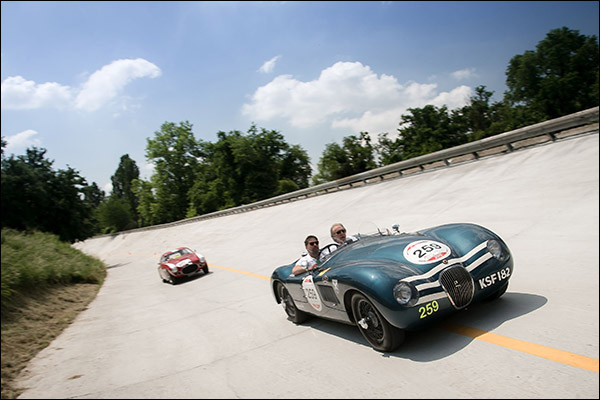
However, the opportunity to drive fast, in fast classic cars and with a lapse in standard road laws lends itself to drivers who may not be as experienced as Bell, attempting to drive maybe a little bit above their abilities.
“The first leg was like a Formula 3 race, I was so surprised at the driving, I didn’t think I’d be able to keep it up! People need to be careful, you don’t need to go as fast as possible all the time because it’s a regularity rally. Luckily it calmed down, as there’s no reason to take so many risks. After an initial shock, everyone settled in and it became a really enjoyable experience. On the last day I felt really comfortable in the car, and it really was a lovely car to drive”
Everyone who has driven it, has a story to tell. In the first half of the 20th century, drivers would blast the route in one go, with the fastest completing it in well under 20 hours, sometimes even under 10, depending on the conditions.
People still have to push hard to win, with the factory efforts from the likes of Jaguar, Mercedes and Porsche these days often struggling to get their cars in the top 100 on the results sheet because the locals know the routes far better. It always was, and still very much is, a rally dominated by Italian nationals.
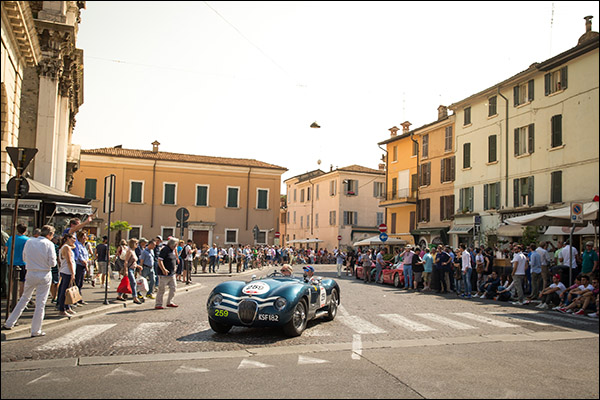
But because it’s not 1000 miles in one stint nowadays, it lends itself to sightseeing far more than it used to be. Cars cruise to the end of each stage, waving to the crowds, while eye-opening old footage exists of men like Moss flying past the chequered flag at the finish with no sign of slowing down to admire the views.
“The spirit of the race I think was this couple I was behind for much of the Mille. They were clearly husband and wife, with their googles and scarves on, just having a good time,” explains Bell. “When it starts plenty of people fly past you, but you can’t get anywhere too early because of the penalties, so they had to slow down at the end. The pair had obviously worked out what the best average to keep at for each stage was, because they were always managing good times at the end despite taking it a bit slower.
“It was ironic today, when I crossed the line at the end and went over the ramp, I looked over and saw Stirling walk across the road in front of me with his wife. He was my hero and now we’re good friends, that moment didn’t mean anything to anyone else, but it was just fantastic, to me it meant a sh*t load.”
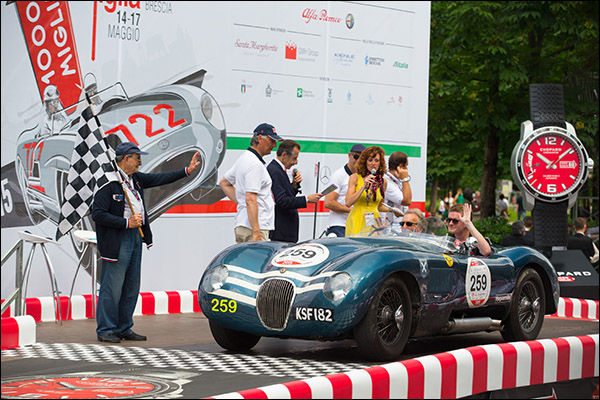
Derek Bell driving the Mille Miglia for the first time on the 60th anniversary of Stirling Moss and Denis Jenkinson’s historic win almost couldn’t have been scripted. His storied career has metaphorically come full circle.
“All my life, I’ve been wanting to do that, I’ve been wanting to do the Mille Miglia,” Bell concluded. “And now after doing it, it makes me wonder just how they used to do it back in the day, at such speeds, in one go, driving for so long?”
I was left wondering the same thing, and I’m no racing driver! There really is something special about the 1000 Miglia.
Stephen Kilbey