Rounding off DSC’s news coverage from the Dunlop Test at Aragon, here’s a third and final notebook, which is focused on Dunlop itself:
Lap times tumble around Aragon
The new regulations for LMP2 this year, coupled with developments with the tyres, have resulted in some impressive times set by the prototype runners earlier this week.
Back in 2016, the best lap time set by an LMP1 L class car was a 1:21.6, with the quickest LMP2 time being a 1:25.4. This year, the LMP2 runners have not only destroyed the best time set by their predecessors, but come to within a second of the fastest lap by LMP1 L.
The time set this year was a 1:22.4, with the majority of its gains coming in Sector 3 which features the long back straight. In that part of the track, the car in question gained over eight tenths on the 2016 LMP2.
Dunlop trials RFID system with sportscars

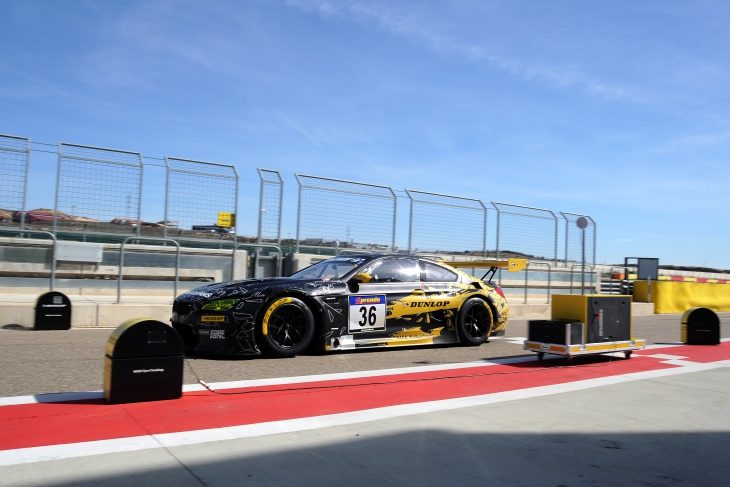
The test at Aragon last week handed Dunlop the chance to trial a new version of its RFID (Radio Frequency Identification) system on sportscars for the first time.
RFID, which has been used in the British Touring Car Championship for the past eight years, allows Dunlop to track which tyres are being used on which cars via a tag placed inside each tyre. Essentially a barcode system, every time a car passes through the pit entry it gets scanned, leaving a digital ‘paper trail’, allowing Dunlop to monitor which sets teams are using for testing. It also cuts costs and time for the manual process which is currently used to complete the same task.
It has the potential to allow the race officials to keep tabs on the amount of sets being used by teams, making the new tyre rules in GTE Pro for instance, much easier to police. Currently though, the ACO utilises its own system for its headline series’, which combines codes and tracks tyres supplied by multiple manufacturers.
Looking further ahead, Dunlop hopes to develop RFID even further. Though admittedly it’s still in its early stages of functionality, the potential is there for RFID to track and monitor more data in the future. As an example, Dunlop could allow the tags in the tyres to monitor tyre pressure and temperature, and feed the data live into the software used by its trackside engineers.
The ELMS/WEC logistics game

With the sportscar calendar growing each year, the logistical challenge for Dunlop is becoming far greater over time.
For Dunlop, not only does it have to manufacture the tyres that its customers use, but also ensure that they reach the right circuits at the right time.
On short-haul weekends it Europe it’s not so bad, as the tyres are produced in Dunlop’s factory in Hanau and transported to the circuits via trucks. At a WEC or ELMS round, in which it has a lot of teams, it will takes five transporters, though for a race as big as Le Mans, it will take 30.
In terms of man power, 80 of Dunlop’s employees will head to the big races like Le Mans or the Nürburgring 24 Hours, while 36 will head to the smaller sportscar meetings.
At each meeting, Dunlop will take 18,000 tyres, though around only 9,000 get used as Dunlop has to bring far more than it will use to prepare for every possibility be it weather or temperature. All the spares are usually scrapped, and recycled.
For the flyaway rounds in the WEC though, it’s a different story, with truck transportation not available everything has to be shipped in containers, which means that everything has to be planned and sent in advance. The process starts as early as July, as the Dunlop prepares for the trips to North America, Japan, China and the Middle East.
Software gains

Dunlop is continuing its R&D into software, as well as its tyre technology.
‘Dunlop Soft’ as its known continues to become more versatile with each passing year, allowing its trackside support engineers to track live data and help teams out with car set up and race strategy more confidently.
For 2017 a new tablet-based software is being trialed and developed, to give the data which its engineers use more portability and functionality in the paddock on race weekends.
2017 tyre timeline

The road to getting the LMP2 tyres to their current state was a long one.
From the moment the 2017 LMP2 regulations were released back in April of 2015, Dunlop began to work on its new product.
By Spring 2016 it was already completing simulations with new compounds and construction before testing with an LMP2 car converted ton meet the new rule book in July.
This sort of work that far in advance meant that by October they had already created a full baseline spec of LMP2 tyre ready to be tested at Sebring in December. Only last week though, were the final 2017 tyres ready to go and be used by customers.