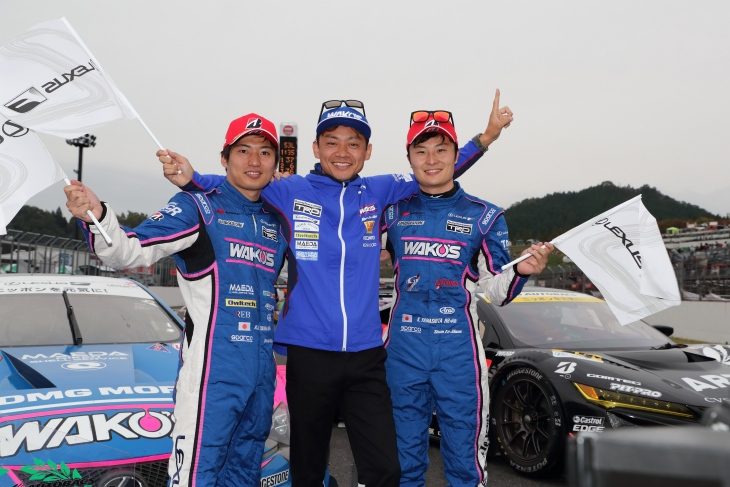
In November 2002, the All-Japan Grand Touring Car Championship came to a close, with Toyota Team LeMans winning the GT500 Championship in their blue Esso Ultraflo Toyota Supra, and Autobacs Racing Team Aguri winning the GT300 Championship in their Toyota MR-S prepared by apr Racing. Seventeen years later, while the cars are different, the liveries are different, most of the drivers, managers, engineers, and mechanics are different, both teams are champions once again.
A hard-fought second-place finish in the Motegi GT 250km Race at Twin Ring Motegi for the number 6 Wako’s 4CR Lexus LC500 of Kazuya Oshima and Kenta Yamashita was enough to clinch the championship for Lexus Team Wako’s LeMans. The first for the team in seventeen years, and the first GT500 titles for 32-year-old Oshima and 24-year-old Yamashita. They took the title by just two points over the #37 KeePer TOM’s LC500 of Ryo Hirakawa and Nick Cassidy, who scored the victory in the final championship round of the 2019 Autobacs Super GT Series.
It was a partly cloudy, and unseasonably warm day at the 4.8 kilometer Twin Ring Motegi circuit, with temperatures at 20°C for the start of the race and a crowd of over 35,000 spectators packing the grandstands for this 250 kilometer, 53 lap championship finale. Going into this race, the Wako’s LC500 had to finish first or second to clinch the title, while the easiest path for the KeePer LC500 to win the title was to win the race with the Wako’s LC500 finishing third or lower.

The race got underway with the reigning World Endurance Drivers’ Champion Kazuki Nakajima leading the field to green in the #36 au TOM’s LC500. Oshima took the start in the Wako’s LC500, but was snookered after dropping three places from his 2nd starting position in just four corners. He was trying to defend from the KeePer LC500 of Cassidy, who jumped up to third on the first lap.
Ronnie Quintarelli in the #23 Motul Autech NISMO GT-R got a good start and moved up to 2nd, but on Lap 6, Cassidy overtook Quintarelli to take 2nd place. The Michelin tyres on the Motul GT-R just weren’t switching on, and two laps later, Quintarelli conceded third and fourth to the #17 Keihin Honda NSX-GT of Koudai Tsukakoshi, and the Wako’s LC500 of Oshima.
From here, the two TOM’s Racing cars pulled away from the pack, with Nakajima and Cassidy running tail-to-nose at the head of the field. Meanwhile, Oshima tried to get around Tsukakoshi – and did so on Lap 19, moving up to 3rd position. The pit window had just opened up, and as predicted, the front-running teams pitted as soon as possible to try and undercut the field.

Cassidy came in from 2nd place at the end of Lap 19. The KeePer LC500 took a full tank of fuel, four fresh tyres, and switched drivers with Hirakawa climbing on board. On the next lap, the au LC500 and Wako’s LC500 pitted from first and second. Yuhi Sekiguchi, who took pole position yesterday, got in the orange and white au LC500, while Yamashita was strapped in to the Wako’s LC500 until the chequered flag.
On cold Bridgestone tyres, Sekiguchi had a big lockup going into Turns 3 & 4, which allowed Hirakawa, with his tyres up to temperature, to close right in. Hirakawa tried a crossover pass at the Hairpin Corner, and a lunge at the 90-Degree Corner, but Sekiguchi was able to fend him off. It was at this point that the idea of team tactics crossed the minds of a few spectators. With Yamashita running a net 3rd position in the Wako’s LC500, if the two TOM’s cars swapped places, it would give Hirakawa & Cassidy the championship.
But Masanori Sekiya, the Executive Advisor to both the 36 and 37 cars, felt that Sekiguchi and Hirakawa could race each other for a bit without impeding Hirakawa, and withheld making “the call”. If that call did come in, it would have been on Lap 32, when Sekiguchi found himself boxed in by a GT300 backmarker going into Turn 3, giving Hirakawa the incentive to go through for the race lead. As they ran with 20 laps to go, Hirakawa and Cassidy would come back from seven points down to win their second championship in three seasons, 83 points to 81.

But in ceding the lead, Sekiguchi also left the door ajar for Yamashita to try and take the crucial 2nd place that he needed to clinch the title for himself and for Oshima. He thought he had the move done at the 130R Corner, but Sekiguchi was able to hold off Yamashita through the S-Curves and retain 2nd position. Yamashita still kept the orange and white Lexus in sight though, and the two ran tail-to-nose for several laps more.
The defining moment of the race came with 16 laps left. Sekiguchi was still putting the lockdown defense on Yamashita to preserve his teammate’s championship lead. At the Hairpin Corner, Sekiguchi caught a couple of GT300 backmarkers, compromising his exit just enough for Yamashita to give him a gentle bump from behind. As they plunged down the hill into the 90° Corner, Yamashita feinted to the outside, then cut to the inside to get the overlap – and with a bit of tyre smoke under braking, Yamashita got through to take 2nd position, but his momentum gave Sekiguchi a chance to take the place right back!
They ran side-by-side under the bridge and into the final corners. The two made contact at Victory Corner, sending both Sekiguchi and Yamashita sliding through the gravel, shortcutting the track, before rejoining the track as the fans in the stands came to their feet in amazement! And it was Yamashita who came away with the position through that exchange, keeping 2nd place and driving away from Sekiguchi, knowing that all he had to do now was just hold his position over the final fifteen laps and he would become GT500 Champion.
During that amazing side-by-side battle, Hirakawa drove away from the pack, and held a comfortable lead in the race. He did everything that he could have possibly done to clinch the title for himself and for Cassidy, and ended up taking the win by 12.2 seconds.

But by hanging on to finish 2nd, Yamashita secured the championship for Lexus Team Wako’s LeMans, 85 points to 83. Their second as a team and their first in seventeen years. This is the 10th GT500 Drivers’ Championship for Toyota Motor Corporation in total.
Entering the season, Team LeMans hadn’t won a race in over five years, and they were still trying to move on from the sudden and tragic death of chief engineer Kenji Yamada on 22 April 2018. Back-to-back victories at Chang International Circuit in Thailand, and the Fuji 500 Mile Race, not only ended that winless drought but also vaulted Oshima and Yamashita to the top of the championship table.
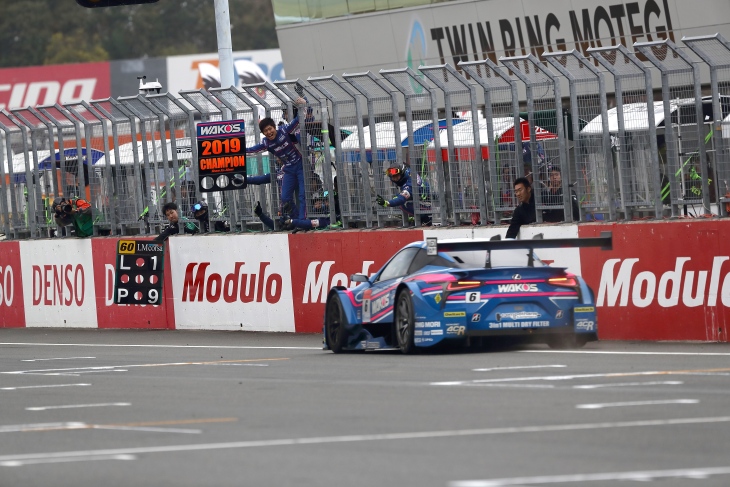
Yamashita, who joined the team this year for his second GT500 campaign, proved to be an instrumental figure in the team’s resurgence – as he enjoyed his best year as an individual driver since winning the 2016 All-Japan Formula 3 Championship. “This was a very special race and I came into it with a determination that we really had to win the title,” Yamashita said.
He recalled his battle with Sekiguchi vividly. “I had anticipated the situation where car No. 36 would be trying to block us, but I had the feeling that I couldn’t be beaten there, and I am very glad that I was successful in the end. The shock when car No. 36 and I collided as I was passing it was really strong and I was worried that it might cause the car to start vibrating, so I was glad that it held out for me to the end.”
It was that level of resolve and determination that led Toyota Gazoo Racing to select Yamashita for their WEC Challenge programme, putting him on the pathway to one day race for the factory team in the FIA World Endurance Championship and the 24 Hours of Le Mans.
“It seems that the tires weren’t well enough warmed up, so the first lap was really tough,” said Oshima about the race from his perspective. “I was very frustrated, but I knew I had to change my mindset and do the best I could and make up the loss afterwards. In the second half, Kentadid a fantastic job of moving up. I’m really grateful to him.”
For Oshima, it’s the culmination of eleven seasons as a Toyota GT500 driver, nine of which have been spent with Team LeMans. He’d debuted in 2006 as a teenager, won the GT300 Championship and the All-Japan F3 Championship in 2007, then after a tough one-off campaign in European F3, returned to Japan from 2009. And now, after 105 championship race starts, the 32-year-old veteran has finally realized his dream of becoming a GT500 Drivers’ Champion.
It was also the culmination of team director Juichi Wakisaka’s mission to lead Team LeMans to the championship as a manager, after winning three championships as a driver – including his first with Team LeMans, in that 2002 season. And it was a championship that the team dedicated to their late engineer Yamada, who, somewhere, could be very proud of the effort that the team that he worked for up until his final days put forward.
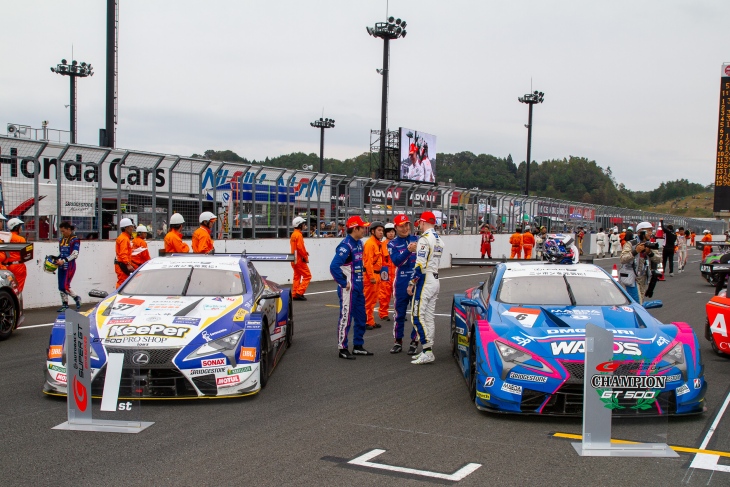
The race win rang bittersweet for Hirakawa and Cassidy, who finish runner-up in the Drivers’ Championship for the second straight season. Lexus Team KeePer TOM’s ended up winning the GT500 Teams’ Championship by a single point, but it was only a token consolation as the champions’ number 1 will go to Team LeMans in 2020.
“In the end we were able to win the race, but it was really disappointing that we couldn’t win the season title, and it is hard for me to put into words how I feel now,” Hirakawa said after taking his sixth career victory. “The first lap out went well, but after that I couldn’t keep up the pace. While I was running behind the #36 car, the grip in the front was not good. After I got in the lead I had good pace and I was able to pull away from the pack.”
Cassidy, who just missed out on his bid to succeed Naoki Yamamoto and become only the fifth driver to win the “Double Championship” of Japan with both the GT500 and Super Formula Championship titles, added: “It was a really difficult race. We started from 4th position on the grid and all of the cars in front of us were strong, but I was able to get a perfect start. Our aim this time was to find the right timing for out pit stop, and that went well so we were able to take the lead. I think our car was the fastest one out there today.”
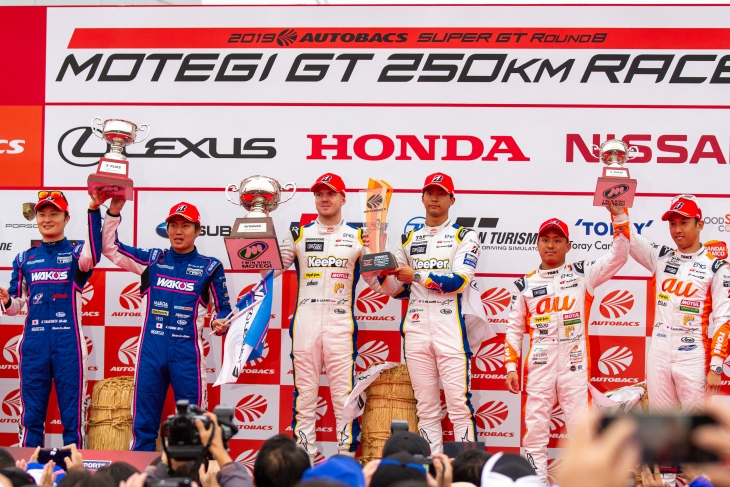
After the hard fight, Nakajima and Sekiguchi completed the podium, an all-Lexus podium in the last race for the LC500 model and the Lexus nameplate itself in GT500. With the victory, the LC500, which made its debut with the first top-six sweep in GT500 history, bows out of GT500 with an incredible 14 victories in 24 races, and two championships won. It also maintains a streak of Toyota/Lexus GT500 cars winning in their last races as the flagship model: The RC F won its last race in 2016, the SC430 won its last race in 2013, and the fourth-generation “A80” Supra won the 2005 finale as well.
In fact, the race ended with a Lexus sweep of the top four positions, with the #38 ZENT Cerumo LC500 (Yuji Tachikawa/Hiroaki Ishiura) finishing in fourth. Next year, the LC500 will be succeeded by the fifth-generation Toyota GR Supra as the revised “Class 1+ɑ” regulations take effect from 2020.
The mid-engined Honda NSX-GT was unable to win its last championship race before its front-engined successor debuts in 2020, but the #17 Keihin NSX of Tsukakoshi and Bertrand Baguette held on for a top-five finish in fifth. That could be the last points-paying race for Real Racing’s Honda in the blue and silver Keihin colours after the team’s longtime title sponsor was acquired in a mega-merger into Hitachi Automotive.
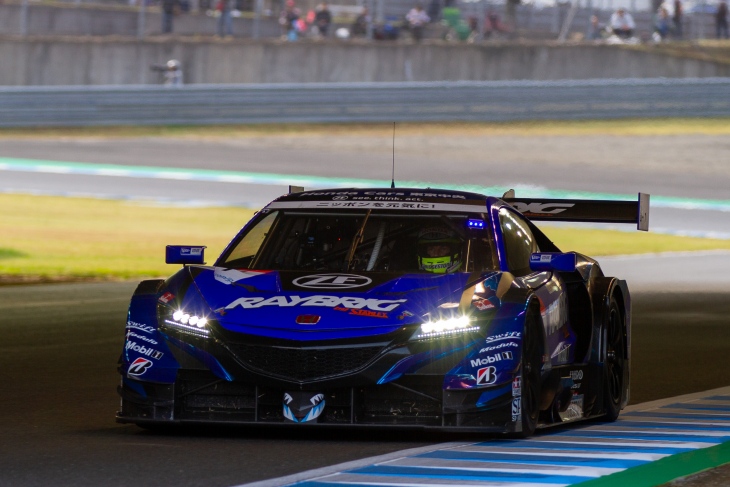
Just behind them in sixth was the number 1 Raybrig NSX-GT, with Jenson Button signing off from his time in Super GT after driving 20 laps in his opening stint, and Naoki Yamamoto taking the car home to the flag.
In a post-race statement on his Instagram account, Button wrote: “As the sun sets on my Super GT career with a P6 finish, I’ve got a lot to be thankful for. We achieved what we set out to do which was to become champions and to have fun while doing it.”
“Big thanks to everyone that has welcomed me into their racing culture here in Japan, thank you Team Kunimitsu for your professionalism and for being such a passionate, lovely, charismatic team. Thank you Honda for this opportunity, and lastly thanks to the guy I drive bloody hard for and never want to disappoint, the main man my team mate Naoki Yamamoto. It’s been a pleasure mate, with you I’ve won a championship and made a very close friend.”
The top ten in GT500 was completed by the #19 WedsSport Advan LC500 (Yuji Kunimoto/Sho Tsuboi) in 7th, the #23 Motul GT-R of Quintarelli & Tsugio Matsuda in 8th, the #16 Motul Mugen NSX-GT (Hideki Mutoh/Daisuke Nakajima) 9th, and the #24 Realize Corporation Advan GT-R (Mitsunori Takaboshi/Jann Mardenborough) in 10th.
8th and 10th for the Nissans salvaged points from a frustrating day, which saw the #3 CraftSports Motul GT-R (Kohei Hirate/Frédéric Makowiecki) fail to take the start due to an engine failure, while a more fiery engine blowout ended the day for the #12 Calsonic Impul GT-R (Daiki Sasaki/James Rossiter), in what might also be the last championship race for the world-famous blue Calsonic Nissan with that title sponsor now being absorbed into the Marelli Corporation.
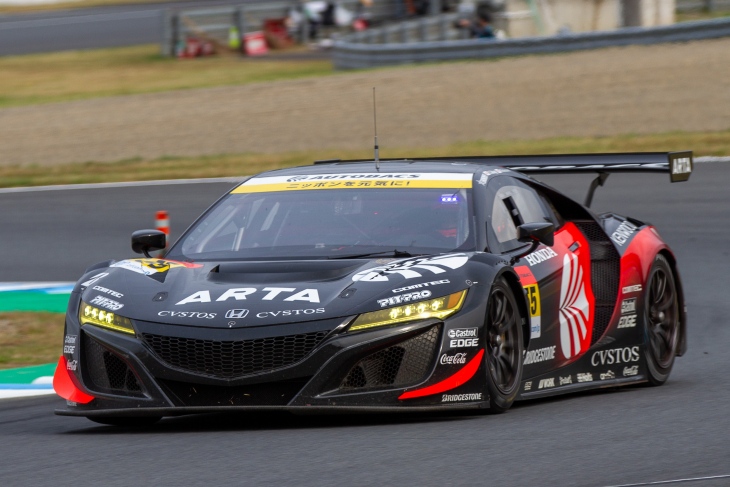
Continuing the theme of “seventeen years on” that Team LeMans started in GT500, the GT300 title went to the number 55 ARTA Honda NSX GT3 Evo of Shinichi Takagi and Nirei Fukuzumi, who sealed up the championship with a fourth-place finish in their class.
Takagi and Fukuzumi complete the year with a 100 percent points-scoring record to give ARTA their first GT300 Championship since their 2002 title run in collaboration with apr Racing – this is their first as a stand-alone GT300 entry. It was also a very popular championship for the Honda supporters at the Honda-owned Motegi circuit, with the NSX GT3 winning its first GT300 title in just its second season on the tour – and ARTA doing so in their first year fielding the NSX GT3 Evo.
More importantly, the championship avenges a crushing defeat in the 2018 season finale, where the team conceded a 12-point championship lead in the last race of the season. Nobody was happier than 49-year-old Takagi, ARTA’s long-time GT300 ace and the second-winningest GT300 driver of all-time, who finally notches his second GT300 Championship crown after waiting seventeen years between his first and his second titles.
“I am very glad to have won such a great championship title after driving for our team manager Aguri Suzuki for 17 years,” said Takagi. “I am very thankful for this. The whole team worked as one to set up this machine and I am glad that we were able to win points in every race of the season. I think that is why we were rewarded with this championship. I am just filled with gratitude.”
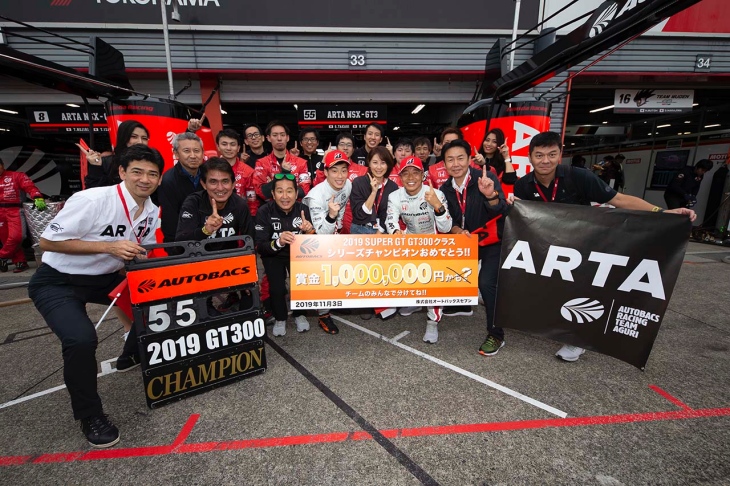
22-year-old Fukuzumi becomes only the sixth driver to win the GT300 Championship in their first full season – the last driver to do so was Hiroaki Ishiura in 2007. “I’m relieved. The number 96 car was very fast. We were fortunate that they had trouble in the qualifying, which helped us win the title. And thanks to the great efforts of Takagi-san and the team we were able to run strongly all season, and I think that is why we won this championship. I am simply very happy with this result.”
A result that Fukuzumi’s former GP3 Series teammate, the late Anthoine Hubert, would have been very proud of.
While the number 55 ARTA crew, headed by Suzuki and the programme’s executive advisor Keiichi Tsuchiya, won the title, the race victory dramatically changed hands on the run to the chequered flag!
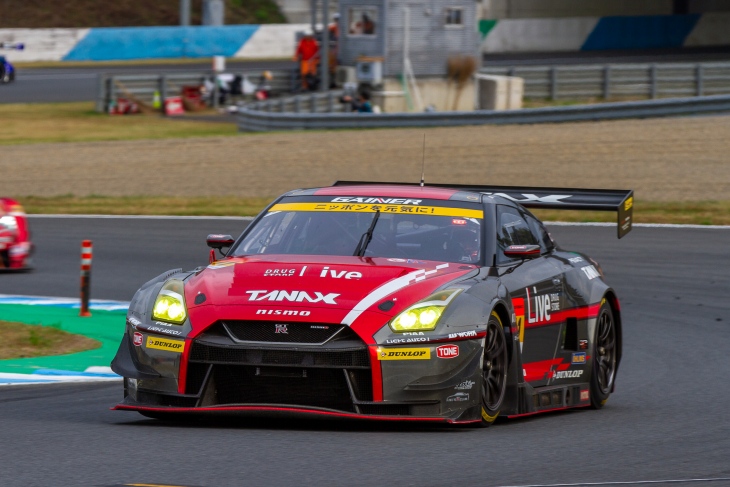
The #65 LEON Pyramid Mercedes-AMG GT3 of Naoya Gamou and Togo Suganami looked poised to take the victory by a comfortable margin, but slowed down coming out of Victory Corner, gifting the victory to the #11 Gainer TanaX Nissan GT-R GT3 of Katsuyuki Hiranaka and Hironobu Yasuda, their second win of the season!
“I thought there wasn’t much chance for us to win the race,” said Hiranaka, “but as I drew near our team platform I suddenly found the LEON AMG so close that I accelerated again – and was able to pass it and take the checkered flag first!”
It’s the ninth career GT300 class victory for Hiranaka, and the fourth for Yasuda – both drivers won the Fuji 500km earlier in the year. The victory vaults Hiranaka and Yasuda to third in the final GT300 Drivers’ Championship results.
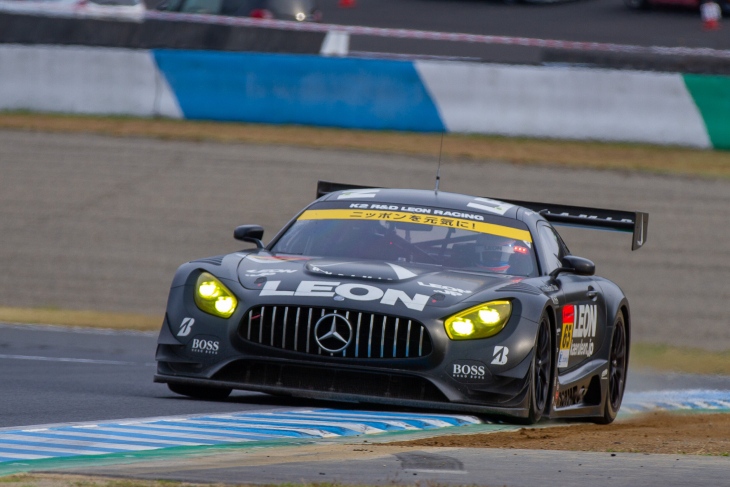
The LEON AMG pitted for fuel only on its stop, and that looked to be the move that would give K2 R&D LEON Racing their third straight victory at Twin Ring Motegi – until the car suddenly lost power in the final few hundred meters. Gamou himself was left confused, because he was sure that the car had enough fuel to get to the end.
They would end up taking the flag in second, just ahead of the #96 K-Tunes Racing Lexus RC F GT3 of Morio Nitta and Sena Sakaguchi, who came all the way up from 17th on the grid after Nitta’s spin in qualifying to take the final spot on the podium in class.
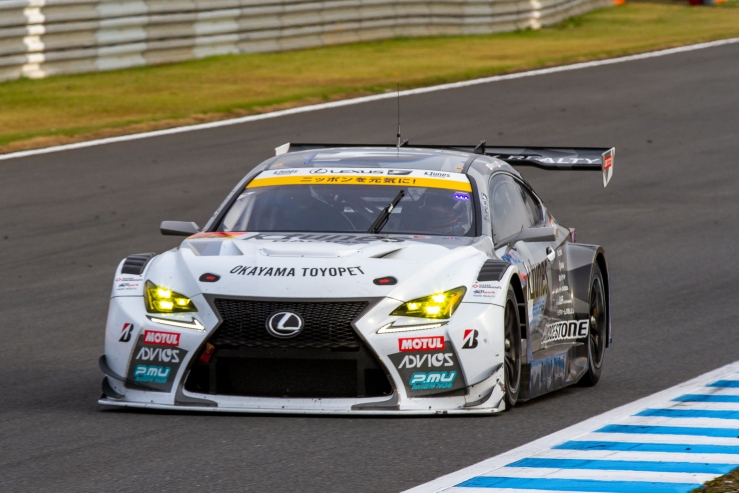
A change in the setup helped Nitta and Sakaguchi charge their way through the field to get on the podium, but one would still be left to wonder what could have been if not for the error in Saturday qualifying. While they ultimately lost the title as the ARTA NSX GT3 of Takagi and Fukuzumi finished fourth, it was, nonetheless, a great fightback for the K-Tunes RC F.
The #4 Goodsmile Hatsune Miku AMG (Nobuteru Taniguchi/Tatsuya Kataoka) finished 5th, ahead of the #56 Realize/Nissan Mechanic Challenge GT-R (Kazuki Hiramine/Sacha Fenestraz), which slowed down momentarily with an electrical glitch and dropped out of a podium place before recovering to 6th. The pole-winning #720 McLaren Customer Racing Japan 720S (Seiji Ara/Álex Palou) couldn’t keep up their pace, but still came away with their second top-ten finish of the year in 7th.
The #33 EVA Racing X Works GT-R (Shaun Thong/Shinya Sean Michimi) completed a remarkable first full season in Super GT in 8th, the #60 Syntium LM Corsa RC F GT3 (Hiroki Yoshimoto/Ritomo Miyata) finished 9th, and in one of the feel-good stories to end the year, Tomei Sports took their first points-paying finish in a Super GT race since 1994, with the #360 RunUp GT-R GT3 (Yusaku Shibata/Takayuki Aoki) finishing in 10th!

Of note, it was a frustrating day for the contingent of JAF-GT300 and Mother Chassis cars, who failed to win a race this year and didn’t get a single car in the top 10 – the best of that group was the #61 Subaru BRZ R&D Sport (Takuto Iguchi/Hideki Yamauchi) in 12th.
The year also comes to a disappointing end for two high-profile teams: The #7 D’station Aston Martin Vantage GT3 (Tomonobu Fujii/João Paulo de Oliveira) ended a snakebitten 2019 campaign with a 17th place finish and zero points for either driver in the championship. The new front-engined Toyota GR Sport Prius GTs of apr Racing also failed to score points this year, with the #31 Prius (Koki Saga/Yuhki Nakayama) finishing the day in 20th.
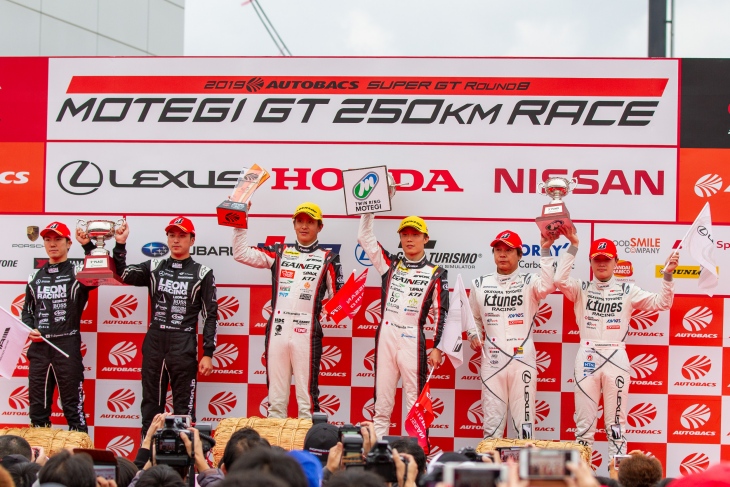
The championships have been decided, but the teams, cars, and drivers of the Autobacs Super GT Series aren’t through racing in 2019.
In three weeks time, they’ll converge upon Fuji Speedway for the much-anticipated inaugural running of the Super GT x DTM Dream Race, and the auto sport Web GT300 Sprint Cup, which takes place on 23-24 November.
GT500 RACE RESULTS >>>
GT300 RACE RESULTS >>>
Photography by Pierre-Laurent Ribault
Additional images courtesy of Toyota and Autobacs Racing Team Aguri