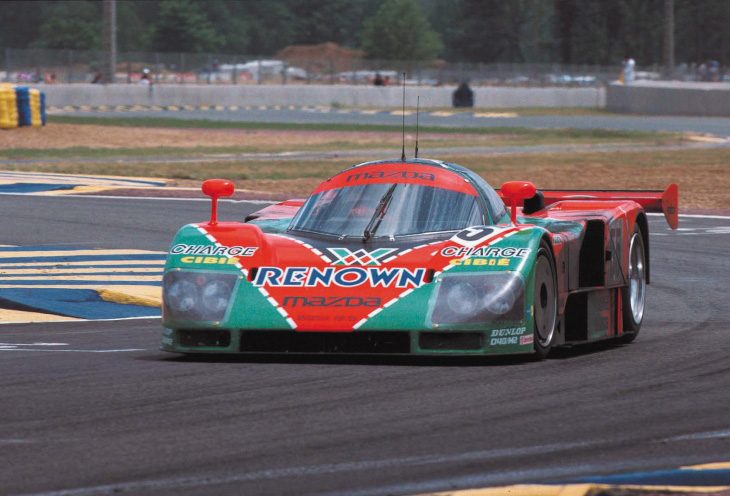
This year marks 29 years since that the world’s favourite Rotarians took a surprising, but deserved victory at the Le Mans 24 Hours. Who knows where the time goes?
Here’s a reboot of a story written for DSC by John Brooks remembering the events of an epic 1991 race.
1991 was a time of great change in the world of sportscars, not much positive but not entirely negative either. The Le Mans 24 Hours was part of the FIA Sportscar World Championship, and there was an uneasy relationship between the Automobile Club de l’Ouest and the sport’s governing body, FISA, led by the eccentric and choleric Jean-Marie Balestre.
The 1980’s had seen a renaissance in long distance sportscar racing. The stability of the Group C and IMSA rules, together with the ready availability and affordability of a Porsche 956/962 to take on the factory projects, meant that the grids were full and the racing competitive. At the end of the decade, a move had been initiated by FISA to bring the engine rules for this form of racing in line with those prevailing at the time in Formula One. This proposal was not popular with the most of the sportscar regulars. Crucially, though, it had the backing of both Bernie Ecclestone and Max Moseley and a new manufacturer with an eye on a Le Mans win, Peugeot. Despite opposition, FISA pushed through the new package and for 1991 the new cars were meant to rule the roost.
At Le Mans the cars were split into Category 1 (the new boys) and Category 2 (the old guard). Category 1 had to have normally aspirated engines of not more than 3.5 litres and limited to 12 cylinders. They had no restriction on the amount of fuel they could use and the whole package had a minimum weight limit of 750kg. Category 2 had no restrictions on engine type or size but had a limit of 2,550 litres of fuel for the race. They were also to be ballasted to 1000kg, with one late exception. There was one other weird rule, designed no doubt to help Peugeot’s image on French TV, the top ten places on the grid would be reserved for Category 1 cars. This would lead to the bizarre sight of an ALD and a ROC leading factory Saubers and Jaguars as the flag was waved at the start.
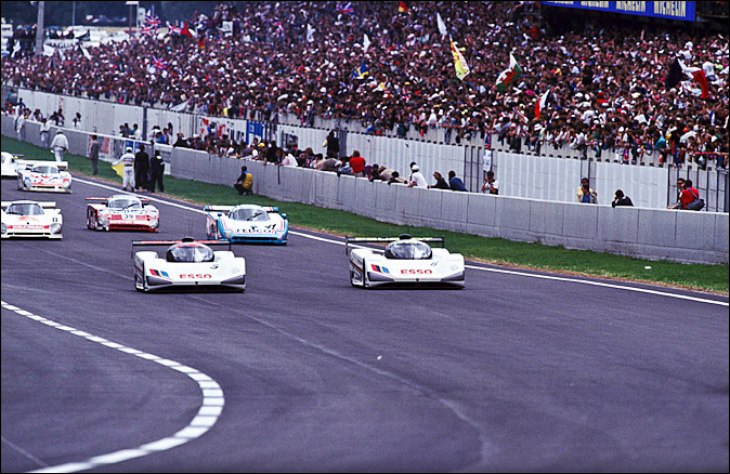
There was a sense of cautious optimism within the sportscar fraternity at the beginning of the season – new 3.5 litre projects from Jaguar, Mercedes Benz and Peugeot were on the grid, with rumours of Toyota also joining in, plus many stories of privateer projects; maybe the changes would work? However, by the time June rolled round and we all assembled in France that feeling had evaporated, with races being cancelled at short notice (Paul Ricard and Montreal) and the costs skyrocketing for both promoters and competitors. Still, the problems of the future were shelved as the serious cars contemplated the task in front of them.
Although FISA forced Jaguar and Mercedes to enter their new cars in France, in reality both factories would rely on their old Group C entries. The new cars were designed with 500 Kilometre sprints in mind and not the La Sarthe classic.
There were three Jaguar XJR-12 entries in addition to the two sprint XJR-14s whose attendance were required by FISA. There had been some major changes to the car that had triumphed the previous year.

The minimum weight was increased to 1000 kilos, as were the Mercedes and Porsches, all part of the FISA incentive programme to encourage the brave new world of Grand Prix Sportscars. To counter some of this penalty, the faithful V12 engine was stretched to 7.4 litres in an attempt to gain some more power. The TWR driver line up was the usual mix of speed and experience; #33 had Championship leader Derek Warwick joined by former winners Andy Wallace and John Nielsen; #34 had Bob Wollek, Teo Fabi and Kenny Acheson on duty; and #35 was crewed by Davy Jones, Raoul Boesel and Michel Ferté.
Sauber Mercedes brought three ‘old’ C11 chassis to Le Mans, plus a new C291.
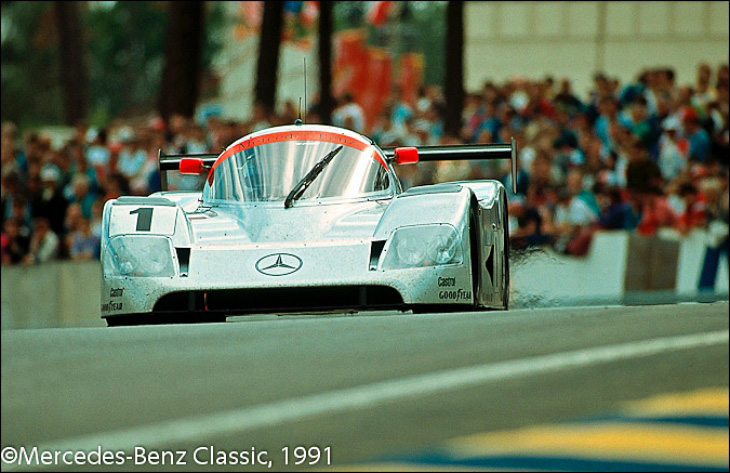
Like their Jaguar rivals the driver line up was top notch. #1 would see the 1989 and 1990 World Champions, Jean-Louis Schlesser and Jochen Mass being joined by Alain Ferté; #31 was the youngster’s car with Michael Schumacher, Karl Wendlinger and Fritz Kreutzpointner on call…
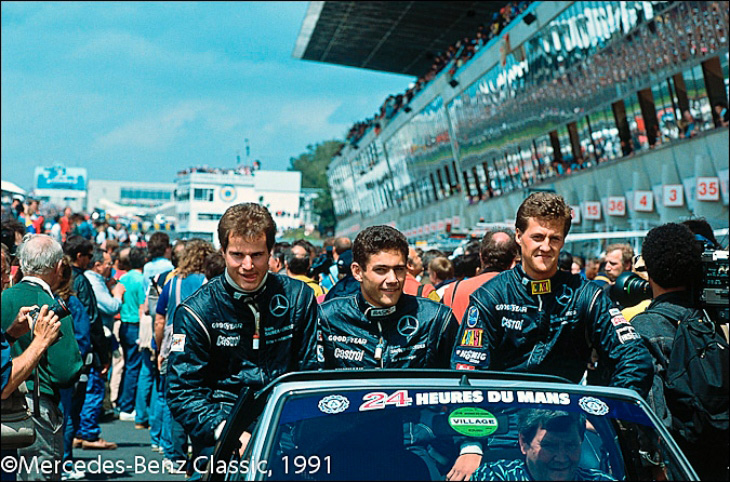
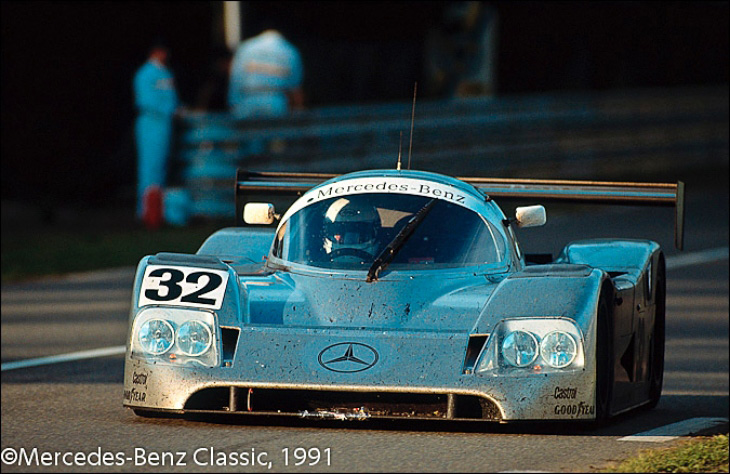
…while #32 had an experienced trio in Stanley Dickens, Kurt Thiim and Jonathan Palmer.
While the established factory teams would place their faith in the tried and tested cars, Peugeot had no such luxury. They had to run the 905, a V10 3.5 litre state of the art design, with little realistic expectations of even reaching sunset, let alone the Chequered Flag on Sunday afternoon. Nevertheless, for Peugeot, the aim would be to grab pole position, create some ballyhoo and learn as much as possible for the following years.
Peugeot brought four cars to Scrutineering, one spare for each crew, just to emphasise their commitment to the new regime. #5 had Mauro Baldi, Jean-Pierre Jabouille and Philippe Alliot in the cockpit, while #6 was staffed by Keke Rosberg, Yannick Dalmas and Pierre-Henri Raphanel.

Porsche were as usual the biggest element of the field, with fifteen 962s of various specifications, but at that point the time of the 962 had passed; and despite teams of the quality of Joest, Kremer and Brun fielding entries, the Porsche was not expected to feature on the podium. There had been no factory development for over two years and the basic design was nearly ten years old.
The final factory team and Category 2 entry was Mazdaspeed, who had three 787 Quad-Rotor powered cars to challenge the other factories. There had been some important changes to the organisation of the factory effort with “Mr. Le Mans”, Jacky Ickx, being appointed Consultant Manager and Hugues de Chaunac’s ORECA team brought in to give technical and sporting firepower.
In reality, the crucial events that would ultimately decide the 1991 result happened some two months before the engines fired up at La Sarthe. While Sauber, Peugeot and Jaguar all watched each other like hawks, they were asleep at the wheel when it came to the Japanese. Mazda (or its new management) extracted a concession from FISA of being able to run their cars at the old level of 830kg instead of having to add another 50kg of ballast. What had been missed by the Europeans were the major improvements in performance that the team had managed to gain in the 787B since 1990. Three low key performances by Mazda at Suzuka, Monza and Silverstone further disguised the true position. By the time Le Mans rolled around, Mazda had a staggering 170kg weight advantage over their Jaguar and Sauber rivals, they were definitely in with a shout.

The Mazdas had a superior power to weight ratio and would be lighter on brakes, tyres and would definitely be easier to drive. I remember Andy Wallace telling me that the 1000kg Jaguars were terrible, borderline dangerous; the effort of braking over a three-hour stint giving the drivers terrible cramp issues with their feet and legs. Mazdaspeed’s driver trios were all experienced at Le Mans: #18 had David Kennedy, Stefan Johansson and Mauricio Sandro Sala…
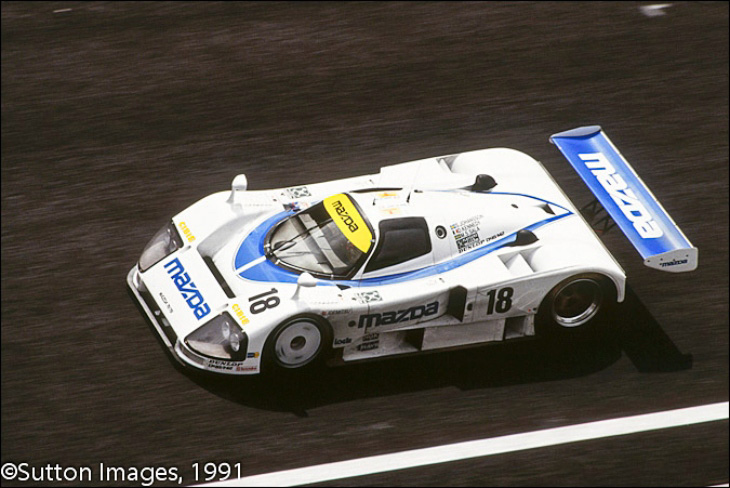
…#55 Volker Weidler, Bertrand Gachot and Johnny Herbert; while #56 (an older 787) was driven by Pierre Dieudonne, Yojiro Terada and Takahashi Yorino.

Weight or no weight, the scrap for pole position honours was between Jaguar and Sauber. Sauber sent Kreutzpointner out in the C291 for four laps, trundling around in a best time of 6:55.969. The car was brought back to the pits, cleaned off and loaded into the transporter and that was the last anyone would see of it that week. Wednesday’s conditions were damp after persistent rain during the day so the real times would be set on Thursday, and so it proved. Andy Wallace, on loan from Toyota, was despatched in the XJR-14 and managed to post a 3:31.912, which was good enough for pole for only a few minutes. Jean-Louis Schlesser showed why he was a double World Champion, upped the boost and scorched round in 3:31.270. Wallace had over-revved his HB Ford V8 and consequently could not respond. The mighty Schlesser’s performance should be considered in the context of his C11 running at 1,010kgs whereas the Wallace Jaguar was 763kg, an astounding difference of 247kg. How anyone, even FISA in that incarnation, thought this situation safe or satisfactory was not explained. After failing to get pole, Tom Walkinshaw withdrew his rocket ship and concentrated on his V12 squad.
The Peugeots at that point lacked the outright pace of the Jaguar XJR-14 and, at Le Mans, the Sauber C11. They were a few seconds slower and headed a motley collection of Spices in the Category 1 class.
Part 2 later today.
Images by kind permission of Sutton-images.com, Mercedes Benz Classic and Peugeot Sport