


The 2021 Autobacs Super GT Series concludes this weekend, when 43 teams converge upon historic Fuji Speedway for the season-ending Fuji GT 300km Race. Six teams and their drivers still have a mathematical chance to win the GT500 Championship, while five teams enter the weekend with a chance of winning the GT300 Championship.
And if it is anything like last year’s final round at Fuji, it will be a must-watch event. The last lap of the 2020 season is still one of the most astonishing finishes ever seen across the entirety of professional motorsport.
It’s hard to imagine that anything that unfolds in Sunday’s 66 lap, 300 kilometre season finale could surpass that for final lap dramatics, and that seems unfair to this weekend’s event. But it will still be a fascinating race to watch, with plenty of story lines and subplots to keep up with.
As is tradition, the Success Ballast that has been accumulated over the first seven rounds of the season is cleared out for this eighth and final round. Victory will be decided purely by the skill of the drivers, the mechanics, and the engineers, along with the sheer speed of the vehicles that they drive and prepare. At the modern version of Fuji Speedway, it’s all about finding the balance between maximising straight line speed down the 1.475 kilometre front stretch, with the grip to negotiate the near flat-out 100R bend and the divisive, technical third sector of the 4.563km lap.

Starting in the GT500 class, where Honda field the three front-runners in the championship table, and the likelihood is great that history could be made for any one of their teams.
GT500
Last season, Naoki Yamamoto snatched victory in the final 700 metres of the 2020 Fuji 300km to win the championship for himself, team mate Tadasuke Makino, and Team Kunimitsu in their last race in the royal blue Raybrig colours. This same team and combination of drivers returns to this venue a year later, with their new silver and orange livery from Stanley Electric, as the favourites to repeat as GT500 Champions.

Of course, Makino’s five-month recovery from meningitis forced him to miss a race, so he will only be able to assist Yamamoto’s bid for the Drivers’ Championship. And for Yamamoto, a historic milestone is at stake for him. He could win his third GT500 Drivers’ title and join an elite club of drivers that have surpassed this milestone: Satoshi Motoyama, Juichi Wakisaka, Yuji Tachikawa, and four-time champion Ronnie Quintarelli. And he can join Motoyama as the only other driver to win at least three championships in both GT500 and Super Formula.
If Yamamoto and Makino win the pole position during qualifying on Saturday, then Yamamoto clinches the title with a win or second place finish. Otherwise, a win in the last race would clinch the championship for Yamamoto. Team Kunimitsu won from the pole at Motegi in July.
After four races in 2020, the #8 ARTA NSX-GT of Tomoki Nojiri and Nirei Fukuzumi was 39 points out of first place, but they scored more points than any other team in the second half of the year, and finished fifth in the standings.
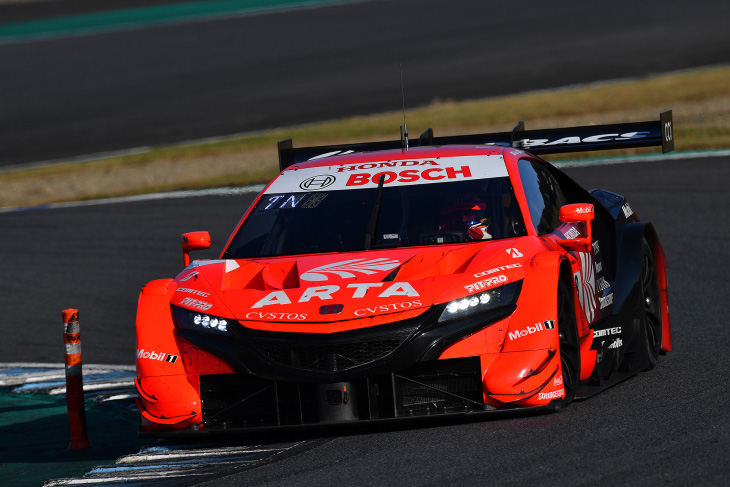
And in 2021, Nojiri and Fukuzumi have pulled off yet another miracle late-season run. After five rounds, a disastrous race at Sportsland Sugo left them 40 points out of the lead, with seemingly no hope of recovery. But after back-to-back victories at Autopolis and Motegi, they’ve now closed to within five points of Yamamoto at the top of the table, and could become the first GT500 team in Super GT/JGTC history to win three consecutive races in a calendar year – in prospect, the ultimate exclamation mark on the greatest championship comeback in GT500 history.
For Autobacs Racing Team Aguri it would be their first set of titles since 2007, and for Nojiri and Fukuzumi, it would be their first GT500 titles. Speaking of Nojiri, he could become part of another elite group of drivers that have won both the Super Formula and GT500 Championships in the same calendar year, a year after Yamamoto became the first driver to accomplish the feat twice. Fukuzumi could also become just the third driver to win championships in both classes of Super GT, joining Masataka Yanagida and Kazuya Oshima.
A pole-to-win victory would clinch the title for Nojiri and Fukuzumi, and they hold the tiebreaker advantage over Yamamoto with their two race wins. If the ARTA NSX wins from outside the pole position, they would need the Stanley NSX to score 15 points or less to win the title. And to win the title with a second-place finish, they need the Stanley NSX to finish fourth, and the next car in the table to finish third or lower, if no bonus points are in play.

That would be the reigning Fuji 500km winners, the #17 Astemo NSX-GT of Koudai Tsukakoshi and Bertrand Baguette. If they sweep the season’s pair of races at Fuji and win Sunday’s race, they would need the Stanley NSX to finish with 11 points or less to win the championship from eight points back.
It would be a long-awaited first title for Astemo Real Racing, for team director Katsutomo Kaneishi, and for drivers Tsukakoshi and Baguette. Tsukakoshi has driven his entire 13-plus season career in GT500 with Real Racing, and has finished in the top three in the standings three times – but has yet to win a championship. Along with Baguette, who is finishing his eighth season, this is the most experienced GT500 lineup that has yet to win a Drivers’ Championship.
That means that all three of the Bridgestone-clad Honda NSX-GTs are at the sharp end of the table with the best chances of winning the championship. For the other three teams that are still mathematically eligible, they are in a literal must-win situation for their championship aspirations.
That includes the highest ranked Toyota GR Supra, the #36 au TOM’s GR Supra of Yuhi Sekiguchi and Sho Tsuboi. They finished second in the first round at Okayama, and third at Motegi in July.
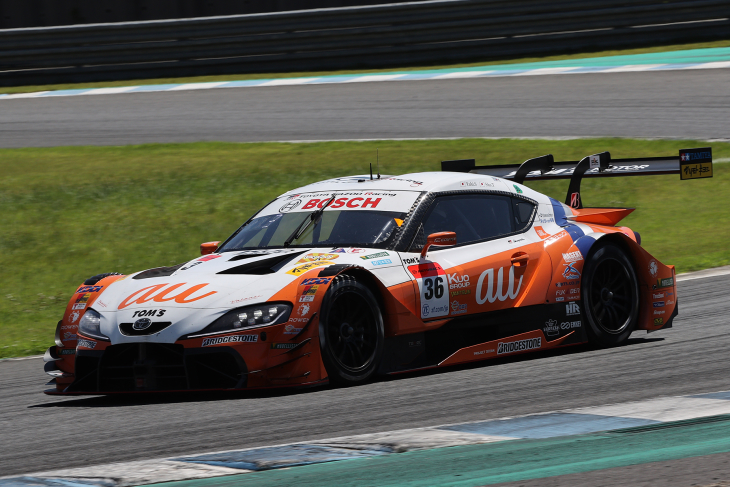
TOM’s won the 2019 Teams’ Championship, and the full set of GT500 titles in 2017. But that was with the number 37 car; the last titles for the flagship number 36 car came back in 2009. It would be the first GT500 titles for the veteran Sekiguchi and his young co-driver Tsuboi.
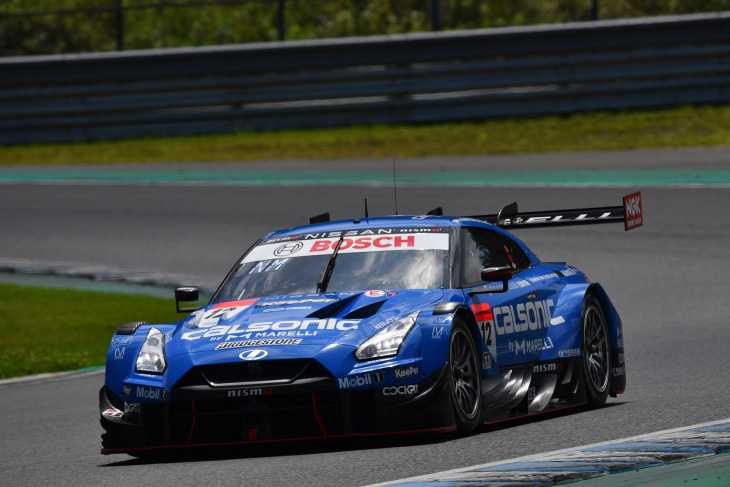
The only Nissan GT-R NISMO GT500 still in contention is the #12 Calsonic Impul GT-R of Kazuki Hiramine and Nobuharu Matsushita, two drivers bidding for their first GT500 titles – as well as the chance to end a 26-year title drought for Team Impul, who last won the GT500 Championship in 1995.

Finally, the #14 Eneos X Prime GR Supra of 2019 champions, Kazuya Oshima and Kenta Yamashita, will try and finish the season as strong as they began it. They won the season-opener at Okayama, and finished second in the Fuji 500km, but didn’t score points again until the most recent race at Motegi. It would be the first GT500 title for ROOKIE Racing in just their second year in the series, and their first operating as a fully-independent team.
Each of these teams sits at least 16 points behind first place, and no team has overcome a deficit of more than 14 points to win the title at the last round. Not only do each of these three teams need to win the race, they also need the three leading Hondas to finish well down the order.
And then, of course, there’s the intriguing subplots, which includes the farewell for GT500’s longest-tenured and most successful model.

After 14 seasons, the Nissan GT-R NISMO GT500 will be retired from competition at the conclusion of this race. Can the R35 GT-R capture its 42nd and final premier class win? Fuji Speedway hasn’t been kind to the Nissan fleet in recent years, but their supporters will be holding out hope for one more victory.
It is likely to be a fond Super GT “see you later” to 2017 GT500 Champion Ryo Hirakawa, who is the odds-on favourite to succeed Kazuki Nakajima in the Toyota WEC lineup. If it is, then he and Sacha Fenestraz would love to avenge last year’s heartaching loss by giving the #37 KeePer TOM’s GR Supra its first win of the season.
46-year-old Yuji Tachikawa could also be making his final start in a GT500 car, at a circuit where he’s won a record nine times.
GT300
And then of course, there’s the battle for the GT300 Championship, which has been decided on the last lap of the season twice at Fuji Speedway – in 2006, and again in 2008.
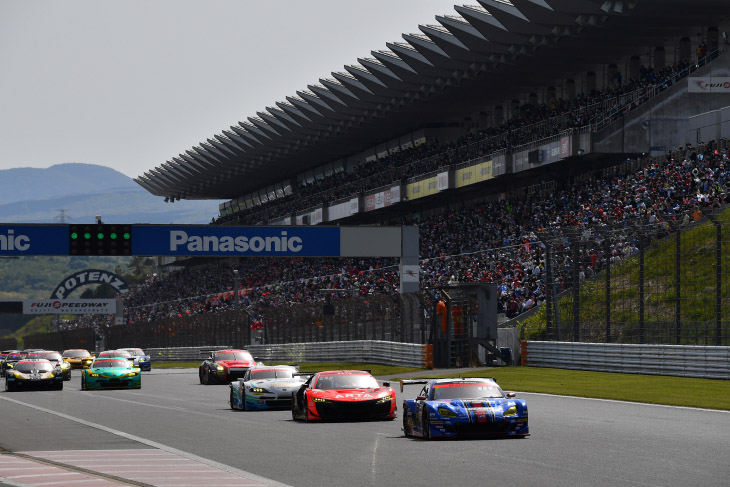
Just like the first race of the season at Okayama, all teams will be required to change four tyres during their routine pit stops to comply with the sporting regulations. Multiple teams tried to double-stint their tyres to gain track position in last year’s finale at Fuji, but this year, that option is not available.
After seven races, the new #61 Subaru BRZ R&D Sport of Takuto Iguchi and Hideki Yamauchi has a six point advantage going into the last round of the season, and they will be racing with the chance to give Subaru and R&D Sport their first Super GT titles – as well as the first for both drivers.

The ZD8 BRZ, one of Super GT’s unique GTA-GT300 class cars, has been one of the best all-around performers of the season. The new BRZ has won from pole at Sugo already, and has three podiums – along with a series-leading three pole positions, including one at the Fuji 500km in May. Iguchi and Yamauchi can clinch the title if they qualify on pole again, and finish second or better. Even without pole position, they would still clinch the title with a race victory.
Defending champions Kondo Racing and the #56 Realize/Nissan Automobile Technical College GT-R of Kiyoto Fujinami and João Paulo de Oliveira are second in the standings, with a win in the first round at Okayama, and two third-place finishes. They are trying to become the first team and driver combination in the history of the class to repeat as champions: Only one driver, Tetsuya Yamano, has won consecutive titles as a GT300 driver, but all three were with different teams.

Fujinami and Oliveira fought back late in last year’s Fuji finale to win the championship with a second-place finish, under extraordinary off-track circumstances within the team.
They would clinch the championship unconditionally by winning from pole, which would give them their second win of the season and the tiebreaker for race victories over the #61 Subaru BRZ. A win from outside pole would be sufficient if the #61 finishes third or lower. And another second-place finish would require the #61 finishing fourth or lower, along with the next car in the standings finishing behind them.
That car is the #55 ARTA Honda NSX GT3 of Shinichi Takagi and Ren Sato, which is ten points out of first place, and in contention for their second championship in the last three years. Takagi and Sato finished third in the Fuji 500km, but have surged back into the championship picture with two runner-up finishes at Sugo and Motegi in the second half.

At 51 years old, Takagi is trying to become the oldest GT300 Drivers’ Champion in history – and trying to join Yamano, Morio Nitta, Nobuteru Taniguchi, and Tatsuya Kataoka in the exclusive club of three-time GT300 Champions. On the other side of the age spectrum, 20-year-old GT300 rookie Ren Sato will try and match his predecessor Nirei Fukuzumi by winning the GT300 title in his first season. If he does, he would break Oshima’s record as the youngest GT300 champion by three months.
The #55 ARTA NSX would win the title by winning the race, with the #61 Subaru BRZ finishing fourth or lower. Winning from pole would increase their chances of overturning a ten point deficit, as they would then need the #61 Subaru BRZ to finish third or lower – as their two second place finishes would give them the second tiebreaker advantage if the #55 and #61 finished level on points in this way.
Behind them are two championship longshots, one of which needs to score the maximum 21 points just to have a chance.

In just their second season, and their first with the new Toyota GR Supra GT300, Max Racing has a chance at the title for their #244 Takanoko-no-yu GR Supra driven by Atsushi Miyake and Yuui Tsutsumi. After capturing their first win at Suzuka, they’ve scored just six points in the last three races.
At minimum, they need to win the race, or take pole position and finish in the top two to have a chance at the title – depending on where the #61, #56, and #55 finish. It would be the first title for both sophomore drivers Miyake and Tsutsumi, while it would also give team director Tetsuya Tanaka his second title as a manager – after leading Gainer to a set of titles in 2015.

Speaking of Gainer, their #11 Gainer TanaX GT-R driven by Katsuyuki Hiranaka and Hironobu Yasuda is the car that needs all 21 points to win the title – meaning if they don’t win pole position on Sunday, they are eliminated from contention. They’ve won two pole positions this season, and desperately need a third one to keep their slim hopes alive.
Then of course, they’d need to win the race, with the #61 scoring no points, the #56 finishing fifth or lower, and the #55 finishing fourth or lower. Hiranaka has finished in the top three in the Drivers’ Championship five times without ever winning a title, but in all likelihood he may still be waiting for his first GT300 Championship as a driver. Yasuda won his only GT300 title at Fuji back in 2008, taking the title on a final lap, final corner pass for position.
There’s also the chance for a car such as the #52 Saitama Toyopet GreenBrave GR Supra (Hiroki Yoshida/Kohta Kawaai) or the #60 Syntium LM Corsa GR Supra (Hiroki Yoshimoto/Shunsuke Kohno) to be the spoiler in this race, given their recent successes at Fuji.

Two-time GT300 Champion Kazuki Hoshino will make his final start as a full-time professional driver, when he drives the #10 Gainer TanaX with Impul GT-R alongside Keishi Ishikawa. It’s a farewell race for him, as well as for the outgoing BMW M6 GT3 that first appeared in 2016.
Qualifying for the Fuji 300km begins Saturday at 14:30 JST (local time) / 5:30 GMT / 6:30 CET / 0:30 EST. Then on Sunday, the final race of the 2021 Super GT Series begins at 13:00 JST / 4:00 GMT / 5:00 CET / Saturday 23:00 EST.
Images courtesy of the GT Association (GTA)


