Kunimitsu Takahashi, one of the greatest luminaries in the history of motorsport within Japan and around the world, passed away today at the age of 82.
Across five different decades, the man known affectionately as “Kuni-san” was a pioneering and successful racer, on both two and four wheels. As a motorcycle rider, Takahashi first made his name at home, winning the grueling All-Japan Motorcycle Road Races around Mount Asama in 1958 and 1959. His success captured the attention of Soichiro Honda, who recruited Takahashi to join the Honda Speed Club factory team in the 1960 World Grand Prix motorcycle racing circuit.

In the 1961 West German Grand Prix at Hockenheim, Takahashi rode into the history books when he won the 250cc class race, becoming the first Japanese rider to win a Grand Prix motorcycle race. He would add three more wins in the 125cc class, before suffering serious injuries in a crash at the 1962 Isle of Man TT. Fortunate to escape with his life, Takahashi would continue his motorcycle career through 1964, but was never able to add another victory after his crash. And by 1965, Takahashi returned to Japan and made the switch to four-wheel racing with Nissan.
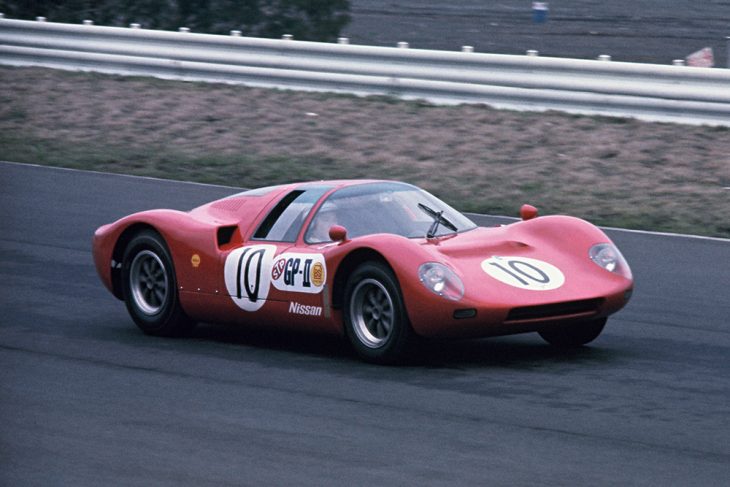
As a Nissan factory driver, Takahashi won his class in the 1966 edition of the Bathurst 500 Miles in Australia – but primarily fought for victory in the prestigious Japan Grand Prix at Fuji Speedway. He finished second in 1967 after a hard-fought battle with the eventual winner, Tetsu Ikuzawa. Unfortunately, the dream of winning the main event of the Japan Grand Prix eluded Takahashi for three straight years, and by 1970, the most prestigious sports car race in the nation had been discontinued.

In the 1970s, Takahashi and Nissan turned their attention to touring car racing, dominating the scene with the boxy Nissan Skyline 2000GT-R. Of the 50 consecutive victories that the Skyline GT-R racked up from 1969 to 1972, Takahashi was responsible for seven of them – including the 50th win at Fuji in March ’72.
Takahashi’s driving flair at the wheel of the “Hakosuka” GT-R would see him drift all four wheels through corners. While he could never have known it at the time, his style would inspire a young man named Keiichi Tsuchiya to adopt a similar four-wheel drift style, and push that forward to pioneer the discipline of drift driving as a legitimate form of motorsport as performance art.
Takahashi made the switch to single-seater racing in 1975. He claimed his first Japanese top formula victory at Suzuka in March 1977, but not before stopping his car to save the life of fellow competitor Kenichi Takeshita after he crashed into the guardrails. Takahashi would go on to win three races that year and finish second in the 1977 standings to first-time title winner Kazuyoshi Hoshino. Towards the end of that year, he was rewarded with a drive in that year’s Formula One Japanese Grand Prix, where he finished ninth in a privately run Tyrrell 007.
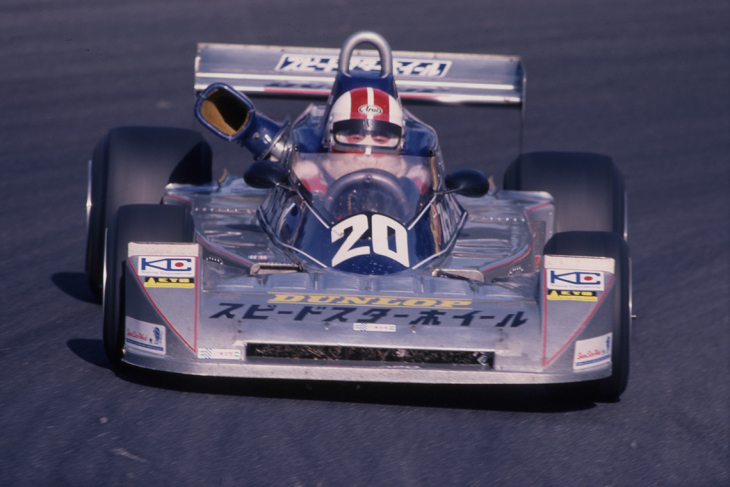
Takahashi’s defining victory came in November 1978 at the JAF Grand Prix Suzuka, where he bested an array of future F1 mainstays from overseas including Patrese, Arnoux, Warwick, and Giacomelli – as well as Hoshino and Satoru Nakajima – to take his first victory in one of Japan’s major motor races.
The 1980s cemented Takahashi’s status as one of the very best all-rounders in a Japanese racing landscape filled with them. He finished runner-up in the Fuji Grand Champion Series in 1981. He was the ace driver of Mitsubishi’s factory touring car team, driving their all-wheel drive Starion coupe to second in the 2500cc+ class rankings in 1986, and third in 1987. He even made a cameo appearance in the ’85 British Saloon Car Championship finale at Silverstone.

But where Takahashi shined brightest was in the world of endurance racing. Driving the Porsche 956 and 962C for Nova Engineering, Takahashi won a record four drivers’ championships in the All-Japan Endurance/Sports Prototype Championship (JSPC): Three in a row from 1985 to 1987, and his fourth in 1989.

He won the Fuji 1000km (forerunner to today’s WEC 6 Hours of Fuji) and Fuji 500 Miles twice, the Fuji 500km three times, and the Suzuka 1000km, Japan’s oldest continuing endurance sports car race, a record four times overall. His nine career wins in the JSPC stood as the all-time record when the series folded after the 1992 season.
Naturally, his domestic success racing Group C Porsches gave him opportunities to race in the 24 Hours of Le Mans. Takahashi competed every year from 1986 to 1990, with a best finish of ninth in 1988, driving the Kenwood Kremer Racing 962 CK6.

In 1992, Takahashi founded Team Kunimitsu, and by 1994, they had found success in the inaugural All-Japan Grand Touring Car Championship (JGTC) – with Takahashi and his one-time admirer Tsuchiya winning at Sportsland Sugo in their Porsche 911.

That same year, Takahashi recorded his final Japanese top formula podium at Fuji, at age 54 – the oldest pilot to stand on the podium in what is now Super Formula. And, Takahashi returned to Le Mans, driving one of the Kremer-built Honda NSX GT2s.

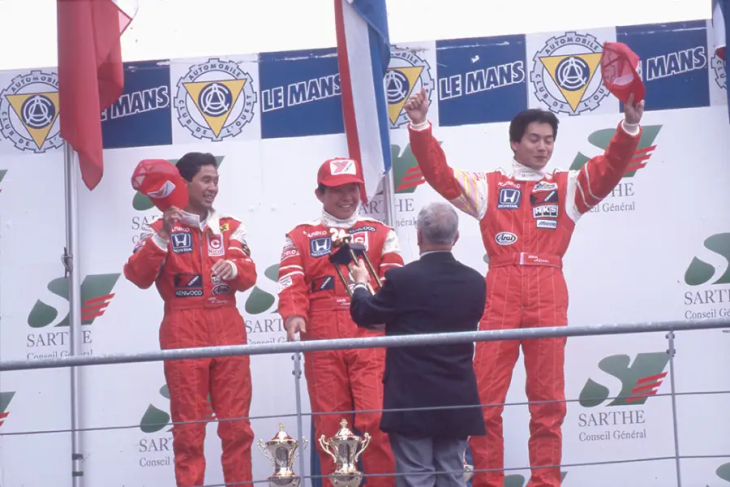
34 years on from his landmark victory on two wheels with Honda, Takahashi again made history when he, Tsuchiya, and Akira Iida drove his bright red NSX to GT2 class victory and eighth place overall in the 1995 24 Hours of Le Mans – giving Honda their first Le Mans win in any class.

Driving the royal blue Raybrig Honda NSX-GT in the JGTC’s GT500 class, Takahashi won at Miné Circuit in 1998, and at 59 years of age, won the Golden Week race at Fuji Speedway in 1999 for his final victory as a driver.
After driving, Takahashi would focus on managing his eponymous team and their now-iconic Raybrig Honda race car. He would also continue to serve as chairman of the JGTC’s promoter, the GT Association (GTA), a role that he held from their inception in 1993, through the rebranding of the series to Super GT in 2005, until he stood down from the role in 2007.

After 25 years, Takahashi would finally see his team win a Super GT title when his ace driver Naoki Yamamoto and Formula 1 World Champion Jenson Button won the 2018 GT500 championship.

Just two years later, and in the final race for the Raybrig brand as title sponsor of Team Kunimitsu’s Honda, Yamamoto and Tadasuke Makino won the team’s second championship in three years, when Yamamoto passed Ryo Hirakawa for the win and the title just 700 metres from the chequered flag.
For his contributions to Japanese motorsport, Takahashi received multiple honours throughout his racing life: He was inducted into the Japan Automotive Hall of Fame in 2002, the 24 Hours of Le Mans Hall of Fame in 2013, the MFJ Motorcycle Sports Hall of Fame in 2018, and in 2020, he was the recipient of the Sportsperson of Merit Award from the Japanese Ministry of Education, Culture, Sports, Science and Technology.
Toshihiro Mibe, Honda president, CEO and representative director, remarked: “I am deeply sorrowful on the passing of Kunimitsu Takahashi. He played a major role as a rider on the world championship stage at the dawn of Honda’s motor sports activities, and his four wheel endeavors, he competed with Honda racing cars for over a quarter of a century, bringing many victories to the company.”
“Takahashi’s influence went way beyond Honda, touching the hearts of everyone involved in motor sports. I am truly grateful for his countless achievements.”
Our sincere condolences go out to Takahashi’s family, his many friends within the world of motorsport, and to the staff at Team Kunimitsu.