A sit down with Jim McGuire over a coffee at United Autosports gave DSC an opportunity to finally understand fully what the AERO product that Jim’s company produces is, and more to the point what it isn’t!
What it isn’t is vinyl, a point made quickly, concisely and pointedly by Jim (pictured below left with 2021 Road To Le Mans co-driver Guy Smith).
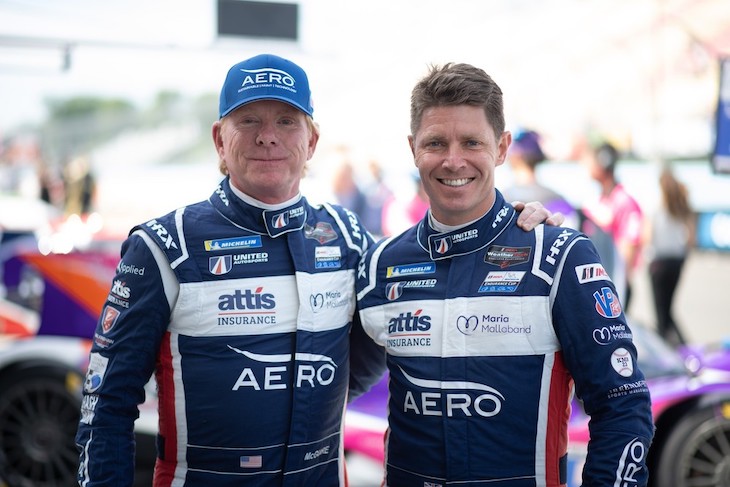
“It comes from a drive from Boeing who were trying to find a film or foil-based replacement for paint.
“Spray applied coatings, industrial high performance coatings are extremely durable. That has nothing to do with a vinyl. Vinyl is a commercial graphic that can’t meet the specifications needed for a paint or other coating. AERO nailed the brief.”
The initial breakthrough for the AERO product came from that Boeing ‘search’, “We cracked the code for Boeing’s problem and, initially it was great, because we won what was effectively a race to find a solution to a really complex problem.

As an indicator of the advantages of the AERO product over the paint it would replace. A fully coated Boeing 747 would be 2500 lighter than with the equivalent paint coating (well over a metric tonne), a huge efficiency saving!
“It became a commercial negative though because with our success in the research, Boeing just started giving us all these research projects. And we were an early stage company based at a major university in the US at Ohio State and, tied up with research, there was no path to revenue. And we had to feed our people!”
What the company needed was a way to demonstrate to a wider marketplace just what their product, effectively a solid foil or coating that replaces the need for a liquid-based paint, could do. The answer came fairly rapidly…
“I was at a tech conference at Ohio State and I met a fluid dynamicist who worked with racing teams around the world. I told them about the tech and he said: “Dude, we gotta introduce you to motorsport.”
“I’ve been into motorsport my entire life, and needed little encouragement!”
That conversation led to an introduction to the Luczo Dragon IndyCar team (the team eventually evolved into the Dragon Formula E team), of Jay Penske, and Steve Luczo.
“We got a shot at their vehicle that back in that time, was sponsored by Make a Wish.
“We did a film that was indistinguishable from the spray apply product they were using but we saved them three and a half kilogrammes on the first instal and we were way more durable than spray paint!
“We did a test the whole season. And by the end of the season, the equivalent weight saved was seven kg, because every two races, they would repaint, and you add weight by doing that!”
That not only impressed the team, but started to turn heads elsewhere too:
“At the Sonoma race, I was there, and I met the US representative for Lotus Formula 1. He thought it was cool. He said, send me a sample. A few months later, via fax, I didn’t even know we still had a fax! came a purchase order from Lotus Formula One.
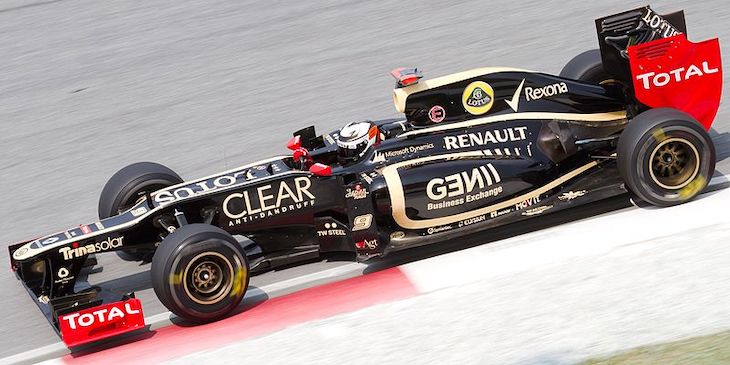
“They ran it on all the high wear areas of Kimi’s car until they ran out of money.”
McGuire and co. had realised that the use of AERO in motorsport was paying huge dividends in two major areas – and it wasn’t just the shop window of publicity
“You find out anytime you have completely new technology, because no one’s ever done the chemical process that is involved in manufacturing this before, you realise there’s a lot of things you just don’t know that you need to find out.
“And there’s no better test place on the planet Earth for product development than motorsports. Because you’re challenged to the extreme limits of everything. And you can fail it but you have fail fast, and you have to recover fast, you can’t go back and have a think about it.
“In the normal commercial world, if they develop a new product and fail they’ll go think about it for a few years and then come back to market, not an option in motorsport!”
Next up was another big name, this time in Indycar again:
“Rahal gave us a shot and after a couple of issues their engineering manager was ready to throw us out after about six months because it was still a product in development.

“But we finally got it right. And so for the last 10 years, all of the Rahal racing cars have been 100%, AERO, all of his pit gear, all of his toolboxes, all of his trailers, all of his tractors, 100% AERO.”
Next to commit was AJ Foyt, a famously difficult man to please!
“I think AJ is an icon. He’s like my biggest hero. He’s the man among men. And he also has distribution shops in Texas that sell spray paint to body shops!

“I got a call from a guy who asked me to do him a favour and send him a free roll of AERO colour-matched to Foyt blue.
“I did. And he did the livery, which is always red, white and blue. They put it outside and AJ had a look at it and couldn’t tell which was spray and which was AERO on the appearance. And, in AJ speak, he said it was effing amazing!
We saved him over two and a half pounds on the shock cover alone!”
The expansion to sportscars would come with a team that were very much on the up!
“The first shot we got in the sportscar paddock was with Mike Shank Racing.
“The year before I met him, I met him at the end of the season when they won the Daytona 24, that was a really big deal for Mike. We talked to him and he really bought into it.
“We did the colours for him and he called me before the Roar and said “You sure I don’t need to put heli tape on my car?”
“And, of course I told him they didn’t need to, because we’re as durable as heli tape.
“Everything was fine but the night before the race he calls me late at night and says “Jim, I’m freaking out all day. You sure I don’t have to put heli tape on this thing for the race tomorrow?”
“And I confidently said, No, you don’t need to, and then that whole night I didn’t sleep.! Well, it’s kind of like an IndyCar race – just a little longer!!

“It was mega because it was our first 24 hour race. In the middle of the night, John Pew went off into a tire barrier and shattered the entire side curtain of the car and the AERO held it intact. So no mandatory pit, no black flag, and they ended up p3.
“They still got on the podium because of AERO!
“And so since then Mike has been with us on the sports cars and later the Indycars too.”
More big names followed:
“Corvette factory racing has us, and they’re doing an evaluation of us for performance and durability. That came from senior leadership at GM, because we’re a sustainable technology, manufacturing in a sustainable way. So it’s a big play.”

How is it sustainable?
“There are other films that have been developed for interior trim components, you know, your old woodgrain stuff, those were films, they’re not durable enough for the exterior. But when you use those films, whether they’re woodgrain, colour, pattern, on an interior of a car, there’s zero CO2 during the application of because you’re not spray painting, you’re not using water. So film is a zero CO2 application.
“We take that further as we have the only film in the world that meets OEM paint specs, and exceeds them.
“But what really makes our technology truly unique is that we manufacture it with a sustainable polymerization process. There’s no solvents, there’s no ovens, there’s no VOCs (Volatile Organic Compounds), which is a major step improvement.
“What the world is getting on to is what they call lifecycle analysis, total lifecycle analysis of CO2.
“10 years ago, what they would do is move a some nasty environmental process to a third world country and call it sustainable, because it was out of their factory. Well, that doesn’t cut it – we have to look at everything across the entire globe.”
But there’s another major market challenge, and it’s very significant for the general automotive market, as well as for motorsport.
“The global refinish market for collision damage is in excess of $10 billion a year of paints and coatings sold into that market globally. 99% of it is not controlled, it all goes up in the atmosphere. So with our film technology, it’s easy to ultimately strip off, we have a way to remove AERO and put a new one on. And again, nothing’s going up in the environment.
“So if you look at the Life Cycle Assessment of our product, our CO2 footprint is a fraction of spray applied coatings. So that’s the application, the way we manufacture it,and the way that it’s suitable for the aftermarket.”
“Every OEM in the world has sustainability objectives to be zero CO2 by 2035, or 2050. They cannot do that with spray paint. So we are turning a legacy industry on its head. That’s exciting. And for the environment our real play at sustainability cannot be challenged – it’s a major impact for the environment. And that’s exciting. It’s really cool. We love it.”
And is it is recyclable?
“Yes. It can be recycled. It’s all urethane based chemistry.”
It’s worth saying that more or less all of the above was news to this writer, and it is hugely impressive – What I had noticed is the visual difference that the product can make to a racecar when properly applied:
“It’s a huge step in appearance, and even post race appearance. We have been on the winning Indy 500 car for 4 years in a row with four different teams. And there is no more aerodynamic race on Earth than the Indy 500!
“This year on Ganassi’s Indycar, the sponsors afterwards wanted pictures next to the car. And they detailed it after the race for the photoshoot. And the sponsors were like, Well, how did you have time to rewrap this car?
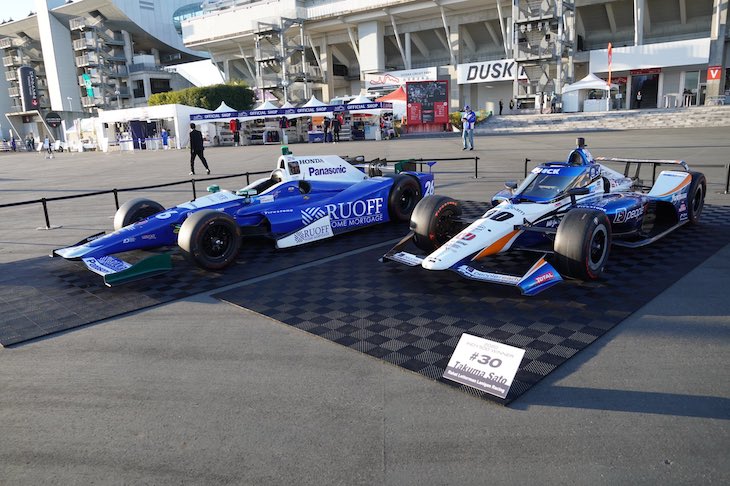
“Sato’s Indy 500 winning car is in the museum in Japan and looks brand new.
“The Mazda Soul Red that we did for Mazda winning the US championship. It’s in their museum.”
The last time we sat down and talked about AERO you were talking about the transition from motorsport applications, high performance but low volume, to the wider automotive marketplaces?
“We felt in 2013 that we had enough understanding of the technology to begin testing to OEM paint specs. So we did that from 2013 to 2016. It takes three years. And we introduced it in 2016 to JLR at Gaydon, as well as to Toyota in Japan.
“We felt that it would be a seven-year runway to even get on an OEM vehicle, which is typical.
“14 months after introduction at Gaydon we were on their ‘Hero’ show vehicle at the Frankfurt Auto Show. It was finished in AERO. And it was on a stage with lightning and rain and there was a commercial filmed in Iceland as a backdrop.
“Fast forward a couple of years later when they relaunched the Defender, which was one of the most anticipated vehicle launches in a long, long time. Three of the five Defenders at Frankfurt were finished in AERO. We have many, many, many, many programmes going forward with JLR.

“We have programmes going in Detroit with a major automotive company.
“We have major programmes going forward with every OEM that’s based in California. It’s really exciting.
“The first low hanging fruit for us is contrast roof. That’s pretty easy because now when they spray a contrast roof, it’s a nightmare because they have to re spray the tub after they mask it back.
“But then we can do complex new colours. There’s a new vehicle launch for JLR which will have a colour that you can’t spray. It’s so complex. thst it’s just not reproducible in a production environment.
“And if you look at motorsport helping us, when Ford did the GT relaunch. They did a colour called Ford GT Blue. And it was developed as a four stage paint with four layers that gave you that liveliness of the colour, the depth.
“Billy Johnson, Ford factory driver pulled me aside at Le Mans and said “Dude, I really need your help, they are giving me a GT and I wanted the blue and they said I can’t have it because they can’t produce It”. And it was a big problem. And so we colour matched that in film in six weeks!

“We can do the complex colours, we can do satin matte finishes that don’t stain, that do not absorb oils that do not de-gloss when you polish them.
“We can do a lot of things. We have some really cool programmes going forward too that we’ve done for the military, but now in the commercial automotive sector too, where we have embedded electronics for communication and sensors. You can’t do that with spray gun – it’s pretty cool.”
Whilst the big, BIG wins are in the wider industrial applications for the product, AERO have not left behind their motorsport roots, not by a long, LONG way! And, unsurprisingly, Jim throws significant shade on those that are choosing a different route top the way they present their cars.
“The hardest thing in the world to get in motorsport is a paying sponsor. and then you put an inferior finish on the livery with their sponsor! It’s like, what are you doing?”
DSC has been party to more than one late change in the ‘look’ of a car that has involved a call to AERO or their agents to colour match:
“It’s taken us anywhere from two weeks to six weeks to match virtually every colour in motorsport, and then a couple of weeks to make it so it’s usually not that long.
“But we’ve got such an amazing library now. Colours that we can take off the shelf that are really so close to just about anything!
“It’s really, really challenging. But it’s really kind of fun to be able to do that and give them ‘their’ colour.”
Together with his ELMS LMP3 and IMSA LMP2 programmes, Jim has other roots within United Autosports too:
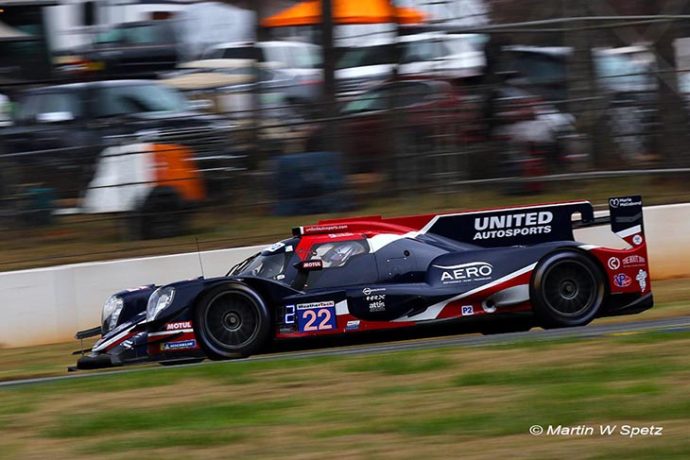
“They distribute AERO for us in the UK. And I actually have an entire application team in the UK that can travel through Europe.
“We do not have a footprint in Europe yet. But we are supplying plenty of film into Europe for a multitude of applications as well as the Middle East, and China, everywhere. We’re global.
“To give you an idea of our total film production, including our clear, because we’re the world’s largest manufacturer of clear paint protection film sold under multiple brands. At our peak, last year we made 1.5 million linear feet by five feet wide in a single month. So this is not an experiment. It’s real, it’s relevant, and it’s growing fast!”