Here’s the third of our four-part trot through every builder of Group Co and/ or Junior / C2 cars in the golden era of sports prototype racing from 1983 to 1993.
Part One can be found here >>
Part Two can be found here >>
Once again with thanks to John Brooks and to the photographers who have contributed to the invaluable www.racingsportscars.com
(Team LeMans) – Japan
Also known as LeMans Garage, the squad developed a string of Nissan-powered Group C machines that contested domestic Sportscar races and Series with Nissan branding and power in the early 1980s, switching to Toyota power and into C1 in later years when the cars also contested World Championship races in Japan.

Lola – GB
Lola, as with March (see below) built chassis for other projects, notably a number of factory Nissan projects, but there were three cars that raced in Group C under the Lola brand.
The T600 raced only in IMSA GTP competition in 1983 and ’84 while the Mazda-engined T616 took a World Championship C2 class win at Monza and (pictured below) a class win too at Le Mans.
Lola’s final World Championship contender was the T92/10 of 1992 with Euro Racing fielding a pair of cars in the final Championship, with some encouraging performances but not a lot in the way of results to show for it! A third car was campaigned in Interseries by Robbie Sterling for many years afterwards.

Lotec – Germany
Built initially for domestic competition in 1983, the solo BMW-powered car found a private buyer in Japan the following year and was campaigned there, domestically and in the visits from the WSC.
Its claim to fame was a Championship domestically and an amazing run at the 1984 Fuji 1000km where the car finished 6th overall ahead of several C1 runners showing astounding fuel mileage!

Lyncar – GB
The 1983 Lyncar MS83 was commissioned by Costas Los and was destined for a mixed life in UK domestic, WSC C2 and IMSA competition that saw a combination of decent pace, unreliability and terrible luck. The car raced on until 1985 in C2 and in Thundersports thereafter.

March – GB
March was a prolific chassis builder for Group C and IMSA GTP almost from the start through to 1988. Whilst the cars saw significant success in IMSA competition the March mare scored very limited success elsewhere under their own name, but they provided chassis for a number of other efforts, notably for Nissan in Europe and BMW in the USA.

Maurer – Germany
The solo BMW C87 debuted in 1987/88 and contested a mixture of races in the WSC, Interseries and Supercup.

Mazda – Japan
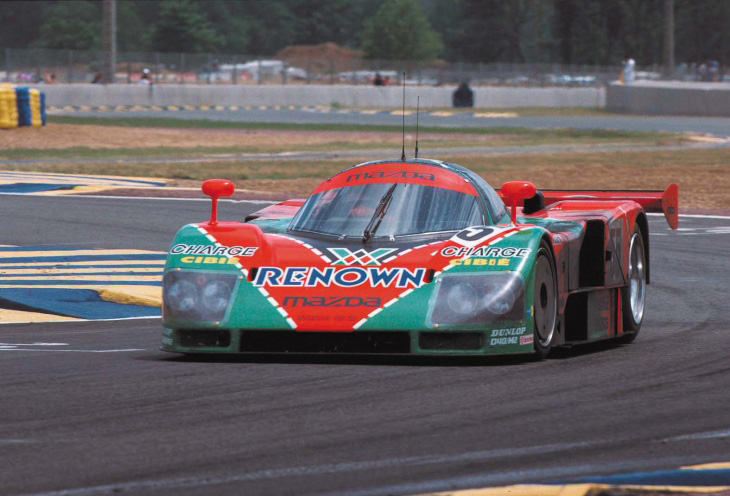
Mazda were early adopters of the Group C formula with C2 followed by C1, the famous victory at Le Mans scored by a 787B in IMSA GTP trim. You can read about Mazda’s history at Le Mans here >>
1992 would see a new car, based on the TWR-built chassis from the Jaguar XJR14 and a 3.5 litre Judd V10, required after the regulations for the season dictated that rotary engines were no longer eligible. The new car scored second place at Silverstone and was retained for a final season in 1993 in domestic competition.
McLaren – GB
A significantly developed version of the Can-Am M8 for Group C rules, the single example competed in DRM and Interseries for several years.

Mercedes Benz – Germany
1990 saw the Sauber Mercedes effort morph into a fully Mercedes Benz badged effort with the C11 replacing the Sauber C9.
The C11s won all bar one races entered in the WSC in its first year, easily taking the World Championship. 1991 saw the planned replacement of the car by the incoming C291 but reliability issues with the car saw the C11 continuing for longer than initially planned before the C291 was introduced mid-season, the car though was still troublesome and took just one victory in the final race of the season.
That turned out to be the final race of the programme with Mercedes Benz opting to pull out of sportscar racing, the further uprated C292 doomed never to race.

Mirage – GB
The Tiga-built, Cosworth V8-powered Mirage M12 has a notorious Le Mans history, ready to join the grid in 1982 it was spotted by a scrutiniser to have a non-compliant oil cooler and non-started, the fact that it was set to be crewed by Mario and Michael Andretti caused quite a stir. The car never raced in the WSC and spent the rest of its competitive days in IMSA GTP competition.
Mooncraft (MCS) – Japan
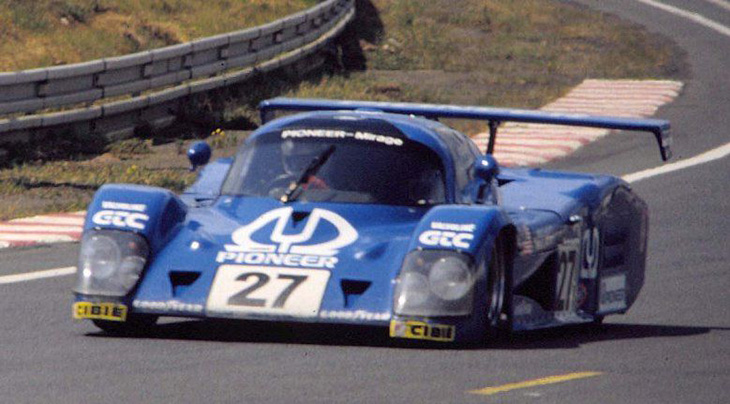
A tidy little C2/ Junior chassis and a range of power plants, Mazda rotary, Toyota and BMW, powered the cars to some little domestic success in 1983 and 1984, and a single World Championship class victory in 1983.
Nimrod – GB
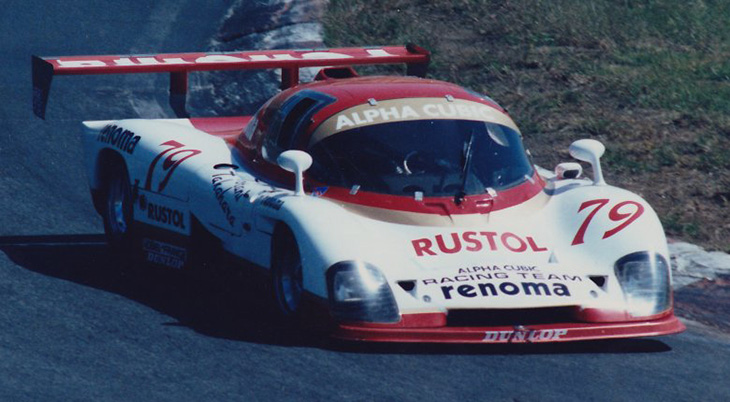
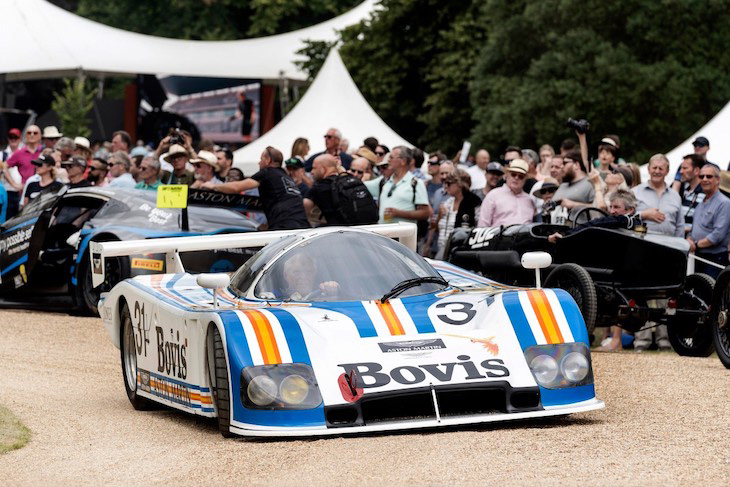
The ‘Rule Britannia’ Nimrod was built around a Lola chassis coupled with Aston Martin’s big V8 engine. Despite being underpowered and overweight the two cars built scored some respectable results both in WSC and in major races in North America. The cars raced on until disaster struck at Le Mans in 1984, both cars were involved in an accident that cost the life of a marshal and left driver John Sheldon with serious burns.
Nissan – Japan
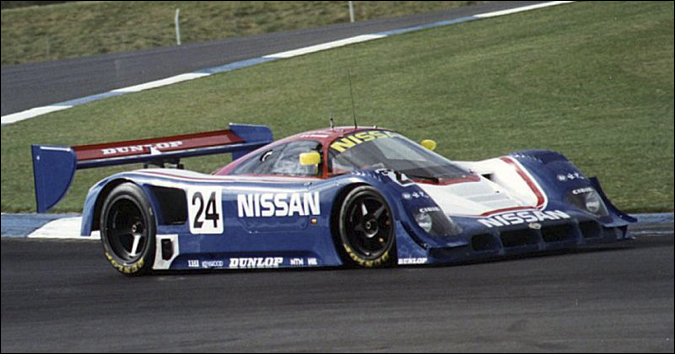
Nissan’s Group C efforts were based first around March chassised cars and then with Lola underpinnings until the in-house, NPTI-developed P35 of 1992, the car never raced and you can read its story here >> and here >>
Nissan drivers took domestic Championship honours every year from 1990-92.
Honours were trickier to find on the world stage with seven podium finishes across the 1989 and 1990 seasons but no wins. At Le Mans, there was less luck still, 5th overall in 1990 the best of the era despite the blinding pace.
Norma – France
The M6 was never raced, an attempt at the 1990 Le Mans 24 Hours fell foul of the car’s Guy Nègre MGN W12 engine that proved to have problems beyond the team’s ability. Another potential start in 1992 at Le Mans, this time with Alfa power, also came to nought. The M6 is likely best known as a wall decoration at Norma’s factory.
Nykjaer – Denmark
Denmark’s only group C car, the BMW-powered C2 car from 1985 saw action in just one World Championship race and performed respectably if not at a winning level.

Olmas – Italy
Another one-off the Olmas 200 LT raced just twice in 1988 and posted a non-start at Le Mans with engine issues from its Cosworth V8.

Peugeot – France
Peugeot’s 905 programme arrived with the 3.5 litre V10 formula, the first car making its racing debut in late 1990 before going on to race, in original and Evo 1 form, 17 times with a total of 9 race wins, including the overall victory at Le Mans in both 1992 and 1993 and the World Sportscar Championship in 1992. You can read more about the 905 programme here >> and more about the unraced 905 Evo 2 here >>