On 21 April, Miki Koyama completed a successful 12-lap Rookie Test at Fuji Speedway, certifying her to race in the Autobacs SUPER GT Series. This week at Fuji Speedway, she made history as only the seventh woman to ever enter a SUPER GT Race.
Koyama isn’t yet guaranteed to run in Thursday’s Fuji GT 450km Race as a third driver. But if she is given a stint aboard the #50 Anest Iwata Racing Lexus RC F GT3, it will be an opportunity richly deserved for the young woman who has blazed a trail for her peers in Japan – and she’ll have up to four more chances afterwards to drive later this season, as Anest Iwata Racing with Arnage’s third driver for the five 450km semi-endurance rounds.
Last year, with the backing of the Toyota Gazoo Racing Driver Challenge (TGR-DC) young driver training programme, Koyama won the FIA Formula Regional Japanese Championship and became the first woman in history to win an FIA-sanctioned, all-gender single-seater championship title.

Most people in the Western world will know Koyama through her two seasons of racing in the W Series, where she put in many competitive performances against women drivers from all corners of the world – starting with virtually no experience on the circuits of Europe and North America.
In 2017, Koyama won the inaugural Kyojo Cup championship – an all-women’s single-make sports prototype series which predates the formation of the W Series. She repeated as Kyojo Cup champion in 2018, setting the benchmark for aspiring women racers from Japan to strive for – all while carrying out concurrent programmes in FIA Formula 4, guest appearances in Super Taikyu, Super Formula Lights, and Formula Regional Asia, and spending time in Honda’s famous Suzuka Racing School Formula (SRS-F) academy.
In the history of the SUPER GT Series and the All-Japan GT Championship (JGTC), six other women have entered a race, and five have taken the green flag – and ahead of Koyama’s first race, DSC wants to examine the stories of those who had come before her.
Cyndie Allemann (2012)

Allemann was the last woman to race in SUPER GT before Koyama, and the only other woman to have raced since the series changed its name in 2005.
She arrived in Japan a year removed from being a part of the all-Swiss female trio in Matech Competition’s ambitious Ford GT1, boasting a strong pedigree in single-seaters between Europe and America. Just weeks before the start of 2012 testing, Allemann struck a deal with Audi Team Hitotsuyama to drive a then-new R8 LMS ultra prepared by Nova Engineering, with young gentleman racer Akihiro Tsuzuki as her co-driver.
With no prior experience at any of Japan’s major racing circuits, Allemann debuted in the season-opening round at Okayama and put in a fantastic debut performance which included a 12th-place qualifying run and a fairly clean opening stint in the race, en route to a ninth-place finish and championship points in her first outing! Allemann’s campaign ended after five races, including an appearance at the Suzuka 1000km.
She has since made a seamless transition into a television presenter, appearing regularly on the German video car magazine show GRIP for RTL since 2013. Her last competitive sports car racing start was the 2015 Dubai 24 Hours.
Keiko Ihara (2003)

Ihara’s foray into the JGTC was a brief chapter in a very influential racing career that spanned over 20 years from race queen to race driver. Many DSC readers will likely know her through her time in the FIA World Endurance Championship’s LMP2 class, where in 2014, she finished third in the 6 Hours of Fuji to become the first woman to finish on a WEC podium.
Tokyo-based R&D Sport – who now operates the factory Subaru GT300 racing team in SUPER GT – gave Ihara her first taste of multi-class racing in 2003 when they put her with Atsushi Katsugawa in the #61 Porsche 911 GT3 R. Ihara, once an aspiring mogul skier who took up modelling to fund her sporting ambitions, had just made her racing debut in Ferrari Challenge Japan four years prior, before venturing off into the world of single-seaters in Europe and continental Asia. In the 2002 Asian Formula 2000 Championship, she became the first woman to win an FIA-sanctioned single-seater race.

Ihara finished 16th in class at her first JGTC race at Fuji Speedway, which happened to be the final race ever run around the “classic” layout. In the next round in Motegi, she finished 12th. After these two races, Ihara turned her focus back to single-seaters for a time – before returning to sportscar racing and finding her niche in prototype racing.
From 2013 to 2018 she was the Japanese representative for the FIA Women in Motorsport Commission, and in 2015 she collaborated with Mazda to launch a programme to train aspiring women racers from the grassroots level. Ihara is now the CEO of an upstart mobility company which manufactures electric bicycles and scooters and their supporting infrastructures and also works as an independent outside director for Nissan.
The next three drivers raced together as the first all-Japanese women’s team at the 1995 24 Hours of Spa-Francorchamps, and soon afterwards, began racing in JGTC’s GT300 category.
Junko Mihara (1996-1998)
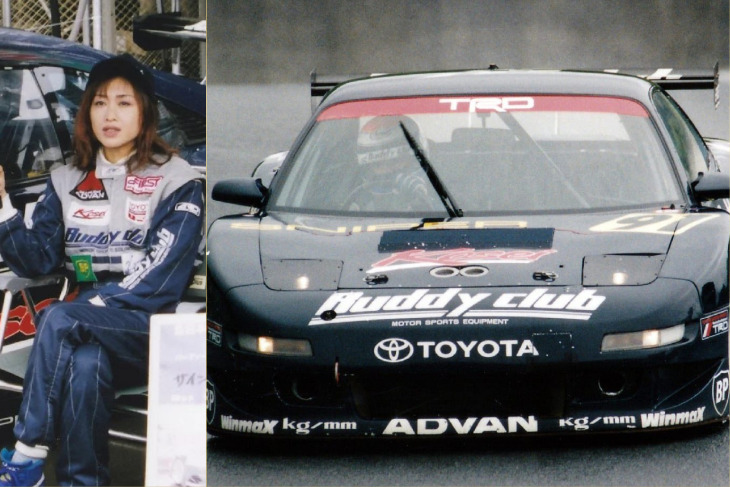
Junko Mihara has seldom been out of the Japanese public eye. From her teenage years, she was an idol; a famous actress and recording artist in her youth. She continues to be a prominent public figure today, as a three-term representative in Japan’s House of Councillors. Mihara was a dedicated racing driver between these phases of her life – and was the first woman to race full-time in the JGTC.
After racing in touring cars and the N1 Endurance Championship (forerunner to today’s Super Taikyu Series), Mihara made her series debut at Sendai Hi-Land Raceway in 1996, driving First Racing Team’s naturally-aspirated #91 Toyota MR2 with her then-husband Masahiro Matsunaga. They were the first and only husband-and-wife driver combination in JGTC/SUPER GT history. After two impressive finishes of ninth at Sendai and eighth in the summer race at Fuji, Mihara had the chance to run the full ’97 season in the BuddyClub MR2.
’97 would prove to be a bit more of a challenging season for Mihara, who came away with just a single points-paying result, ninth at Miné Circuit, and then a sixth-place finish in race two of the All-Star Race at Twin Ring Motegi. The ill-fated 1998 All-Japan Fuji GT Race was Mihara’s last entry as a racing driver, where she was due to be part of the first all-female driver line-up in series history alongside Kumi Sato in the #60 Kraft Toyota Cavalier.
While she stopped driving, this was not the end of her contributions to motorsport. From 2003 to 2004, Mihara was the Team Director for GT300 upstart Team Mach – which is still competing in SUPER GT to this day. As a politician, Mihara serves as part of a special sub-committee to promote motorsports activities.
Kumi Sato (1997-2001)

With 25 entries and 23 starts between 1997 and 2001, Sato is the most experienced woman to race in JGTC/SUPER GT so far – and she entered the series with a decorated CV. Multiple podiums in the All-Japan Touring Car Championship’s lightweight class, two class wins in the Tokachi 24-Hour Race, and a season championship in the 1996 N1 Endurance Series Class 3 bolstered her reputation.
As something of a front-wheel drive specialist at the time, Sato debuted in Kraft’s #60 Toyota Cavalier – the captive import of Chevrolet’s American-market compact car. In just her second race at Miné Circuit, Sato and co-driver Minoru Tanaka finished in fourth place, a remarkable achievement that would go on to be her best career finish. Sato reeled off three more top-ten finishes in six starts aboard the Cavalier in 1998, a full-season campaign.
Sato joined TOM’s Spirit halfway into the ’99 season, driving their front-wheel drive Toyota Celica – and racing alongside Masahiro Matsunaga. Her best season came in 2000 when TOM’s Spirit switched to the rear-wheel drive Toyota MR-S. Despite the team entering late, Sato made the most of her time that season with three top-ten finishes: Sixth at TI Circuit Aida (Okayama), ninth at Miné, and seventh in the finale at Suzuka. She returned to full-time racing the following season.
The penultimate round of the 2001 season at Suzuka very well could have seen Sato take her first win. Matsunaga was leading early in the Netz MR-S but spun out of the lead on his own while trying to defend his position, and Sato would consolidate another seventh-place finish.
After her run in the JGTC came to an end, she turned her attention back to her work as an automotive journalist (and a member of the Japan Car of the Year Award selection panel), a driving instructor, and a frequent challenger of the 24 Hours of Nürburgring. Sato entered the race nine times from 1994 to 2015 – her crowning achievement was an SP3 class win in 2014, driving Gazoo Racing’s Toyota 86.
Michiko Okuyama (1997)

Okuyama, sadly, never got to start a race in the JGTC – but being on the entry list for the 1997 Fuji Golden Week race warrants inclusion to reflect upon what could have been.
Especially when considering that she was set to drive one of the series’ more unusual entries – the ultra-lightweight, open-top Renault Sport Spider! Okuyama was to have driven the #57 Renault at Fuji alongside Hideyuki Tamamoto in GT300. Like Mihara and Sato she had prior experience in touring cars and N1 Endurance races.
An engine failure in pre-event testing forced the Ecurie SiFo team to withdraw, and by the time they made it back to the grid for their one and only race in Sugo with the Spider, it was with a different line-up of drivers. Regrettably, another opportunity never materialised and Okuyama’s racing career effectively ended.
June Okanoya (1995)
Has there ever been a woman that has stood on the podium in a JGTC or SUPER GT race throughout the thirty-year history of the series? The answer is yes. Her name is June Okanoya.

In the second season of the All-Japan GT Championship, Ohyama Racing entered its #32 Lantec Nissan Skyline GT-R R32 in the GT300 class. Okanoya would drive the ex-Group A GT-R alongside team owner Shigeru Ohyama. At the time, Okanoya had been racing in Clubman-level motorsports since 1988, and she was a bit of an everywoman – working as a driving instructor, track announcer, and circuit rescue instructor.
Okanoya had the distinction of being the first woman to race in the JGTC when she started the Suzuka GT 300km Race aboard the Lantec Skyline. Ohyama drove to the chequered flag in second place in what was then known as the “GT2” class – which put Okanoya on the podium on her debut. In the All-Japan Fuji GT Race during Golden Week, against a much larger GT2 grid, Okanoya once again contributed to a strong result with a seventh-place finish, leaving her and Ohyama second in the Drivers’ Championship after two races.
Even after the great run at Suzuka, Ohyama expressed concerns about the team’s budget. Likely as a result of those budget issues, the team ceased operations – which brought Okanoya’s JGTC career to an abrupt end after just two races. But in those two races, she scored 19 points and finished 13th in the Drivers’ Championship – single-season records for a woman in series history. Okanoya continues to be involved in motorsport long after the end of her driving career as a course announcer for national-level clubman races.
But her life’s work has been dedicated to saving the lives of others. Before she ever drove in the JGTC, Okanoya established the Japan First Aid Society, which teaches critical, first-aid training and provides disaster relief efforts. Her organisation provided and promoted emergency first-response care for infants and children at a time when it had not yet been prevalent in Japan. Thirty years later, the JFAS continues to provide these life-saving lessons to those eager to assist.
Feature image © Anest Iwata Racing