The second part of DSC’s 100 Le Mans Moments feature series has arrived!
If you missed out on Part 1, catch up HERE >>>
11. Toyota’s heartbreak (2016)
I was in the Radio Le Mans commentary booth alongside John Hindhaugh and Paul Truswell, alongside a BBC TV crew filming the Chris Hoy documentary.

For whatever reason, we did not have the in-car audio that TV audiences heard, and for several moments believed that the two Toyotas might be forming up for a photo finish. That moment passed when it was clear the second Toyota had passed the second TS050. From there on in, there was a sense of widening disbelief, as we realised that history of the most extraordinary sort, was unfolding before our eyes.
Kazuki Nakajima stopping on the line added further layers of drama, with his and the team’s emotion on display for all to see, in front of the packed tribunes. It is difficult to imagine, outside of real tragedy, a more heart-wrenching moment in motorsport.
12. JMW’s vintage GTE Am win (2017)
JMW Motorsport has a proud history at Le Mans having contested the race almost continuously since the team stepped onto the international stage in 2009, Jim McWhirter’s Ferrari having been campaigned under the Virgo Motorsport banner prior to that.

The team’s Ferrari 458 GTE was retired after the ELMS race at Monza in 2017 (a race it won!) before JMW’s brand-new 488 GTE was delivered (initially in GT3 spec).
Always up for a challenge, the tight-knit little team debuted the car at Le Mans with Rob Smith joined by Dries Vanthoor and Will Stevens, Smith and Vanthoor on their Le Mans debuts.
They duly took a famous win, beating off competition from AF Corse and Kessel Racing.
That was not the end of the story though. The very same Ferrari 488 car will start its seventh consecutive Le Mans 24 Hours in 2023, seeing out the GTE era.
13. Audi’s quick-change gearbox (2000)
Le Mans has a proud history of technological advancement. Much of which, has taken forward progress for the cars that we drive today. It also has a parallel history of teams and manufacturers finding ways to gain an advantage within the rules, that others at the time simply cannot counter.

Such was the case with the early versions of Audi’s now-iconic Audi R8 LMP900. It was a car that raised the bar for top-class prototypes to such an extent that it would dominate Le Mans despite successive restrictions on weight, power, aero and other aspects of its performance, for half a decade.
In 2000 though, on debut, the attention to detail from Audi was proudly on display, with one particular aspect of its design – a quick-change rear end, including the whole gearbox.
Used by the factory team to offset concerns about the car’s gearbox and bearings, the #9 car eventually finished second having undertaken a full rear-end switch during the race, in a stop that included a full fuel fill, driver change and tyres, in six minutes and 21 seconds.
The winning car also underwent a slightly longer change later in the race.
To put the effectiveness of this in perspective. Audi finished 1-2-3, with its nearest competitor, a Pescarolo Sport Courage, coming home 24 laps behind the winning car.
Perhaps unsurprisingly, this advantage became a “one and done”. The following year’s regulations mandated that the car’s full gearbox casing was needed to complete the entire race.
The principle of quick-change components lives on, with even the newest GT3 cars utilising large, easily-exchanged, sections of bodywork to prevent lengthy repair.
14. Lapierre’s four LMP2 wins (2015-2019)
All too often we focus only on the winners in the overall standings, but the history of Le Mans has plenty of legends in the supporting classes which have always supplied action and drama aplenty. It’s as tough, and often tougher, to win a class as the overall.

To keep winning then is much, much tougher and to win four times in a single class is something very special indeed!
Between 2015 and 2019, a period spanning two different LMP2 formulae, Nicolas Lapierre won the LMP2 class four times in four attempts, the run interrupted first by a recall to the Toyota LMP1 team in the incident-ridden 2017 race and then in 2020 when he finally lost his ‘Mr 100%’ crown with 8th for the Cool racing team that he now doubles up for as a driver and Team boss.
With three of the wins coming for the Signatech Alpine team and his first win in 2015 coming for KCMG, Lapierre is the most successful Le Mans driver in the history of LMP2.
15. The famous Dalmas safety car drift (2016)
Race Control Driver Advisor and four-time Le Mans winner Yannick Dalmas has a variety of duties, one of which is to advise Race Control on the viability or otherwise of whether it is safe for cars to continue in prevailing poor weather.
He did that with some aplomb during night qualifying in 2016 with an impromptu drifting demonstration in the Audi R8 Safety car in streaming wet conditions.
With complete dumb luck, the DSC Editor was in Race Control (for the one and only time at Le Mans thus far) when it happened, and can report that the collective sharp intakes of breath all but pulled the wallpaper off! Yannick – what a Legend!
16. Le Mans runs behind closed doors (2020)
2020 was an all-around weird year – the COVID-19 pandemic meant that event after event was postponed or cancelled, mask-wearing, social distancing, testing and form-filling became the norm.

The Le Mans 24 Hours itself became a “will they, won’t they?” proposition before the green light finally came for the race to take place, finally happening in September rather than the traditional June and with no Test Day to further assist the teams with the inevitable stresses and strains that the pandemic had incurred.
Without a doubt though the major difference was the lack of spectators and it was just…. strange.
Very limited media presence was allowed in the paddock too – just TV and a handful of print journalists, all of who were housed in the TV compound ‘bubble’ and were not allowed into the Media Room!
The best thing to observe about the event was that it happened and that no doubt helped many teams to keep their heads above water at the end of a very, very difficult year. Many long-held ‘runs’ for drivers, teams and spectators ended in 2020 though, not least that of Corvette Racing, which opted out of the race with transaltlantic protocols, in particular, proving very taxing.
The centenary edition in 2023 hopefully will prove to be joyous enough to blow away some of the memories of a year that many will want to forget!
17. Allan McNish’s R18 shunt (2011)
2011 was a race of real drama throughout, punctuated by two enormous accidents from Audi. The first of which came just 14 laps in when Allan McNish was fighting for the lead with the sister car, tagged Anthony Beltoise through Dunlop, pitching the #3 Audi R18 TDI hard-left through the gravel and into an accident that to this day, this writer still cannot believe, did not lead to serious injury to the driver and for those trackside.
However, the immediate TV pictures left DSC’s crew on-site in the press room not only worried for McNish’s safety, but also for one of its own. Longtime DSC snapper Peter ‘Pedro’ May was in line of fire, spotted immediately by the DSC editor on the TV screens. Marcel Ten Caat was immediately dispatched to find him, the message from him that he was “shaken up but ok”, is right up there with the most welcome text messages this writer has ever received.”
18. Robertson Racing steers its Ford GT to the podium (2011)
Amongst the most unlikely, and welcome podium finishes of the modern era was the 2011 third in GTE Am scored by Robertson Racing and its Doran Ford GT.

Andrea and David Robertson, a husband and wife driver combo, had seen little success in the ALMS, Andrea always significantly the faster of the pair. But this was an effort fuelled by passion of the very best kind, and the enthusiasm for the effort and the sport was palpable every single time you met them.
It was a podium earned through a run that used the ‘smarts’ in pit lane, long-time crew chief Andrew ‘H’ Smith had the Robertson’s trust and engineer Lee Penn prepped a car that had few foibles. The faces on the podium said it all… Disbelief and joy in equal quantity, with the team’s regular ‘Pro’ David Murry equally elated.
David passed away last year, a truly sad occasion. The Robertsons though, will always have a little paragraph in the now century-long history of the greatest race in the world.
19. Truth in 24 is filmed (2008)
The world hears a lot about the Netflix ‘Drive to Survive’ show, but in truth that trail was blazed a full decade before by the NFL Films team who followed the trials and tribulations of the Audi Sport team leading up to and through the Le Mans 24 Hours.
It was a ground-breaking piece of television and gave viewers insight into the teamwork behind success at Le Mans, the original film bringing the contribution of a number of support staff, most notably Howden ‘H’ Haynes, in bringing success to the team.
The 2008 original was followed up in 2012 with Truth in 24 II and this time a new star was born: Leena Gade. The film, in a stroke, redefined the role of women in the sport in the consciousness of millions beyond the paddock gates. We have, very literally, not looked back since!
20. TVR goes green! (2003)
TVR’s two-car effort in 2003 came with bright yellow (and black) Dewalt backing and the bright-eyed and bushy-tailed PR effort behind it was full of good ideas to capture attention at the race.

One of those was a plan, reportedly hatched by driver Richard Stanton, to have all six of the drivers with their hair dyed in a similar hue to their cars.
Great idea!
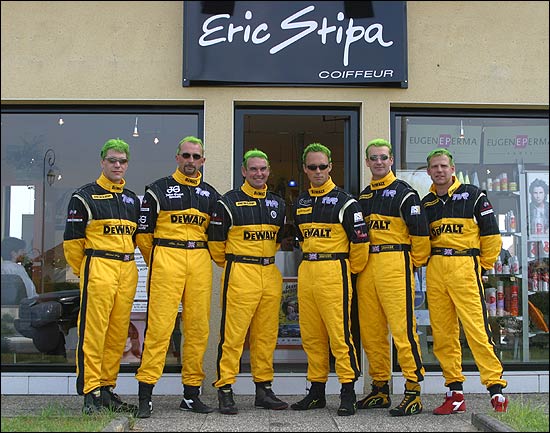
However, and whether this was an ‘operator error’ or a ‘lost in translation’ has never really been established. It didn’t turn out that way, and all six appeared at the parade with hair that was undoubtedly not yellow, but green!