For 10 days in the build-up to the 2023 running of the Le Mans 24 Hours, DSC is reflecting on some of the best, worst and wacky moments from its time covering the event since the turn of the century.
Today is the eighth day of DSC’s 100 moments feature, the previous parts can be found below:
PART 1 – PART 2 – PART 3 – PART 4 – PART 5 – PART 6 – PART 7
71. Rollcentre finishes fourth! (2007)
After the Dallara adventure for Rollcentre Racing came a Pescarolo 01 Judd and in 2007 at a rainy Le Mans the little team that could almost made the podium, a late race charge from Joao Barbosa putting the debuting Peugeot squad under pressure to ensure they finished – see elsewhere in this series for Sebastien Bourdais’s wit for the flag!
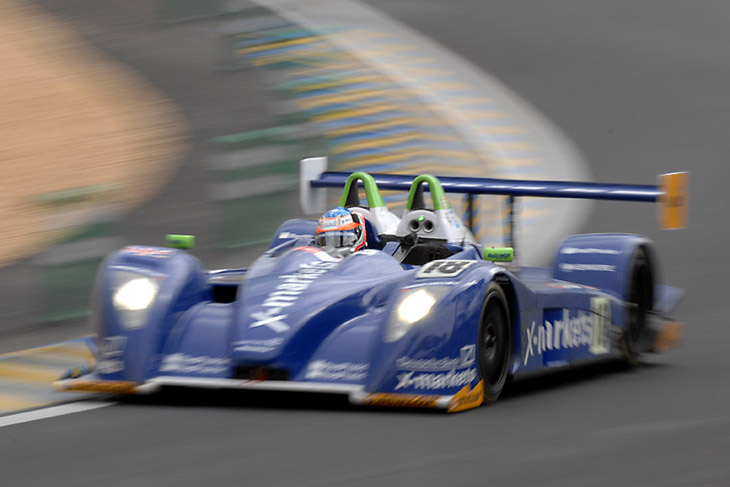
Either way, fourth overall was a massive result for a completely privately owned and run LMP1 team.
72. Hideki Noda’s Dunlop Bridge shunt (2008)
One of the most dramatic accidents and recoveries in the race’s history came in 2008 when ex-F1 racer Hideki Noda suffered a violent barrel roll aboard the #44 Kruse-Schiller Motorsport Lola Mazda in night practice.
Noda got the car out of shape on the run-up to the Dunlop Bridge the car getting sideways and briefly airborne before tumbling through an eight-roll accident that comprehensively demolished the car. Miraculously, Noda was able to leave the car unaided and was almost unhurt.
The car was assessed overnight by Lola and deemed able to be repaired at the circuit, though the damage was very substantial, including a small hole in the tub.
After a huge effort from the team, and from Lola, the car did make the start – though it would retire after completing 147 laps.
73. The first hypercar win (2021)
While this year’s Le Mans 24 Hours features a Hypercar class that has come of age, the category’s humble beginnings in 2021 at the race shouldn’t be forgotten.
Held in the second year of the COVID pandemic, Hypercar’s first year at La Sarthe was held in testing circumstances. 50,000 fans were allowed in, real progress after the September 2020 edition held behind closed doors. But again the race was postponed and held in August, with so much uncertainty surrounding the rules and regulations that would need to be imposed on everyone in attendance.
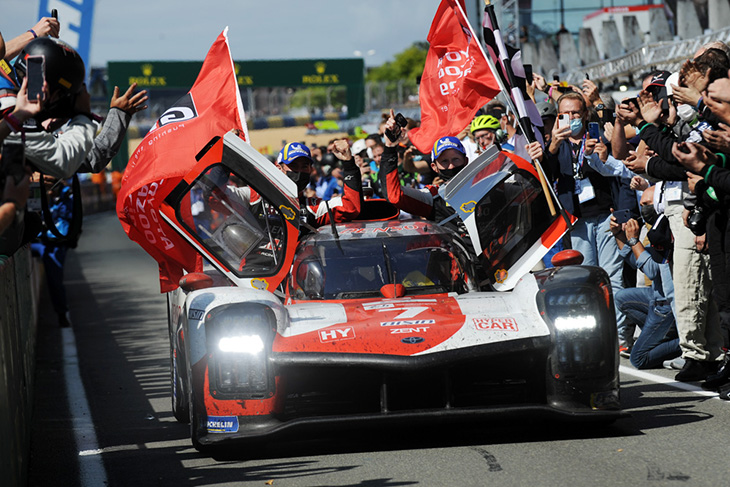
Nevertheless, the five-car Hypercar field, racing in front of fans for the first time, provided an intriguing race. Toyota’s brand new GR010 HYBRID would face off against a more tried and tested grandfathered LMP1 from Alpine and a pair of plucky Glickenhaus 007s.
In the end, it wasn’t much of a contest, but the 1-2 from Toyota, with the #7 of Mike Conway, Kamui Kobayashi and Jose Maria Lopez coming home first after 371 laps was still impressive. It laid the foundations for the booming class we see today.
74. Incidents aplenty (2014)
2014’s Free Practice and Qualifying was a difficult watch!
Free Practice saw an enormous accident for the #1 Audi of Loïc Duval the car lifted off after/during a spin in the Porsche Curves, clearing the wall and impacting catch fencing above the barriers, taking down a lamppost behind the fence.
The Audi was heavily damaged and Duval was fortunate to be able to climb from the car. Loic though was not geared to continue after medical assessment, the team had to build up a new car and Audi’s reserve driver Marc Gené was recalled from JOTA where he had been due to drive (he was replaced by late call-up Oliver Turvey).
The #99 Aston Martin of Fernando Rees, was the next car in major strife, a major shunt in the Porsche Curves in the first qualifying session on Wednesday, the session was halted for barrier repairs, Rees was basically ‘OK’, but the car was out of the race.
Thursday saw another GTE Pro car in trouble, James Calado rolling his #81 AF Corse Ferrari, once again in the Porsche Curves, the car requiring a replacement chassis and Calado unable to continue after medical advice and replaced by Pierre Kaffer.
Finally, Bret Curtis in the #79 Prospeed Porsche spun at the Dunlop Chicane and hit the inside wall hard.
Curtis was knocked out in the incident and became the fourth driver not to be cleared to return to driving.
Prospeed nominated Sebastien Crubile as a replacement for Curtis, but the ACO did not allow him to participate due to a lack of laps taken under night conditions. The team elected to continue as a two-driver operation and, because the driver rankings did not support their staying in GTE Am, switched to GTE Pro.
All in all, it was a relief to get to the race proper!
75. JOTA wins with last-minute reserve (2014)
In the wake of Loic Duval’s seismic shunt in Free Practice, Audi recalled their nominated reserve driver Marc Gené to the fold to replace the sidelined Frenchman.
That saw the JOTA team, who Gene had been due to race with requiring a late replacement and it was Oliver Turvey that got the call, back to the team he had made his Le Mans debut with the previous year alongside 2014 debutant Harry Tincknell and returning gentleman driver Simon Dolan.

The trio produced, despite the last-minute nature of the squad’s eventual formation, a battling performance that saw them take the lead in the final hour from the Thiriet by TDS Ligier. They would go on to score the first of JOTA’s (so far) three LMP2 wins.
76. Rain chaos (2014)
Sudden and heavy rain showers hit parts of the circuit in the second hour of the 2014 race and several cars were caught out by the change in conditions.
The KCMG Oreca of Richard Bradley, battling for the class lead with JOTA Sport’s Zytek, hydroplaned into the first Mulsanne chicane and made heavy contact with the tyre barriers.
Just a little further on and seconds later there was a multi-car incident when several car, including the #3 Audi of Marco Bonanomi, checked up for the conditions and, it seems, a yellow flag.
Nicolas Lapierre meanwhile was closing fast and spun in the #8 Toyota, aquaplaning into the outside barrier and cannoning into the rear of the Audi.
Both were then immediately collected by the Ferrari of Sam Bird!
Lapierre managed to get his car back for repairs. Bird and the luckless Bonanomi were out on the spot whilst Bradley actually retained second place!
77. Audi’s ‘last man standing’ (2011)
The 2011 race was marked by a pair of HUGE accidents for two of the three factory Audis – both of which feature in this series.
After that though the race was an astonishing cat-and-mouse game between the #2 Audi of Andre Lotterer, Benoit Treluyer and Marcel Fassler and a trio of Peugeots.
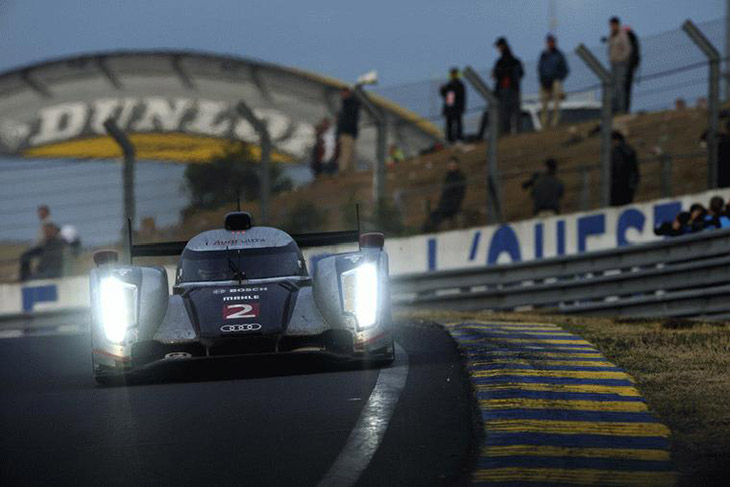
There were incidents galore that saw leading cars hot minor troubles, Safety Car interventions more than once interrupted the battle and there was more than a hint of gamesmanship as two of the Peugeots delayed the then-leading Audi as it tried to lap them.
Much of the drama was recorded for posterity in the second Truth in 24 documentary, which again showed clearly the key part in the victory by both the pit crew and by Race Engineer Leena Gade.
The Audi would take a famously hard-fought win after one of the best and longest lead battles in the history of the race.
78. Audi’s first win (2000)
After a sighting mission in 1998 with a long-tail McLaren, and the somewhat confused 1999 when the team fielded its original R8R and the badly underdeveloped R8Cs, Audi Sport was back with a vengeance in 2000 with a trio of new R8s.
And so began one of the most crushing displays of dominance in Le Mans history. The R8 would win the race in all bar one year of the next 6, and in the one it failed to win (2003) it finished behind the (Audi-powered) Bentleys to complete the podium.
The 2000 race would see the new cars, and the Joest Team that ran them for Audi Sport, utterly dominate, a peerless display of power, efficiency, technology and teamwork that would launch the Audi Le Mans story for a decade and a half.
In 2000 the third-placed car completed 365 laps, and the fourth placed Pescarolo Courage 344. The winners completed 368, a lap ahead of the second-placed car. It would take the opposition half a decade, and a slew of rule changes to reel in the power, aero efficiency and range of the R8 to even get close!
79. Expanding the entry (Various years)
It’s a mark of the health of the greatest race in the world that the only clarion call about the entry for the future is to question how best to expand the entry, such is the demand not just for one-off runners, but for those clamouring to run season long FIA WEC, IMSA, European LMS and Asian LMS cars.
At the dawn of DSC’s era with the race just 48 cars were able to start but with successive temporary and permanent additions to the pit garages, we now welcome 62, a 30% boost in 24 years.
The current core building, completed in time for the 1991 running of the race has 46 pit garages, with an additional pair of garages completed soon afterwards at pit-out giving a maximum entry of 48.
That total increased by two in 2002 when the makers of the Michel Vaillant movie funded the construction of two garages in an extension of the ‘granny annexe’ towards pit out, the maximum entry then up to 50 cars.
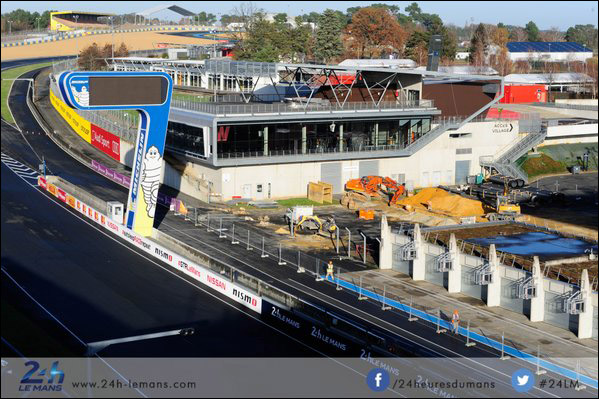
The next expansion came in 2006/2007, the four granny annexe garages demolished in time for the 2007 race and replaced by a new complex of nine more permanent and substantial structures, the entry was up to 55.
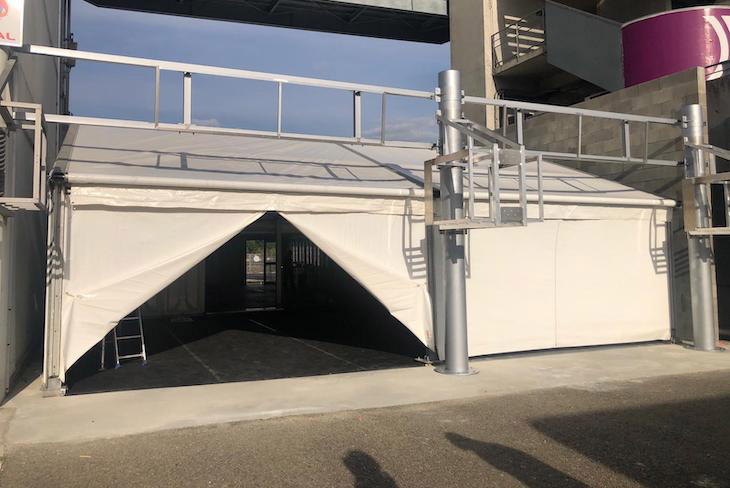
2010 saw the (very) late addition of a further garage into the previous gap between the main building and the ‘annexe’, the maximum entry was up to 56. (This btw was the origin of the ‘Garage 56′ moniker for the Innovative car’ entry filled in 2023 by the Camaro NASCAR).
2016 then saw the additional 4 garages added, giving a total of 60 before 2019 saw the installation of two temporary garages in the gap between the main pit building and the Module Sportif.
The Hypercar and LMGT3 eras present new problems, initially at the very least because of the popularity of the new top class, and because of the demand for and from GT3 teams and manufacturers. There are going to be a lot of disappointed faces in the years to come, with or without a revived plan for a further expansion of the pit facilities!
80. HubAuto puts a privateer Porsche on GTE Pro pole (2021)
GTE Pro in 2021 was strong – AF Corse Ferraris, Corvette, the Porsche GT Factory team and a pair of privately-entered Porsches from WeatherTech Racing and from HubAuto, the Taiwanese team getting the nod from the Selection Committee for its Project 1-assisted 911 RSR.
And its made the Top six for Hyperpole too ahead of one of the Corvettes and the WeatherTech car.
What perhaps nobody was expecting though is that Dries Vanthoor put the car on pole!
I a session that saw Kevin Estre crash out in the much-fancied #92 factory car, the young Belgian kept his head and banged in a lap good enough to humble a quintet of factory cars in the Hyperpole session!
HubAuto didn’t make the finish, but they started with a headline that put smiles on the team owners face!